Showing posts with label Industry. Show all posts

Tuesday, 12 October 2021

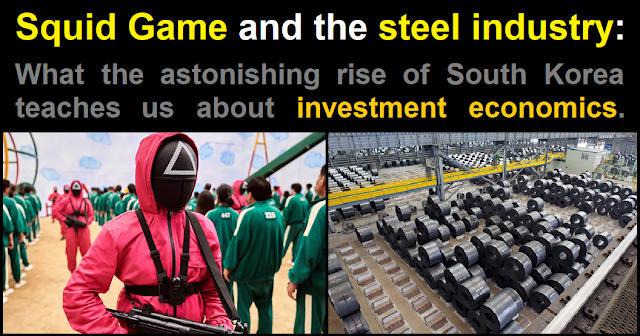
Squid Game and the steel industry


In the mid-20th Century South Korea was an economic minnow. It was a war-ravaged country with a largely pre-industrial economy.

In 1960, if you divided the total economic activity of South Korea by its population (GDP per capita) it amounted to just $79 per person, but within sixty years, this figure has multiplied to over $47,000 per person, which makes it one of the most prosperous large economies on earth, above large developed nations like Japan, Italy, Spain, Argentina, and Russia.

This remarkable period of economic growth in South Korea is known as the Miracle on the Han River, and it started off in the early 1960s when their government initiated the first of the country's 5 year economic plans.

The objective was to modernise the South Korean economy through full employment, and strategic investment across numerous sectors, including infrastructure (roads, rail, ports), core industries (steel, fertilizer, cement, petrochemicals ...), science, and technology.

South Korea's rapid climb up the world development rankings is proof  of how astonishingly successful their strategic investment agenda has been.

Steel industry

When South Korea set about building their first modern steel production plant they were derided by the so-called experts. Why would a country like South Korea make their own steel, when they could just import it from countries with established steel industries?

Well, South Korea ignored the heckling and derision, invested in their own steel industry, and rose from absolutely nowhere in steel production, to become the 6th largest steel producer in the entire world in 2020. 

From having no modern steel industry at all half a century ago, they've soared past countries with long-established steel industries like Germany, France, and the UK.

In 2020 South Korea produced almost ten times as much steel as the United Kingdom! 

A country with a population of just 51 million people produced almost as much steel as economic giants like Russia (146 million), Japan (125 million), and the United States (331 million).

Not bad for a country that were laughed at when they first proposed developing their own steel industry eh?

Having their own government-owned steel industry gave South Korea a huge economic advantage, allowing them to provide cheap steel to other industrial sectors they wanted to develop, especially ship building, electronics, civil engineering, and road vehicle production.

This ready supply of cheap steel helped turn small South Korean firms like Samsung, Hyundai, Kia, and LG into globally recognised brands.

Thanks in a large part to the development of their own steel industry, South Korea is now the world's largest ship-builder, with 40% of the global ship-building market!

Only China even comes remotely close to the shipbuilding power of the South Koreans.

Strategic investment, and the deliberate nurturing of core industries turned South Korea from an economic backwater into an absolute powerhouse over the course of just a few decades.

While developed countries like the UK were deliberately de-industrialising their economies and outsourcing production overseas, South Korea rocketed past them by modernising their core industries and establishing themselves as the premier high-tech, high-skill, hyper-productive economic workshop of the world.

Creative industries

Having learned from their strategic investment in core industries, the South Koreans have recently begun investing in their cultural industries too, with the objective of establishing their nation as one of the creative powerhouses of the world.

The results have already been spectacular:

You'd have to have been living in a box for the last few weeks to have not heard of the South Korean survival drama Squid Game, that's absolutely smashing streaming records across the world.

But the hit Netflix show Squid Game is far from the first massive South Korean cultural export. 

In 2020 the South Korean boy band BTS absolutely dominated global music sales, securing first and second place in the IFPI album sales chart.

Then there's Bong Joon-ho's black comedy thriller Parasite, which became the first non-English language film ever to win the Oscar for best picture in 2019.

Either it's a massive coincidence that South Korea has come from nowhere to suddenly deliver worldwide smash hits in television, music, and cinema, or maybe could have something to do with their deliberate policy of investing in their cultural industries?

Investment vs Austerity

South Korea have proven twice over that strategic investment is the key to delivering future economic prosperity, but certain western nations seem determined not to learn this lesson, especially the increasingly-parochial United Kingdom.

The UK was home to the industrial revolution, and pioneered all kinds of industries from steel foundries, through railways, to ship building.

It's all gone now, thanks to the deliberate neoliberal policy of de-industrialisation that's been pursued for the last four decades.
  • The country that invented the modern steel industry is no longer even in the top 20 world steel producers, and the remnants of its privatisation-wracked steel sector is now owned by Jingye Group, which is a state-owned Chinese regional bank.
  • The country that invented the railways no longer has a single train manufacturer.
  • The country that once "ruled the waves" deliberately tore down its own ship-building industry as part of a demented radical-right war on trade unionism (destroy the entire industry and the trade union dies with it).
As South Korea has stormed up the world rankings thanks to their strategic investment policy, the United Kingdom is falling away thanks to policies like de-industrialisation, under-investment, and austerity.

And there's a big danger of the same kind of sectoral decline happening in the UK cultural industries.

The UK is still an undisputed world leader in the creative industries, punching miles above its small island status in music, film, television, sport, and arts, but the process of decline is already underway.
  • And just to make his utter contempt for the wellbeing of Britain's £111 billion cultural industries unmistakable, Boris Johnson has recently appointed the notoriously thick, radically right-wing, culture war grifter Nadine Dorries as Britain's culture minister!
South Korea showed the UK the way on industrial strategy, but the Brits ignored it and did the polar opposite, which means South Korea is now an industrial powerhouse, and the UK seems locked into in terminal industrial decline.

South Korea is busy showing the UK the way on cultural strategy too, but once again the British government is doing the opposite, slashing away at cultural funding, when strategic investment is obviously the key to success.

The UK has already reduced itself from industrial pioneer to absolute minnows in industrial sectors that they themselves invented, and if there's not a rapid change in direction, the UK is going to see its position as cultural world leaders eroded away by the same myopic agenda of austerity cuts, and radical-right 'leave it to market forces' ideology, while other countries like South Korea surge ahead by actually investing for the future.


 Another Angry Voice  is a "Pay As You Feel" website. Access to my online writing will always remain free. If you see some value in what I do, please consider supporting my work with a small donation/subscription.


OR

Monday, 17 September 2018

Why do Tory MPs get a total free pass on their astounding anti-business attitudes?


Today a Tory MP publicly accused the boss of a major UK employer of lying. The accusation was made by Bernard Jenkin who responded to the fears of Jaguar Land Rover that a "no deal" Brexit would be catastrophic for their company and their workforce by saying "I think he's making it up".

Now just imagine for a moment that a Labour Party MP had openly accused the boss of a major British employer of lying to the public.

The mainstream media would obviously be absolutely teaming with "Labour are the anti-business party" takes, at least for the rest of the day, and with the incident referenced over and again for months as evidence of Labour's anti-business agenda.

But because the badmouthing of British business is coming from a Tory MP, it's barely elicited a whisper of condemnation from mainstream media hacks, other than a few Tweets from half-decent journalists like Gavin Esler and Norman Smith.

Sustained media partisanship

Alarmingly this isn't the only example of highly partisan editorial decisions to avoid vehement condemnation of the Tories. Last week the majority of Tory MPs joined all the fascist parties in the European Parliament to vote in support of Viktor Orbán's anti-Semetic, judiciary-rigging, free speech-attacking, human rights-trashing regime in Hungary.

Again, just imagine the deafening howls of condemnation had it been Labour MEPs defying the European consensus to vote in favour of the most notorious anti-Semite in Europe, but somehow the Tories get a free pass.

Labour are now the party of business!

If you believed all the mainstream media rhetoric about Labour being rabid extreme-left fanatics under Jeremy Corbyn, the idea that they've taken over as the obvious pro-business party would seem insane, but the reality is very different from what orthodox neoliberals in the mainstream media are trying to make you think.

Admittedly Jeremy Corbyn has said that corporations would have to pay their fair share in tax (especially if they want to bid for government contracts) and that the Corporation Tax rate is going to have to rise so that it's back in line with the G7 average, which wouldn't go down all that well with Britain's most avid tax-dodgers and corporate profiteers.

However, most business leaders should be able to see the sense in many of Corbyn's strategies, and that the economic responsibility of paying their fair share in tax comes with significant payoffs too.

Making sure that major corporations pay their fair share in tax would create a much fairer playing field for hundreds of thousands of small and medium sized businesses that can't afford to pay expensive tax lawyers to hide their profits in tax havens.


Corbyn has clearly listened to British businesses (large and small) and to trade unions and he's made it clear that Labour would seek to retain access to the Customs Union and Single Market, while the Tories keep on threatening the ruination of a "no deal" Brexit and smearing prominent business leaders who express their concerns about this reckless game of ideological brinkmansip as liars!

Labour's policies of investing in Britain's creaking public infrastructure and building hundreds of thousands of affordable homes would clearly create huge opportunities for construction companies, engineering firms, and myriad suppliers.

Labour's "Build it in Britain" industrial policy certainly must make a lot of sense to British-based manufacturers.

And Labour's policy of introducing a National Education Service to provide free education and training to all, would clearly help to ensure that the UK has the kind of flexible and highly-skilled workforce that is needed in order to reverse the Tory productivity crisis and make Britain a high-tech economy fit for the 21st Century.

Whether you support Jeremy Corbyn's investment-based economic strategy or not, you certainly won't be hearing any Labour MPs saying "fuck business" like Boris Johnson, or smearing prominent British business leaders as liars like Bernard Jenkin just did.

You can read more about Labour's industrial strategy here.

 Another Angry Voice  is a "Pay As You Feel" website. You can have access to all of my work for free, or you can choose to make a small donation to help me keep writing. The choice is entirely yours.


OR

Tuesday, 24 October 2017

Theresa May's idea of providing certainty is to demand unicorns!


Given Theresa May's lamentable failures to clear up doubts about her Brexit strategy, it's time to consider whether this absolute shambles has come about through abject incompetence, or as more and more people are beginning to suspect, an underhand strategy of deliberately undermining the Brexit process until the negotiations fail. 

Theresa May's reliance on her "no deal is better than a bad deal" rhetoric is a strong indicator that she might actually want the negotiations to fail. Otherwise why on earth does the centrepiece of her negotiating strategy play right into the hands of those in her own party who desperately want the negotiations to fail, by allowing them to characterise any UK concession in the negotiations as proof of a "bad deal", which May has continually portrayed as being a worse option than marching the country over the "no deal" cliff edge?

The suspicion that Theresa May is less than fully committed to achieving a negotiated settlement was further aroused when she rushed to meet her own arbitrary and self-imposed March 2017 deadline for triggering Article 50, starting the clock ticking on the time limited process of leaving the EU before her government had developed anything even remotely resembling a coherent negotiating position. 

What made this rush to trigger Article 50 even worse was that immediately after initiating the time limited process of quitting the EU, she suddenly decided to squander two months of the very limited negotiating period on a needless vanity election.

After wasting two months of the negotiation period in order to throw away her parliamentary majority in a fit of hubris, Theresa May and the Tories have made shockingly little progress on the first stage of the Brexit negotiations that need to be resolved before the trade talks can get underway. 

Of course the Irish border issue is highly complex, but the other two items should have been resolved already. Instead of cynically using the lives of EU citizens as gambling chips, a fair offer on citizens' rights could have been made as a demonstration of goodwill before the negotiations even started, and agreement on a financial settlement really shouldn't be taking so long to quibble over.

It's seven months since Theresa May triggered Article 50, and somehow we're still bogged down in stage one of the negotiations. The idea of coming up with even the framework of a comprehensive mutually beneficial free trade agreement between the UK and the EU in a single year is fantastical enough, but now Theresa May has decided to up the stakes by saying that unless the trade talks are completed by March 2019, she's going to screw off the idea of having a transition period, and immediately shove the UK economy off the "no deal" cliff edge.

This latest move is quite extraordinary, especially given that she's been under increasing pressure form British business leaders to provide some certainty on the post-Brexit transition, but instead of providing certainty, she's actually decided to hand them a huge incentive to scale back UK investment and move as many of their operations as possible overseas and out of the increasingly likely "no deal" Brexit disaster zone.

Just look at the Tory track record in government. This is a party that has spent seven years on their flagship welfare policy of combining six benefits into one payment and they're nowhere near getting it right. Originally announced in 2010, the Tories claimed that Universal Credit would have been completely rolled out across the UK by now, but after one reset on their completion date after another, they're now predicting completion in 2022 (five years behind schedule). What's worse is that even in the areas in which Universal Credit has been rolled out are beset with massive problems like delayed payments, indebtedness, rent arrears, food bank dependency, and even evictions.

Just think about it. If the Tories can't even complete the task of competently streamlining the benefits system within the seven year time period they set themselves, how on earth can investors and business leaders have any confidence that the same people are going to secure a comprehensive multi-faceted trade deal with the EU in just one year, especially since they've already wasted seven months without even getting beyond the first round of negotiations?

Additionally Theresa May's threat to scrap the transition phase (the policy that she brazenly nicked off Labour and then begged for in her Florence speech just a few weeks previously) if the trade deal isn't completed by March 2019 doesn't even make any sense.

What is the point of even having a transition phase if the trade deal is fully completed? The only way a transition phase makes sense is if the broad outline framework of the deal is signed off on by March 2019, but then the complicated details are agreed and implemented gradually sector by sector in order to mitigate some of the worst difficulties and uncertainties of the transition.

Even if we ignore the fact that there are bitter divisions in her own cabinet over what kind of Brexit they actually want, and overlook the Tories' proven track record of incompetence and endless delays when it comes to rolling out their flagship Universal Credit policy, and forget the fact they've wasted seven months of the negotiation period already, Theresa May's latest threat to jump off the "no deal" cliff edge if trade talks aren't completed and ratified by March 2019 looks an awful lot like a ridiculously spoiled brat threatening to jump off a cliff unless she gets a unicorn for Christmas.

Either Theresa May is delusional enough to think that she can actually get a unicorn for Christmas if she just stamps her feet hard enough, or she's demanding a unicorn because she actually prefers the "no deal" meltdown scenario that is favoured by the hard-right fringe of the Tory party, and is seeking to blame the EU by crying that they're at fault for not giving her the unicorn she was demanding.

Whatever her motivation, this latest escalation of the "no deal" threat can't possibly be inspiring any confidence whatever amongst investors and business leaders. They just demanded clarity on how the government is going to proceed with Brexit in a manner that creates as little uncertainty and economic turmoil as possible, and what they got was exactly the opposite, a ridiculous escalation of Theresa May's diplomatic temper tantrum. 


 Another Angry Voice  is a "Pay As You Feel" website. You can have access to all of my work for free, or you can choose to make a small donation to help me keep writing. The choice is entirely yours.


OR

Tuesday, 3 May 2016

The leaked TTIP documents


In May 2016 Greenpeace Netherlands released copies of the highly secretive negotiation documents on the TTIP so-called "trade deal" between the EU and the US.

The highly secretive nature of the TTIP negotiations and the extremely anti-democratic attitude of the EU institutions towards opponents of the deal have already created a huge rise in opposition to TTIP. In fact almost 3.5 million European citizens have already signed a petition against TTIP and several European governments are threatening to veto the deal if it is presented in its current format.

One of the biggest complaints about the TTIP corporate power grab is the inclusion of Investor State Dispute Settlements, which are designed to allow multinational corporations to completely bypass national democratic and judicial institutions in order to sue nation states in secretive transnational tribunals. These appalling ISDS rules have already been written into countless so-called free trade deals across the world, allowing corporations to sue countries whenever their democratically elected governments introduce policies that might reduce their profits. From the introduction of plain cigarette packaging, through bans on toxic petrol additives to environmental laws to stop the corporate destruction of the natural environment - multinational corporations have been using ISDS rules to sue governments all over the world.

The leaked TTIP documents show that the US are refusing to budge on demands for removal of the ISDS components of the TTIP corporate power grab. This is no surprise whatever given that the highly lucrative and rapidly growing transnational law industry is almost entirely based in the US*, and many of the biggest beneficiaries of ISDS tribunals so far have been US based multinational corporations.


Greenpeace analysis of the leaked documents also reveal that the TTIP negotiations are designed to weaken European laws and regulations, especially in areas like the food industry, pesticides and insecticides, genetically modified organisms and the chemicals industry.

TTIP negotiators have already defined things like energy efficiency labels; fuel efficiency standards for cars; sustainable public procurement policies; regulation of unconventional fossil fuel extraction, including shale gas and tar sands; sustainability standards for bio-energy; and the banning of climate-damaging f-gases in appliances such as refrigerators and freezers as "technical barriers to trade".

It's absolutely clear that TTIP is designed to weaken European standards and create a situation where European governments are powerless to restrain the excesses of multinational corporations, because they will be sued in US dominated secret transnational tribunals every time they try to introduce new laws that multinational corporations object to.

John Hilary of War on Want had this to say about the TTIP leaks:

"We have long warned that TTIP is a danger to democracy, food safety, jobs and public services. Now we see it is even worse than we feared. Today's leak shows the European Commission preparing to sell us down the river, doing deals behind closed doors that will change the face of European society for ever. It is simply unacceptable that a group of unelected officials should be allowed to contemplate such a thing without any public scrutiny."
The fact that the people of Europe are reliant upon secret documents leaked via Greenpeace in order to get a proper idea of what is being negotiated between unelected technocrats behind closed doors is appalling, especially since the establishment class are always willing to trot out the Orwellian mantra of "if you've got nothing to hide, you've got nothing to fear" in order to justify the highly intrusive, privacy destroying state surveillance powers they want to award to themselves.

Now that it's absolutely clear that the TTIP corporate power grab will erode European standards and allow multinational corporations to completely bypass democratic and judicial institutions in European states, the deal should be scrapped in its entirety. What is more, the EU should begin an enquiry into how secretive negotiations towards a damaging, anti-democratic corporate power grab were ever allowed to develop so far in the first place.

  • If you want to download the leaked TTIP documents and look at them for yourself, here's the link again.


  • If you would like to join the 3.4 million+ people who have signed the petition against TTIP, here's that link.

 Another Angry Voice  is a "Pay As You Feel" website. You can have access to all of my work for free, or you can choose to make a small donation to help me keep writing. The choice is entirely yours.


OR

* If you want to know more about the transnational law industry I highly recommend this German documentary.

Saturday, 17 August 2013

Who is responsible for mass uncontrolled immigration?

So you claim that "lefties"are to blame for mass uncontrolled immigration do you?

Don't worry! Politically illiterate claims like this are remarkably common. You're not alone in having been misled by the corporate media into believing that "the left" introduced and continue to support mass uncontrolled immigration.

In reality mass uncontrolled immigration is a right-wing policy.

I can almost hear the alarm bells ringing in your head.

You don't like it do you?

You refuse to believe it ...

Alright then ... Have a little think about who benefits from mass uncontrolled immigration.

Is it the workers (you know, the ones that "lefties" are supposed to represent)?

No, of course it isn't.

Uncontrolled immigration drives down their wages and increases the competition for jobs (especially low-skilled jobs), making the prospect of unemployment, low pay or the horrors of zero hours contracts much more likely for millions of ordinary workers.

Another way in which ordinary workers lose out through mass immigration is the increased pressure on local services such as health and education, on which they, and their children rely.

So who does benefit then?

The corporations and rich employers benefit from the large labour surpluses created by mass uncontrolled immigration, because the increased competition for jobs allows them to drive down the wages they pay, therefore increasing their profit margins.

The profitability of the labour surplus is hardly a new concept. Karl Marx explained how capitalism benefits from surplus labour way back in the mid-19th Century. A large standing army of unemployed, provided with just enough welfare to keep them alive is absolutely fundamental to the modern neoliberalised capitalist system.

The wealthy minority are almost completely insulated from the negative effects of mass uncontrolled immigration. They don't even notice the extra pressure on services, because the majority of the executive class generally have private health plans and privately educate their kids. What is more, they are much more likely to be dodging their taxes, so many amongst them don't even contribute towards the costs of providing these extra services, despite the fact that they are the ones benefiting most from mass uncontrolled immigration.


How did you come to such a remarkably backwards conclusion then?

One of the most important factors that leads to your confusion is that us "leftie liberals" tend to advise you not to blame the individual immigrants. After all, they have every legal right to come here, and we would do the same in their circumstances: If we could earn 400% or 1,000% of our current salary working abroad in low-skilled jobs, we'd be off in a flash. What us "leftie liberals" tend to advise you to do is to blame the politicians that introduced these neoliberal open borders reforms to the immigration system. We like to council you that mass uncontrolled immigration isn't the fault of the immigrants that come for a better life, it's a macroeconomic problem created by the political class.

It is quite easy for the right-wing corporate media to warp and misrepresent this "don't blame individuals for macroeconomic policies" message into a simplified straw-man argument that "bleeding heart leftie liberals love mass immigration".

Another major factor in the spread of this popular misconception is the tide of misinformation from the right-wing corporate media. The vast majority of newspapers in the UK push the neoliberal agenda and continually deride "the left".

One of their most brazen propaganda strategies is to blame the spectacular failures of the neoliberal policies that they steadfastly support, on "the left". Thus, in the right wing press, the 2007-08 financial crisis wasn't caused by recklessly deregulated banks gambling wildly with other people's money on all kinds of junk that they didn't even understand; it was supposedly caused by "excessive welfare spending".

Perhaps even more brazen than the lie that welfare spending caused the ongoing "debt crisis" (The Great Neoliberal Lie) is the concept that mass uncontrolled immigration enabled by one neeoliberal government after another is somehow also the fault of "the left".

"Ah" but I hear you counter "Labour opened the immigration floodgates, so it is the left's fault, Hah!". However, this counter-argument of yours relies on the flawed conception that the modern Labour party is actually a left-wing party.

You're not happy with this either are you? The right-wing corporate media have told you over and again that Labour are a left-wing party. You know that Labour are more left-wing than the Conservatives, so therefore they can't be right-wing can they?

How are you so wrong about New Labour too?

When Tony Blair and Gordon Brown took over the Labour party in 1994 they re-branded it as "New Labour" and embraced the right-wing economic ideology of neoliberalism. Here are just a few of the many indicators that demonstrate that almost 20 years ago Labour became a right-wing party, wedded to the pseudo-economic ideology of neoliberalism.

Privatisation
If you know just one thing about left-wing politics, it's got to be that they nationalise things, not privatise them.

In 1995 Tony Blair re-wrote Clause IV of the Labour party constitution in order to get rid of the commitment to "common ownership of the means of production, distribution and exchange". Once New Labour came to power in 1997, not only did they refuse to renationalise even the most botched Tory privatisations (such as the rail franchising mess or the hopelessly wasteful and inefficient water companies), they actually set about privatising even more state owned infrastructure (such as Air Traffic Control and the HMRC property portfolio). Indeed, New Labour reforms to the NHS, the Post Office and the state education system also kicked open the door to the mass privatisation schemes currently being enacted by the Tory government.

Do left-wing governments support the neoliberal privatisation agenda? 


Of course they don't!

PFI
One of Gordon Browns favourite policies was a special kind of privatisation scam called PFI, which resulted in the government building up some £200 billion in liabilities to the private sector, to be paid back over the course of decades for infrastructure that would have cost less than £50 billion had the government funded it directly and built it themselves. Don't take my word for it: A Parliamentary select committee found that PFI "is an extremely inefficient method of funding [public infrastructure] projects". [It is worth noting that George Osborne and the Tories have reneged on their commitment to ditch the use of PFI].

The PFI "economic alchemy" scam has two main benefits for a right-wing government. Firstly, through the use of a ludicrous accounting trick, these vast long-term debts to the private sector are hidden from the national debt figures. To create a simplified household analogy: PFI is very much like borrowing £2,000 at a ludicrous rate of interest from a Payday lender like Wonga in order to avoid borrowing an extra £500 on the very low interest loan facility that you have with the bank. Using the PFI accounting scam allows the right-wing government (with a commitment to siphoning countless billions of private sector cash into private sector pockets) to maintain the illusion that they are fiscally prudent by borrowing money in an "extremely inefficient" manner.

The other benefit for the right-wing government is that it allows them to hive off public services into the private sector in a much more favourable way than the old-fashioned Privatisation 1.0 used by the Thatcher government. Margaret Thatcher's government actually expected the private sector to cough up a token payment of a tiny fraction of the value of the assets they were "buying", PFI actually creates the situation where public infrastructure is transferred to the private sector, then the government pays them subsidies of many times the actual value of the assets over the course of decades.

Do left-wing governments use complex economic alchemy scams in order to hand control of public infrastructure to the private sector and pay them £billions in subsidies on top?

Of course they don't!

Industry
Another indicator that New Labour are not a left-wing party is their track record of contempt for British industry. Instead of intervening to support and save British industries and British jobs, they just sat on their hands as the industrial decline that began under the Thatcher regime continued to wipe out industry and jobs (mainly in left-wing Labour voting heartlands too!). What made this refusal to intervene in the shocking decline of British industry and manufacturing so much worse is that in 2008 they couldn't intervene quickly enough to save the financial sector from the consequences of their reckless gambling. The financial sector bailouts amounted to well over 90% of GDP, to put that into perspective, the official national debt in 2008 was just 37% of GDP.

Labour poured almost three times as much cash into the financial sector black holes of debt than all the debt that has been built up over the decades to pay for absolutely everything else the state provides (hospitals, schools, universities, local services, infrastructure investment, policing, military expenditure, subsidies, R&D loans, roads, fire services, libraries, pensions, disability benefits, other welfare spending, and not least; the illegal invasion and occupation of Iraq).

It doesn't take a lot of imagination to realise how much better the employment situation might be right now had Labour spent just a tiny fraction of these vast financial sector bailouts (or the cash they wasted on the invasion of Iraq) on supporting British manufacturing and industry during their 13 years in power.

Do left-wing governments steadfastly refuse to intervene to slow the decline of manufacturing and industry rsulting in the losses of millions of skilled working class jobs, then rescue the financial sector from the consequences of their own reckless behaviour with the biggest state interventions in the whole of history?


Of course they don't!


Tax
Another thing one expects from a left-wing government is the establishment of a progressive tax collection regime and a strong stance against tax-dodging, in order to protect government revenues. What New Labour gave us was exactly the opposite.

They kept most of the regressive taxes they inherited from the Tory party, and escalated several more regressive taxes. Even worse than their refusal to fix the regressive tax system was their disgustingly lax attitude towards tax-dodging. Nobody in their right mind would expect the Tories to do anything serious to stop the massive scale of tax-dodging, given that so many of their major donors are themselves tax-dodgers, which leaves the situation that if anyone was ever going to sort it out it should have been Labour. That they didn't bother, and actually allowed the situation to get significantly worse during their 13 years in power is yet another indication that New Labour is absolutely nothing like a party of the left.

Do left-wing parties oversee extremely regressive tax systems and refuse to do anything meaningful to combat tax-dodging?

Of course they don't
!

Conclusion

On the face of things, your argument that "the left" are to blame for mass uncontrolled immigration appears to be a remarkable display of political illiteracy. However, you shouldn't feel too bad about it: The most likely reason you came to believe such a ludicrous thing is that the right-wing press have drip-fed these lies to the public for years. The corporate media carefully maintain the fiction that the New Labour party are a left-wing party, when they have actually become far more right-wing than the Tory government of Harold MacMillan ever was.

The corporate media also maintain the fiction that "the left" approve of mass uncontrolled immigration. Just a little bit of independent thought on the subject reveals that the main beneficiaries of mass uncontrolled immigration are the corporations and the wealthy employers (traditionally right-wing) and the main losers are ordinary working people (traditionally left-wing). The genuine left tend strongly oppose mass uncontrolled immigration, in favour of targeted immigration (where migrants are welcomed if they have the skills and attributes that are needed by society).

The people that favour mass uncontrolled immigration are the Lib-Lab-Con political establishment, who all plough the right-wing furrow of neoliberal pseudo-economics. There are only a few genuinely left-wing MPs left in parliament, there's tirelessly hardworking Caroline Lucas of the Green Party, the loud mouthed but rarely present George Galloway of the Respect Party, and a small bunch of Old Labour backbenchers such as Dennis Skinner, Michael Meacher and John McDonnell. To blame this minority for mass uncontrolled immigration when the right-wing neoliberals have been running the show since 1979 really does take quite a major abandonment of reason.

Just to reiterate:
  • New Labour are not a left-wing party and haven't been for nearly 20 years.
  • The genuine left is not responsible for mass uncontrolled immigration because they haven't been in power for decades.
  • The obvious beneficiaries of mass uncontrolled immigration are the corporations (you know, the things that "lefties" usually try to limit the power of).
Now that you are armed with this new perspective, perhaps you might start blaming those that are actually responsible for the problem: The adherents of right-wing neoliberal pseudo-economics that have usurped the leadership of all three Westminster establishment political parties.

Oh, and before you go thinking that UKIP are the alternative, bear in mind that they are even more zealous about pushing neoliberal pseudo-economics than any of the three establishment parties.


Clarifications

As a measure of how hysterical people get when mass immigration is mentioned, I have been accused of being a "Daily Mail scaremongerering", "UKIP supporting", "xenophobic", "Daily Express reading" believer in unicorns for daring to raise the subject.

If you think I'm just making up uncontrolled immigration, I suggest you take a look at how the EU freedom of movement for workers legislation actually works.

If you think net immigration isn't happening, I suggest you look at the August 2013 UK Labour Market Statistics, which will tell you that the number of foreign born workers rose by 204,000 in the last year, whilst the headline rate of unemployment is still almost 2.5 million, down just 11,000 from a year earlier. That's Marx's standing army of surplus labour isn't it?

Mass immigration and high unemployment are deliberate macroeconomic policies designed by politicians to create wage repression, yet the right-wing reactionaries love to blame the immigrants and the unemployed, and the left-wing reactionaries love to deride anyone that points at the verifiable evidence as a "Daily Mail Scaremongerer!".

Other people have insinuated that I an anti-immigration, which I'm not. I am opposed to the current shambolic immigration system, and in the article I clearly stated that I am in favour of targeted migration, where immigrants are judged on their skills and attributes rather than their nationality.

Under the current system there are no limitations on the number of unskilled immigrants that can come in from the EU, whilst immigration of migrants from outside the EU (often highly skilled) is made almost impossible with ludicrous fees, bureaucracy and arbitrary income requirements if the non-EU immigrant is not married to an EU migrant.

If a non-EU citizen is married to someone from elsewhere in the EU (Italy, Poland, Estonia, Spain, Hungary, Lithuania, Germany, Portugal, Slovenia, Belgium. Latvia, Greece ...) they can come and go as they please, no matter if they can't speak a word of English or have no skills.

If a non-EU citizen is married to a Brit on the other hand, the Tory government (and the Neo-Labour government before them) make it ludicrously difficult for them to enter, even if they are highly skilled, speak English, have English kids and want to stay in the UK and contribute.

This situation is absolutely ridiculous.

I believe there should be a points based immigration system, with the biggest positive scores coming from factors like :
  • Has British family (spouse, kids, relatives) 
  • Has a skill that is in shortage in the UK economy 
  • Speaks English
 
                         
 Another Angry Voice  is a not-for-profit page which generates absolutely no revenue from advertising and accepts no money from corporate or political interests. The only source of revenue for  Another Angry Voice  is the  PayPal  donations box (which can be found in the right hand column, fairly near the top of the page). If you could afford to make a donation to help keep this site going, it would be massively appreciated.


More articles from
 ANOTHER ANGRY VOICE 
             
Tory immigration policy: Discrimination against the families of British citizens
                    
The economic case against tax-dodging
                         
What is ... Neoliberalism?
                  
The "Golden Hammer" of neoliberalism
                     
Mixed Economy vs Neoliberalism


The incompatibility of Christian ethics and modern Conservatism
                          
What is ... Regressive Taxation?
                        

Tuesday, 9 April 2013

Margaret Thatcher is dead, but her toxic legacies live on


On Monday 8th April 2013 it was announced that the former Prime Minister Margaret Thatcher was dead. The sense of jubilation at her death was truly remarkable and obviously distressing to the many millions of right-wing people that describe her legacy in glowing terms, even going as far as making claims that she was "the best Prime Minister ever", despite her massive unpopularity and her appalling legacy of failure.

The fact that so many people took to open celebration of her death is evidence of her destructive legacy. The woman clung to power by dividing society and setting the factions against each other, instead of allowing them to unite against her. Even after her death British society is still clearly divided, and the same divisive scapegoating tactics are being used again by the incumbent Tory led government.


Margaret Thatcher and her friend, the murderous
Chilean dictator Augusto Pinochet.
Thatcher became Prime Minister in 1979, the first ever adherent of neoliberal pseudo-economics to gain power at the ballot box, rather than through violent US backed military coups. She remained a lifetime friend of her fellow neoliberal adherent, the murderous Chilean dictator General Pinochet, even going as far as direct intervention to assist Pinochet in evading justice after he was threatened with extradition to Spain to face trial for crimes against humanity.

Thatcher's rise to power signaled the end of the post-war consensus mixed economy and the beginning of the neoliberal age. The old agreement between the parties that Britain should strive to balance regulated capitalism with state control over vital infrastructure was torn up in favour of Thatcher's barmy post-industrial dream of a hyper-capitalist nation built around the financial services industry in London.

One of the core tenets of Thatcher's neoliberal agenda was the fire sale of state assets based on the absurdly fallacious reasoning that capitalists can always run things more efficiently than the state. Huge swathes of taxpayer funded industry and infrastructure were given away at bargain basement prices. In some cases such as the sale of British Telecom, the exponential improvements in technology give the impression that privatisation was a success, however the privatisation of utilities like gas, electric and water have severely damaged the UK economy by eroding the disposable income of the public with ever inflating prices, meaning that the public have less money to save or to invest in genuinely productive activity. 

Even after Thatcher's demise, this mania for privatisation continued with all kinds of economically illiterate privatisation scams from John Major's botched privatisation of the railways to Gordon Brown's massive expansion of PFI economic alchemy schemes. Some of the most barmy privatisations include the sale and leaseback of the HMRC property portfolio to a tax haven based company (seriously) and the privatisation of the UK independent nuclear deterrent into the hands of a consortium 66% owned by US based companies!

Another way in which the Thatcher government fueled the City of London post-industrial fantasy was through the abandonment of capital controls and the deregulation of the financial sector, which opened the floodgates to an unprecedented tax-dodging bonanza. In return for these changes, financial sector interests and major tax-dodgers poured cash into Tory party coffers allowing them to present their loopy free-market ideology as some kind of slick modernisation programme through expensive ad agencies such as Saachi and Saachi.

The Thatcher government introduced the new brand of politics where style took precedence over substance and the real political agenda remained hidden behind impenetrable layers of presentation. Subsequent leaders such as Tony Blair and David Cameron have pushed this kind of spin even further, seeming at perfect ease as they outright lie to the public (Iraqi WMDs, David Cameron's debt reduction lies, "No more top-down reorganisations of the NHS", etc).


Margaret Thatcher and Rupert Murdoch shared a marriage of convenience.
She allowed him to build up a vast anti-competitive press empire, and he
used that empire to back her policies.
Slick advertising wasn't the only way in which the Thatcher government managed public perception. Thatcher allowed right-wing interests to build up vast media empires. The most famous example being her intervention to ensure that Rupert Murdoch could buy up the Times newspaper. This marriage of convenience between the UK establishment and Rupert Murdoch has continued to the present day. Murdoch commands a huge audience and continues to be sucked up to by British political leaders despite the shocking revelations about the disgusting criminality and corruption at his newspapers.

Aside from handing over valuable state assets for derisory prices and recklessly deregulating the financial sector, another way in which Thatcher coddled the wealthy was through huge tax cuts justified with the ludicrous trickle down fallacy. Allowing the wealthy to extract ever more wealth from society was never going to enrich the poor as the Thatcherites loved to claim, especially given the the way that the Thatcher regime facilitated offshore tax-dodging. 

Instead of investing the glut of North Sea oil wealth and the cash raised through privatisations into a sovereign wealth fund like Norway, or reinvesting it in British industry, Thatcher wasted it all on ludicrous tax breaks for the super wealthy and obvious pre-election bribes for the masses.

Another area in which Thatcher wreaked her havoc was in housing policy. Her loathing of anything social led to her direct attacks upon social housing. Her government arranged the fire sale of social housing with the stipulation that the money raised could not be reinvested in building more social housing or renovating existing social housing stock. The construction of social housing was all but abandoned in the 1980s and has never resumed. Othodox neoliberal theory tells us that a reduction in state intervention in the housing market should lead to a rise in private sector housebuilding, however, just like with most neoliberal theory, the reality has been completely different and this rise in private sector housebuilding never happened. In fact, private sector housebuilding has declined ever since the 1980s. The housing shortage created by Thatcher's assault on social housing led to unsustainable property price inflation, with investors preferring to get fat as ever rising demand pushed their property prices and profit margins upwards, rather than investing in anything economically productive like the actual construction of new houses.

Thatcher also oversaw the deregulation of the private rental sector and the abolition of security of tenure for private tenants. Countless greedy Thatcherites have sat back and raked in the cash as they allowed other people to pay off their buy-to-let mortgages. This idle rentier class is now a clearly defined Tory demographic. In a way, it is a return to the old days of idle landlords soaking up the wealth of entire communities by renting shit houses to transitory "peasants". One of the very worst aspects of Thatcher's housing reforms is that one third of all of the social housing that was sold off on the cheap has now found it's way into the hands of the idle buy-to-let brigade. In fact, probably the largest former council house property portfolio in the entire country belongs to the son of the minister charged with selling off all those state owned properties in the first place!

In order to build the foundations of this ideologically driven neoliberalisation experiment, Thatcher needed to hobble all opposition and consolidate as much power as possible in her own hands. She castrated local government, closed down the Greater London Council and oversaw a centralisation of the education system (based on privately operated exam boards competing to make their exams ever easier to pass) that has churned out generation after generation of inadequately prepared and politically naive students.


Thatcher spent eleven consecutive new years eve celebrations with
Jimmy Savile. The idea that he would have been allowed such a close
relationship with the Prime Minister without being thoroughly vetted by
the security services is frankly laughable.
Undoubtedly the most famous way in which she consolidated her own power was through her war on the trade unions. She famously derided the miners who had been the productive backbone of the nation for centuries as "the enemy within" then removed their union powers and crushed their industries, ruining countless communities throughout the industrial heartlands of the UK. The fact that these communities built around their mines, shipyards, and steel factories were predominantly Labour voting areas was absolutely no coincidence. Not only did she castrate their unions and steal their jobs, she had no plan at all for the regions she was destroying, other than to leave them in a permanent state of destitution and social degeneration. It took the outright defiance of Michael Heseltine to save cities like Liverpool from suffering even more from the brutal indifference of Thatcherism.

Such a centralisation of power runs entirely contrary to the libertarian and minarchist principles that supposedly underpin neoliberal theory, but the only way that such a barmy neoliberalisation process could ever have been enforced was through the ruthless revocation of power from anyone that stood in her way. The fact is that all of Thatcher's successors have all enjoyed the dictatorial powers she carved out for herself, with very few central government powers being redistributed back to local government.

Another defining characteristic of the Thatcher regime was brazen economic mismanagement. The massive inflation peaks in the early and late 1980s; the deliberate neglect of British manufacturing; the ever widening trade deficits; and the fact that her government ran constant budget deficits in all but two of the years for which she was Prime Minister (in fact the 1988 and 1989 budget surpluses are the only Tory budget surpluses recorded since 1973, so perhaps, with an 18% budget surplus rate as compared to 0% for all of her Tory party successors, she wasn't actually that bad by the usual Tory standards).

Still, it didn't seem to matter that interest rates on people's mortgages went through the roof; that the long forgotten phenomena of mass unemployment was stalking the land again after a 50 year hiatus; that British industry was collapsing into terminal decline: The right-wing press and the Tory propaganda machine spun an unrelentingly positive story of "modernisation" and the public lapped it up and carried on voting for her.

Returning to Thatcher's war with the trade unions. The ongoing decline in British manufacturing can be traced back to this divisive class war against the working people of Britain. Thatcher's ideological hatred of the trade unions was so rabid that she would rather the entire industry be destroyed than allow adequate trade union representation for the workforce. A good contrast can be made with Germany, where instead of playing class warfare, with the government and business interests on one side and the workers and trade unions on the other as Thatcher did, they built their industrial strategy on co-operation between the bosses and the unions, even allowing union representatives onto the boards of directors as a matter of course. Thatcher's divide and rule strategy has resulted in decades of industrial decline, social fragmentation and vast trade deficits, whilst Germany have cemented their place as world leader in the production of high tech machinery, successfully reunified their divided nation and run enormous trade surpluses.

Any commentary on Thatcher would be incomplete without mention of the Falklands. It is quite clear from declassified documents that the conflict was deliberately provoked through the withdrawal of the South Atlantic naval defence. Thatcher was warned several times by military experts that such a withdrawal would be seen as an open invitation for the Argentine military dictatorship to invade. In the buildup to the invasion, Thatcher was languishing in the polls, the most unpopular Prime Minister in history. After the Falklands victory she rode the tide of jingoism to a landslide election victory and a whitewash investigation concluded that the war had been "unavoidable".

Another incident that must not be forgotten is the Hillsborough disaster where 96 Liverpool FC fans were crushed to death due to police incompetence. It took 23 years for the evidence to be released. Evidence which demonstrates beyond any doubt that the Thatcher government and South Yorkshire police colluded in a massive cover-up campaign, where blame was deliberately transferred to innocent Liverpool supporters with the willing assistance of the right-wing press. Especially the S*n, (belonging to Thatcher's chum Rupert Murdoch) which is still boycotted in the city of Liverpool to this day as a result of the outright lies that were printed about the behavior of Liverpool fans on that tragic day.

The final factor that cannot possibly be excluded is the policy that eventually brought the Thatcher regime down. By the late 1980s Thatcher must have come to believe that she was invincible. She'd crushed the unions, castrated local government, sold off the national silver on the cheap, slashed taxes for her wealthy backers and done it all with three landslide victories at the polls. Her final folly was Poll Tax; a policy so unpopular that it provoked the largest wave of civil disobedience in living memory. Only a power crazed fool with a head full of neoliberal gibberish could possibly have thought that they could get away with imposing it. She was warned by her Tory party colleagues that it wouldn't float but she persisted with it until she was driven out of office by her own MPs.

Only the blue tinted spectacles brigade would even try to pretend that Thatcher didn't leave the UK countless toxic legacies such as over-centralised power, adherence to ideological neoliberal pseudo-economics, countless failed privatisations, the massive scale of tax-dodging, industrial decline, mass unemployment, housing policy neglect, rising debt (national, corporate and private), a hopelessly mismanaged education system, political subservience to the Murdoch propaganda empire and the reckless gambling of the deregulated financial sector that eventually led to the global financial sector meltdown. 

Probably the single thing that stands out above all of these toxic legacies is the way that Thatcher ruthlessly reversed the gains of the post war society, cynically setting sectors of society at each others throats whilst deliberately re-extending the wealth gap.

Another of Thatcher's toxic legacies was Tony Blair. Many Tories try to deny the link between Thatcher and Blair, however the similarity is absolutely obvious to most people. Tony Blair was quite clearly a Tory in a red tie. Instead of undoing the damage that Thatcher had wrought, he intensified it with more privatisations, more dodgy outsourcing contracts, more Murdoch love-ins, more bank deregulations, more tax-dodging scams and more deliberate neglect of British industry. Even the most rabid Tory would hesitate to contradict Thatcher herself ,and when asked what her greatest achievement in politics was, her reply was "Tony Blair and New Labour". The affection between the two was mutual, with Blair providing a grotesquely uncritical eulogy to the sworn enemy of anyone remotely left-wing or socially liberal:
"Margaret Thatcher was a towering political figure. Very few leaders get to change not only the political landscape of their country but of the world. Margaret was such a leader. Her global impact was vast. And some of the changes she made in Britain were, in certain respects at least, retained by the 1997 Labour Government... As a person she was kind and generous spirited and was always immensely supportive to me as Prime Minister ...  you could not disrespect her character or her contribution to Britain's national life. She will be sadly missed."
Tony Blair was obviously saddened to hear of the death of his ideological mentor. I thought that I'd actually be much happier on the day that Thatcher finally died. However, it is absolutely clear from the shape of the UK political landscape that she is actually still alive. All three of the establishment parties are now wedded to her brand of ideologically driven orthodox neoliberalism; the scars of her economic blundering can be seen carved across the landscape and across countless communities; the gap between rich and poor is wider than ever and still growing; the post war welfare system is under ruthless attack; crony capitalism and industrial scale tax-dodging are rife and the tactic of playing elements of society off against each other in order to distract attention away from the villainy of the establishment powers is even more prevalent today than it was at the height of Thatcherism.

It doesn't matter that the woman is so reviled that her grave would need to be kept behind a security cordon to prevent it from becoming an extremely popular open air toilet. It doesn't matter that she is dead and that people are satisfied that she is gone. Her toxic legacy has not gone, in fact, the current Tory government are busy with schemes that Thatcher herself would never have dared dream of, such as privatising the NHS and simply giving away thousands of schools in England (£billions worth of taxpayer funded property and all) for free, to unaccountable private sector interests (including several major Tory party donors).

It is 34 years since Thatcher introduced neoliberal pseudo-economics to the UK and we're still paying the price now. Hell, we'll still be paying the price in another 34 years given that the entire political establishment is utterly riddled with this rotten ideology. The economic and social destruction she inflicted can never be fully repaired. Too many industries destroyed, too many taxes dodged, too many communities divided, too many lives ruined and too many generations brought up on the right-wing mantra of "greed good; social conscience bad".

 Another Angry Voice  is a "Pay As You Feel" website. You can have access to all of my work for free, or you can choose to make a small donation to help me keep writing. The choice is entirely yours.