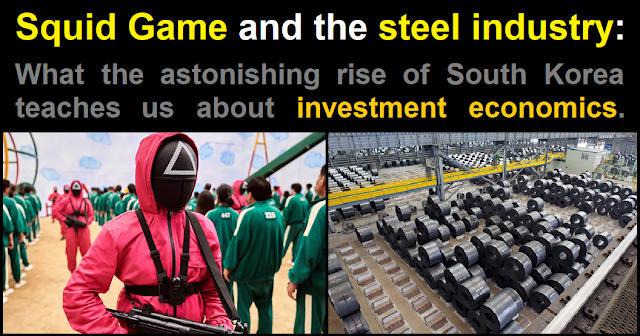
In the mid-20th Century South Korea was an economic minnow. It was a war-ravaged country with a largely pre-industrial economy.
In 1960, if you divided the total economic activity of South Korea by its population (GDP per capita) it amounted to just $79 per person, but within sixty years, this figure has multiplied to over $47,000 per person, which makes it one of the most prosperous large economies on earth, above large developed nations like Japan, Italy, Spain, Argentina, and Russia.
This remarkable period of economic growth in South Korea is known as the Miracle on the Han River, and it started off in the early 1960s when their government initiated the first of the country's 5 year economic plans.
The objective was to modernise the South Korean economy through full employment, and strategic investment across numerous sectors, including infrastructure (roads, rail, ports), core industries (steel, fertilizer, cement, petrochemicals ...), science, and technology.
South Korea's rapid climb up the world development rankings is proof of how astonishingly successful their strategic investment agenda has been.
Steel industry
When South Korea set about building their first modern steel production plant they were derided by the so-called experts. Why would a country like South Korea make their own steel, when they could just import it from countries with established steel industries?
Well, South Korea ignored the heckling and derision, invested in their own steel industry, and rose from absolutely nowhere in steel production, to become the 6th largest steel producer in the entire world in 2020.
From having no modern steel industry at all half a century ago, they've soared past countries with long-established steel industries like Germany, France, and the UK.
In 2020 South Korea produced almost ten times as much steel as the United Kingdom!
A country with a population of just 51 million people produced almost as much steel as economic giants like Russia (146 million), Japan (125 million), and the United States (331 million).
Not bad for a country that were laughed at when they first proposed developing their own steel industry eh?
Having their own government-owned steel industry gave South Korea a huge economic advantage, allowing them to provide cheap steel to other industrial sectors they wanted to develop, especially ship building, electronics, civil engineering, and road vehicle production.
This ready supply of cheap steel helped turn small South Korean firms like Samsung, Hyundai, Kia, and LG into globally recognised brands.
Thanks in a large part to the development of their own steel industry, South Korea is now the world's largest ship-builder, with 40% of the global ship-building market!
Only China even comes remotely close to the shipbuilding power of the South Koreans.
Strategic investment, and the deliberate nurturing of core industries turned South Korea from an economic backwater into an absolute powerhouse over the course of just a few decades.
While developed countries like the UK were deliberately de-industrialising their economies and outsourcing production overseas, South Korea rocketed past them by modernising their core industries and establishing themselves as the premier high-tech, high-skill, hyper-productive economic workshop of the world.
Creative industries
Having learned from their strategic investment in core industries, the South Koreans have recently begun investing in their cultural industries too, with the objective of establishing their nation as one of the creative powerhouses of the world.
The results have already been spectacular:
You'd have to have been living in a box for the last few weeks to have not heard of the South Korean survival drama Squid Game, that's absolutely smashing streaming records across the world.
But the hit Netflix show Squid Game is far from the first massive South Korean cultural export.
In 2020 the South Korean boy band BTS absolutely dominated global music sales, securing first and second place in the IFPI album sales chart.
Then there's Bong Joon-ho's black comedy thriller Parasite, which became the first non-English language film ever to win the Oscar for best picture in 2019.
Either it's a massive coincidence that South Korea has come from nowhere to suddenly deliver worldwide smash hits in television, music, and cinema, or maybe could have something to do with their deliberate policy of investing in their cultural industries?
Investment vs Austerity
South Korea have proven twice over that strategic investment is the key to delivering future economic prosperity, but certain western nations seem determined not to learn this lesson, especially the increasingly-parochial United Kingdom.
The UK was home to the industrial revolution, and pioneered all kinds of industries from steel foundries, through railways, to ship building.
It's all gone now, thanks to the deliberate neoliberal policy of de-industrialisation that's been pursued for the last four decades.
- The country that invented the modern steel industry is no longer even in the top 20 world steel producers, and the remnants of its privatisation-wracked steel sector is now owned by Jingye Group, which is a state-owned Chinese regional bank.
- The country that invented the railways no longer has a single train manufacturer.
- The country that once "ruled the waves" deliberately tore down its own ship-building industry as part of a demented radical-right war on trade unionism (destroy the entire industry and the trade union dies with it).
As South Korea has stormed up the world rankings thanks to their strategic investment policy, the United Kingdom is falling away thanks to policies like de-industrialisation, under-investment, and austerity.
And there's a big danger of the same kind of sectoral decline happening in the UK cultural industries.
The UK is still an undisputed world leader in the creative industries, punching miles above its small island status in music, film, television, sport, and arts, but the process of decline is already underway.
- And just to make his utter contempt for the wellbeing of Britain's £111 billion cultural industries unmistakable, Boris Johnson has recently appointed the notoriously thick, radically right-wing, culture war grifter Nadine Dorries as Britain's culture minister!
South Korea showed the UK the way on industrial strategy, but the Brits ignored it and did the polar opposite, which means South Korea is now an industrial powerhouse, and the UK seems locked into in terminal industrial decline.
South Korea is busy showing the UK the way on cultural strategy too, but once again the British government is doing the opposite, slashing away at cultural funding, when strategic investment is obviously the key to success.
The UK has already reduced itself from industrial pioneer to absolute minnows in industrial sectors that they themselves invented, and if there's not a rapid change in direction, the UK is going to see its position as cultural world leaders eroded away by the same myopic agenda of austerity cuts, and radical-right 'leave it to market forces' ideology, while other countries like South Korea surge ahead by actually investing for the future.
Another Angry Voice is a "Pay As You Feel" website. Access to my online writing will always remain free. If you see some value in what I do, please consider supporting my work with a small donation/subscription.
Clement Attlee was born on January 3rd 1883 and served as Prime Minister of the United Kingdom between July 1945 and October 1951. He was, in my view, by far the best UK Prime Minister of the 20th Century and his government was an inspiration to the developed world.
When Attlee's Labour government came to power in 1945 the UK was a blitzed-out and war fatigued nation with the biggest national debt in its entire history (more than 237% of GDP). Attlee's government rapidly reconstructed and restructured the UK economy to avoid a post-war crisis, founded the NHS, improved pensions, introduced Legal Aid, nationalised core industries, improved workers' rights and built hundreds of thousands of decent houses a year to replace the appalling slums that George Orwell wrote about in The Road To Wigan Pier.

The really incredible thing is that this amazing post-war government reconstruction and investment frenzy actually resulted in a huge drop in the national debt.
Attlee's government took on a massively complex post-war reconstruction project; lifted millions of people out of dire poverty, ill-health and slum dwellings at the same time; and they did it in such a way that he actually ended up significantly reducing the national debt in the process.
In light of all of his incredible achievements, not least the foundation of the NHS during his tenure, I have no hesitation in saying that Attlee was the best Prime Minister of the 20th Century.
It's very interesting to contrast the 40%+ drop in the national debt Attlee's government achieved between 1945 and 1951 through their investment and reconstruction agenda with the massive increase in the scale of UK public debt after a decade of this ruinous Tory austerity agenda.
After a decade of being continually blitzed with Tory austerity propaganda lies that public debts can be reduced by slashing wages, public services, education, and investment, it may seem somewhat surprising that the national debt fell dramatically despite all of Attlee's spending and investment.
The reality of course is that all of the Tory austerity propaganda has always been economically illiterate nonsense designed to dupe the gullible into supporting the radically right-wing Tory agenda of massively enriching the tiny mega-rich minority, whilst making the rest of us pay the tab with an unprecedented period of wage repression, public service cuts, infrastructure under-investment, and ideologically driven vandalism of the social safety net.
Attlee proved the correct way to reduce debts and dramatically increase prosperity is through infrastructure investment, decent wages, education, public ownership, social housing, and the development of advanced public services.
History is shouting us a clear message that strategic investment is the key to recovery, not some ludicrous economic fairy tale that there is no alternative to a load of endlessly repeated Tory "let's cut our way to growth" austerity nonsense.
Clement Attlee proved that it is absolutely possible to make life better for all sectors of society through strategic investment, whilst actually reducing the national debt in the process.
In the wake of the coronavirus pandemic the Tory Chancellor Rishi Sunak is proposing to let whole sectors of the UK economy simply die off, and threatening the most savage package of cuts to the social safety net in history, proving the Tory determination to do the precise opposite.
Another Angry Voice is a "Pay As You Feel" website. Access to my online writing will always remain free. If you see some value in what I do, please consider supporting my work with a small donation/subscription.
Here's a short list of some of the stuff that the British electorate rejected in the 2019 General Election:
- A 33% reduction in rail fares
- A National Education Service and an end to rip-off tuition fees
- The most ambitious environmental targets of all the major parties
- An end to the systematic government abuse of sick and disabled people
- £10 per hour minimum wage, and zero hours contracts banned
- Reversal of the 67% Tory cut to the local government budget
- Repayment of the pension money stolen from 1950s women
- The rollout of free super-fast broadband
So why did the British electorate reject all of this, in favour of an economy-tanking Tory administered Brexit shambles?
In my view there are two main reasons that British people decided that Corbyn was some kind of evil Santa offering impossible gifts: the bombardment of lies and the credibility gap.
The bombardment of lies
The research shows that 88% of the sponsored Conservative adverts injected into millions of people's Facebook feeds were demonstrable lies, mainly about the cost of Labour's policies and the absurd lie that everyone's tax bill would jump by £2,400, despite Labour's costed pledge not to increase Income Tax for anyone earning below £80,000.
Then on election day a fake "independent" Conservative front organisation launched a massive illegal propaganda campaign targeting polling stations in marginal constituencies across the country.
If you look at their illegally posted anti-Corbyn poster, you can see how much they were lying.
Apparently Evil Santa was threatening to "steal the children's inheritance", by, err, properly funding their education, freeing them from student debt, paying them £10 per hour, charging them 33% less for getting to work, building hundreds of thousands of affordable homes, and investing in high-tech, high-skill, high-pay industries.
Labour's policy was actually to maintain the inheritance tax threshold at £325,000, but scrap an additional property allowance, meaning the absolute maximum extra inheritance tax anyone would have had to have paid was £40,000, but only on inheritances of over £425,000.
Apparently this £40,000 paid only by the children of the property rich, was "stealing the children's future", but saving everyone who attends university from repaying rip-off inflation + 3% loans that most won't even pay off in their entire working lives, guaranteeing them all a decent wage whenever they leave school, and saving any of them who end up commuting to work fortunes on their rail tickets every year is unspeakably awful!
Then Evil Santa apparently wanted to "dictate their education", which is a total reversal of reality. The fact is that 75% of secondary schools in England have been privatised into the hands of unaccountable private operators, many of them major Tory party figures and donors, who get to control the curriculum, and dictate our children's education. Corbyn wanted to reverse this.
Point three is the terrorism smear-mongering which has dogged Evil Santa the entire time because he openly proposed talking to the Sinn Féin politicians before the Irish peace process and the Good Friday Agreement, at a time when Thatcher and her Tory government were secretly negotiating with the actual terrorists behind a wall of secrecy.
As Foreign Secretary Johnson sold weapons to the Saudi head-choppers, despite knowing that they were using them to commit war crimes, and despite knowing they were passing military hardware onto Al Qaida terrorist groups, but yeah, Corbyn is the terrorist-sympathiser and Johnson is the guy to protect us from terrorism!

The bit in the black box is also highly relevant. Corbyn is apparently the economic extremist for proposing public ownership of the railways, water supply, national grid, Royal Mail, and NHS.
Johnson and the Tories are the 'economic moderates' despite their demonstrable track record of outright defying the public will to privatise front line police services, swathes of the NHS, thousands of schools, prisons, the probation service, and conducting an enormous swindle to flog off the Royal Mail property portfolio at a tiny fraction of its true value.
It's impossible to deny that such a barrage of lies was an important factor in the election, especially the illegal postering campaign, ensuring the last thing that hundreds of thousands of people saw before they voted was a bombardment of lies.
The credibility gap
The Tories lied their way to victory, but Labour did themselves absolutely no favours at all with their election strategy.
I have no idea whose plan it was to launch a load of surprise policies like free broadband, the 33% rail fare reduction, and the repayment of the stolen WASPI money, but doing it as a sequence of surprise announcements was a terrible idea, because it made the party look incredibly irresponsible.
If you want to argue the case for increased public spending and more money in people's pockets, you need to lay the groundwork, you don't just dump it all on people as if it's a load of reckless pre-election bribes.
The majority of people in Britain simply have no idea at all about macroeconomics, because they've never been taught, and it's just not the kind of thing most people would choose to research for themselves.
If you want to switch from austerity extremism to investment economics, you need to develop a clear and simple economic case for doing so.
You need to come up with a few slogans along the lines of "invest now for a prosperous future", "you don't grow a business by cutting it, you invest, so why would you cut a country", or "more money in your pocket is more money in the economy", then you repeat it and repeat it and repeat it until everyone has heard it so many times they're bloody sick of it, but it's in their heads, so when you announce big public investments, or policies to put more money in people's pockets, they can link it to the slogans.
If you fail to do this, they link your pledges to ludicrous economic baby talk nonsense like "no such thing as magic money trees", or "how will they pay for it?", or "the money will run out" and then you're absolutely screwed.
The fact that millions upon millions of people still somehow think about the economy as if its a household budget, with a limited supply of money that can potentially "run out" is the origin of Labour's economic credibility gap, and their failure to establish any kind of simple counter-narrative absolutely did for them.
Announcing grand spending pledges as surprises just hammered nails into their own economic coffin, especially since they were as much surprises to their supporters and social media cheerleaders as they were to everyone else.
If "rail fares are too high in Britain" (which they are) and "for the sake of the environment and killer air pollution we need to encourage people onto public transport by making it cheaper than going by car" had been a significant talking point for the previous year, then a surprise 33% reduction in rail fares could have gone down really well, but again the architecture simply wasn't put in place to explain why, so it just came across as a reckless pre-election bribe.
Labour's absolute failure to clearly explain the macroeconomic case for investment and increased public disposable income was a lamentable failure in basic planning.
It's irrelevant if you've got the better economic policies if you don't give ordinary people the basic architecture to understand why they're good for the economy.
It's a quite astonishing Labour Party failure that the Tories are still widely considered the party of economic credibility after the slowest economic recovery in centuries, the worst period of wage stagnation since records began, the worst productivity crisis the UK has ever suffered, the soaring trade deficit, losing Britain's AAA credit ratings, failing to eliminate the deficit after an entire decade when they said they'd do it in 5 years, and dragging the nation to the brink of a chaotic economy-tanking, job-destroying Brexit meltdown.
It was bad enough that Ed Miliband failed to capitalise on Tory economic incompetence in 2015, which was only halfway through this economy strangling austerity chaos, but the Labour Party has subsequently failed to win the economic argument twice more under Corbyn, and it's pretty damned obvious that if they don't start communicating investment economics to the masses fairly soon, they're in for another defeat at the next election too.
It's now stunningly obvious that people will not elect a party they can't trust on the economy, even if the alternative is deliberately steering the economy towards an unprecedented self-inflicted crisis!
Another Angry Voice is a "Pay As You Feel" website. You can have access to all of my work for free, or you can choose to make a small donation to help me keep writing. The choice is entirely yours.
It's a busy election campaign so I shouldn't really be wasting my Sunday analysing the activities of a silly nonsense party like the Lib-Dems, but their latest policy announcement of 'Ultra-Austerity Forever' is so bizarre, so wrong headed, so economically illiterate, so off the charts crazy, it's a matter of morbid curiosity.
Like a horrific pile up on the other side of the motorway, it's giving me the compulsion to slow down and have a look.
I know it's sick and wrong to gawk like this, when I've got much more important election priorities to focus on like hammering the Tories for their malice and incompetence, or talking about the ambitious democratic socialist policies Labour are putting forward, or taking a more detailed look at the political landscape in Scotland, Wales, or Northern Ireland ... but I just can't help it.
So here are 12 things you should know about Lib-Dem Ultra-Austerity Forever.
Ultra-Austerity forever
There are two main strands to the Lib-Dem policy of Ultra-Austerity Forever.
The first is the enforcement of a "fiscal rule" that the government must create a permanent budget surplus of 1%, meaning that the government permanently extracts more wealth out of the economy than it invests back into it.
The second element is that the government deny funding to any project that cannot prove itself economically profitable, no matter the other benefits (social, environmental, public health, immeasurable effects on future economic prosperity ...).
No apologies
The Lib-Dems have never apologised for the ruinous consequences of the austerity fanaticism enforced by the 2010-15 Tory/Lib-Dem coalition (collapsing living standards, soaring poverty, the worst sustained decline in the value of workers' wages since records began, the slowest economic recovery in centuries, vandalism of the social safety net, deliberate under-funding of public services, the worst house building figures since the 1920s, the loss of the UK's AAA credit ratings, the lowest levels of infrastructure investment in the developed world ...).
Neither have they apologised for the fact that austerity extremism caused the living standards collapse that drove the Leave vote marginally over the winning line in 2016.
All of this devastation and chaos was caused by George Osborne's incompetent efforts to cut state spending back to a balanced budget (a 0% deficit).
The Lib-Dems aren't just unapologetic about their role in this devastation, they're actually promising to intensify austerity by aiming for a budget surplus of 1% (a deficit of -1%)!
They're not just refusing to apologise for austerity extremism, they're doubling down on it and pushing it harder than ever!
Investment vs Austerity
Investment economics says that you create prosperity by investing in stuff like infrastructure, housing, skills and education, high skill jobs, quality services.
Austerity economics says that you create prosperity by wantonly slashing away at all aspects of state spending in the vain hope that your economy will finally be the one that breaks precedent by demonstrating that it is possible to mindlessly cut your way to growth and prosperity.
There's absolutely no way that any Lib-Dem can pretend that their party leaders are intending to use tried and tested investment economics to achieve this 1% surplus because their political language is utterly infested with the kind of economic baby talk we've come to expect from austerity fetishists.
During the Lib-Dems' Ultra-Austerity Forever launch speech Ed Davey said "The spending competition between the Labour and Conservative fantasists has made Santa Claus seem like Scrooge".
He's literally ridiculing the idea of investing in public services and infrastructure projects! You'd have to be utterly clueless to not understand that this kind of anti-investment rhetoric is motivated by undying belief in crackpot 'let's cut our way to prosperity' austerity dogma.
Arbitrary economic illiteracy
Politicians love to put inflexible targets on things because they think "fiscal rules" make them sound important and knowledgeable, but in reality economists tear their hair out at nonsense like an inflexible 1% budget surplus, no matter what the circumstances.
You don't even need to have any economics training whatever to understand the idiocy of arbitrary targets like this. Just ask yourself why exactly 1% is the economically ideal number. Why not a 0.9% surplus? Why not a 1.25% surplus?
There's clearly been no actual calculation done. They've just settled on 1% because it sounds catchy and memorable, haven't they?
Also, what happens if something changes dramatically? What if these's a natural disaster? or a nuclear power station melts down? Or somebody explodes a dirty bomb in a British city?
Or what if it's something utterly mundane like the cost of government borrowing going up or down dramatically?
Under what circumstances does it become acceptable to break this completely arbitrary 1% fiscal rule?
Shrinking the state
An arbitrary fiscal rule enforcing the government to only ever spend 99% of what it extracts from the economy is quite obviously a recipe for shrinking the state relative to the size of the economy.
The desire to shrink the state has always been a mainstay of hard-right politics, and the Lib-Dems have actually thought of a way to legislatively encode this state shrinking ideology!
Bully for them. They're more dedicated to the hard-right state shrinking ideology than the Tories!
The price of everything, the value of nothing
The Lib-Dem strategy of using beancounters to analyse every single bit of government spending to ensure it is capable of turning a profit might sound fairly sensible in practice, but in reality it's an exercise in knowing the price of everything and the value of nothing.
Just think about investments like a NHS diabetes awareness campaigns, or providing children's music lessons in schools, both of which cost money in the present, but have extremely nebulous and hard-to-measure potential future economic benefits in the long-term.
How is it even possible to estimate the long term economic benefit of these things in terms of reduced demand on NHS services and fewer lost sick days from work, or the potential future contribution to the £100 billion UK creative industries market?
And what might the cost of scrapping their funding turn out to be in 25 years time? How would you even begin to calculate the long-term economic repercussions?
Then there's the simple fact that money isn't everything.
OK, maybe a public investment only returns 90p in the pound, but what about other factors like the social benefit? Environmental benefits? Public health benefits? Quality of life benefits?
Why scrap all of that into the bin just to fixate on whether the investment pays back more than it cost in monetary terms?
How about paying for granny's operation after she's had a fall?
It turns out that elderly people with broken hips become exponentially more likely to die the longer they wait for treatment , which means the state would save huge amounts of money on the cost of the operation, the cost of future medical care and social care, the cost of future pension payments etc.
Spending money on reducing hip replacement waiting times for elderly people is clearly counter-productive if you view things from a purely fiscal perspective.
If it's more profitable to just let granny slowly die in agony rather than replace her broken hip, isn't that the fiscally responsible thing to do?
Incompatibility with their own damned policies
The idea of scrutinising every single element of government spending from a purely financial perspective isn't just narrow-minded, it's also incompatible with a number of the Lib-Dems own policies!
Take their pledge to plant 60 million trees.
From an environmental perspective tree planting is actually a fairly good idea (although not as good as setting aside land to naturally re-wild itself), but in terms of an economic investment alone, it's unjustifiable.
How on earth is planting millions of trees over thousands of acres of viable farmland ever going to spin an economic profit for the government?
The Lib-Dems are so inept that their headline election pledges are completely at odds with their proposed fiscal rules!
Outflanking the Tories
It's quite extraordinary to see the party of Charles Kennedy attempting to outflank the Tory party on the economic hard-right, with their state-shrinking, Ultra-Austerity Forever agenda.
This is a party that competed with Labour for socially progressive centre-left votes until just a decade ago, yet now they're presenting themselves as the most radical economically right-wing political party in British politics!
The last of the Cameroons
The last politician to dare raise the spectre of austerity to infinity was David Cameron, who gave a truly extraordinary speech promising permanent austerity for the masses, whilst surrounded by gold ornaments and all of the trappings of wealth and privilege at the Lord Mayor's banquet in 2013.
Promising 'austerity forever' was a bold move, even at the height of austerity mania in 2013, but promising it now, in the middle of an election campaign, when austerity has gone completely out of fashion so much that even the Tory party is trying to distance itself from it ... well it's absolutely wild, isn't it?
The Lib-Dems are clearly pining for their glory days of coalition government, six figure salaries, ministerial cars, important cabinet meetings ... And in their pathetic attempts to bring those past glory days they've resorted to the magical thinking of channelling David Cameron's political ghost!
Reconsidering the austerity coalition
Jeremy Corbyn has won the Investment vs Austerity argument so comprehensively that even the Tories are trying to distance themselves from austerity extremism, so it's incredible that the Lib-Dems have decided to double down on it as the last austerity party standing.
Given the Lib-Dems are the last remaining advocates of hard-right austerity fanaticism in British politics, surely it's time to reconsider their claims to have moderated the Tories during the austerity coalition years?
Why are we taking their claims at face value, when it now seems much more likely that they were just as keen on austerity as the Tories at the time, if not actively egging them on?
Tory target seats
Attempting to outflank the Tories to the economic hard-right looks like a suicidal political move if you think the Lib-Dems are after 'centrist' socially progressive votes, but in reality almost all of the Lib-Dems' priority target seats are Tory-held constituencies in the south and in suburbia.
Are they attempting to portray themselves as "more Tory than the Tories" in order to poach Tory target seats?
With the Lib-Dems there's always the strong possibility that whatever they're doing is the result of abject strategic incompetence, but in this case it does seem possible that they're attempting to resuscitate Cameroonian austerity extremism in order to woo voters in these marginal Tory seats.
Remainer doublethink
What the Lib-Dems clearly haven't considered is how their efforts to reanimate the political corpse of austerity is going to come across to the other core demographic they're targeting: Remainers.
For the last three years Remainers have been arguing against Brexit by saying it would mean "more austerity"*, so how on earth can Remainers even try to square this austerity is bad anti-Brexit argument with the Lib-Dems' stated economic policy of delivering ultra-austerity forever?
If you see yourself as a socially progressive 'centrist' type, who opposes Brexit because of the disastrous effect it would have on ordinary British people, how on earth would it be possible to support a party that's going to push ruinous austerity extremism even harder than Cameron and Osborne did?
Orwellian doublethink seems like the only plausible answer.
Conclusion
The Lib-Dems haven't just learned absolutely nothing from the two thoroughly deserved electoral kickings they've taken in 2015 and 2017, they've somehow convinced themselves to believe the polar opposite of the lesson they should have learned.
The obvious lesson they should have taken from these electoral routs is that they colluded too closely with the Tories, and that austerity extremism was a social and economic disaster that they should apologise for.
They should have not just apologised for the dire destruction in living standards that austerity delivered, but for the fact this austerity living standards collapse contributed directly to their own worst nightmare of the 2016 Brexit vote.
But what they've actually convinced themselves to believe is that the 2010-15 pre-Brexit period was some kind of magnificent utopia, and that the only way to return to those marvellous glory days is to dig up all the corpses from the austerity graveyard and reanimate them as ultra-powerful austerity zombies!
They're trying to bring back their own personal glory days by returning to the very stuff that actually brought their party crashing down!
Another Angry Voice is a "Pay As You Feel" website. You can have access to all of my work for free, or you can choose to make a small donation to help me keep writing. The choice is entirely yours.
* = The Remainer argument that "Brexit means more austerity" is every bit as dishonest as the Brexiteers' "£350m for the NHS" ... and I say this as a Brexit-sceptic.
Austerity is a policy of cutting investment in an economic downturn. It's an economically illiterate response to crises. The tried, tested, and proven response to economic crises is investment in stuff like infrastructure, housing, transport, manufacturing, services, skills and education (create quality jobs and modern infrastructure = create prosperity).
No matter the scale of a Brexit economic downturn, austerity would always be the wrong answer, and anyone claiming it would be inevitable is guilty of legitimising the outright lie that austerity is the correct response to a crisis, when the slowest economic recovery in centuries and the worst period of wage decline since records began post-2008 is damning proof that austerity is absolutely the wrong one.
Here's an article on this tragic piece of remainer 'groupthink': Are you unwittingly guilty of spreading hard-right Tory propaganda
The Tory party have concocted an absolutely absurd misinformation campaign aimed at convincing the gullible that Labour would waste £1.2 billion if they win the next election.
If you come across anyone dim-witted enough to actually repeat these nonsense numbers, here are eight simple questions you can ask them to illustrate exactly how gullible they're being.
1. Where did you get this figure from
The figure was jumbled together on the Tory 'costofcorbyn' website, and then uncritically splashed all over the pages of the right-wing billionaire-owned propaganda rags.
No reputable source has mentioned this bogus figure without the disclaimer that it's been calculated in an incredibly shoddy way. Even the BBC called it out as "bogus numbers" and "dodgy accounting"!
2. Why do you believe it?
Whether this claim has been sourced from the Tories directly, or rote learned from the pages of the S*n/Daily Mail/Express, whoever is repeating it is believing it at face value with no critical thought whatever.
Don't they even know not to trust politicians without checking their claims first, or that they shouldn't believe everything they read in newspapers?
3. Did you check the workings?
Whoever is repeating this nonsense obviously didn't check the workings, because they're absolutely full of basic errors.
The idea that Labour would enact every single one of their policies on the day they formed a government is as blatantly ridiculous as the idea that government investments create absolutely zero returns to offset the cost.
Anyone who even remotely looked into how this figure was devised would definitely not be repeating it, because nobody actively wants to make themselves look an economic illiterate. Do they?
4. Do you understand the difference between an investment and an expenditure?
This is absolutely basic accounting stuff, but it's apparently beyond the abilities of the Tories who devised this number, and all the gullible piss-wits who are regurgitating it.
The difference is that when you invest in something, like taking the water supply, railways, or national grid back under public ownership, it's an investment that provides returns on investment, while expenditures are not recouped (at least not directly).
Investing in the de-privatisation of vital national infrastructure and services is not an expenditure with no returns because once private profiteers are prevented from soaking away the benefits in huge dividends and bloated executive salaries, the profits go back to the nation.
Jumbling up national investments up with government expenditures, like extra spending on stuff like free childcare, and free school meals is utterly ridiculous.
5. How did they work it out when Labour haven't published their manifesto yet?
Working out what a party's election manifesto would cost before they've even published it seems like pretty odd behaviour, especially since Labour set the precedent of explaining their spending pledges in their last manifesto.
Shouldn't the Tories be working on their own manifesto, and figuring out how much it would cost, rather than making up fake figures to discredit Labour's manifesto, when they've not even seen it yet?
6. How much does the Tory manifesto cost in comparison?
In an extraordinary car crash interview Tory minister Kwasi Kwarteng was asked by Sky News how much the Tory manifesto was going to cost in comparison, to which he gave the incredible reply that he was "not going to bandy around figures".
The absolute brass neck of bandying around such economically illiterate figures about Labour's spending plans, then bare-faced dodging questions about their own!
7. If the Tories are this bad at maths, why would you trust them to run the country?
The £1.2 trillion figure is so riddled with basic errors and economic illiteracy it's absolutely astounding that anyone would be happy to have the incompetents who produced it running the country.
If they can't even do basic stuff like differentiate between an asset and an expenditure, is it any wonder the Tories have delivered the slowest economic recovery in centuries, caused the worst period of sustained wage depreciation in history, and chucked away the UK's AAA credit ratings?
8 How much has austerity cost?
In 2010 the Tories promised that austerity fanaticism would have eliminated the budget deficit by early 2015, it's late 2019 and the national debt is still growing.
How much has all of this extra borrowing added to the national debt?
Well the national debt has risen almost £1 trillion since 2010, and what do we have to show for it? Worse public services, failing schools, smaller army, fewer police and fire fighters, bankrupt local councils, vandalised social safety net, the lowest level of infrastructure investment in the developed world, cancelled flood defence spending, soaring poverty, collapsing wages ... and according to Tory tribalists that represents money well spent!
And how much has the ruinous economically stifling austerity agenda wiped off the value of the UK economy?
According to research by NEF austerity has wiped a whopping £100 billion off the value of the UK economy already, and that's not a made up figure, it's economic value that's already been destroyed.
Do you see any Tories crying over that?
Of course you don't, because they don't actually care about the health of the UK economy, all they care about is transferring as much wealth as possible from the poor and ordinary to the mega-rich, no matter what harm this upwards wealth redistribution does to the wider economy.
Another Angry Voice is a "Pay As You Feel" website. You can have access to all of my work for free, or you can choose to make a small donation to help me keep writing. The choice is entirely yours.
The Tory austerity myth told us that the only way to reduce public borrowing was a massive programme of public sector spending cuts.
During the austerity years the Tories and their Lib-Dem enablers pushed all kinds of ruinous policies that resulted in the slowest economic recovery in centuries, and the worst collapse in the value of UK workers' wages since records began, but perhaps the most damaging aspect of all was their deliberate reduction in infrastructure investment so that the UK became the lowest-investment country in the entire developed world.
The bulk of the Tory austerity cuts (especially reductions in local government funding and cancelled infrastructure projects) have been deliberately aimed at non-Tory voting areas like the North East, South Wales, the central belt of Scotland, and the former industrial cities of Yorkshire, the North West, and Midlands.
Infrastructure investment is generally a strong fiscal multiplier, especially at times where the cost of borrowing is exceptionally low (like the last decade), because this kind of spending creates jobs and economic demand in the short-term, and increases the future economic potential of an economy in the long-term (high-skill, high-tech, high-pay companies are far more likely to locate in places with great infrastructure, than places with failing public services and outdated and over-crowded public transport links).
It seems too obvious to have to spell it out in simple like this, but a near-decade of Tory austerity fanaticism has proven that huge swathes of the UK population will simply believe that the only way to reduce borrowing is to wantonly slash spending on the things that actually increase economic potential and prosperity!
The latest evidence that "let's cut our way to growth" austerity fanaticism is completely backwards comes from the Office for National Statistics data on economic surpluses and deficits by region, which demonstrates a strong correlation with their data on investment on stuff like infrastructure and public transport.
It's surely no coincidence that the two regions with by far the highest levels of public investment in infrastructure and public transport also have the biggest per capita surpluses, while the three most austerity-blighted regions with the lowest levels of investment are the ones with the worst per capita deficits.
Of course this isn't a hard and fast rule, because the North West and Scotland buck the trend slightly in the graph with larger per capita deficits despite higher rates of investment, but it's important to note that these regions have also suffered much more severely due to Tory austerity fanaticism compared to regions with higher levels of habitual Tory-voting, like the South West, East of England, and East Midlands.
All the evidence points to the fact that the Tories have got it completely backwards. That cutting the deficit is achieved by increased public investment, and that low-investment high-austerity regions continue running deficits.
The more you cut, the worse the deficit.
But this blatant Tory backwardness won't bother most people.
Most of the mainstream media will continue refusing to explain explaining the relatively simple fact that austerity fanaticism does exactly the opposite of what the Tories claimed it would, so they people won't even know about it, and many of those who do somehow come across the mountains of evidence that austerity is completely backwards economic gibberish will simply ignore it because it actually takes bravery to admit that you've been the subject of a decade-long con job, when it's much easier on the ego to just ignore the compelling evidence that you got totally duped.
Another Angry Voice is a "Pay As You Feel" website. You can have access to all of my work for free, or you can choose to make a small donation to help me keep writing. The choice is entirely yours.


