Showing posts with label Nationalisation. Show all posts

Saturday, 25 June 2022

Why does Starmer keep insisting that the public are wrong?

Keir Starmer was elected as Labour leader on the back of 10 pledges, which promises party unity, the continuation of Corbynite policies, and a clear cut commitment to communal ownership of vital infrastructure and services like water, rail, and energy.

Starmer knew he couldn't win the Labour leadership without promising these things, because public ownership is not just overwhelmingly popular with the Labour Party members who were voting, they're popular policies across the entire British public.

Polling consistently demonstrates that overwhelming support for renationalisation of the energy sector, the water supply in England, and the railways.

In the two years after his election as Labour leader circumstances have handed Starmer a series of ideal opportunities to promote these overwhelmingly popular renationalisation policies.

Raw Sewage

In 2021 Johnson's Tory rabble triggered a massive public backlash when they voted to allow privatised water companies to keep artificially inflating their profits by dumping vast quantities of raw sewage into our waterways and coastal waters.

Starmer could easily have used this scandal to promote the popular policy of bringing England's privatised mess of water suppliers back under public ownership.

Instead he sent his subordinates out to argue that the profiteers must stay in charge of the water supply, in order to signal that Labour represents no threat to vested capitalist interests.

Energy Crisis

We've all seen the chaos of massively inflated energy bills, soaring energy producer profits, a sequence of energy suppliers going bust, and the government regulator forcing abandoned customers onto much more expensive tariffs.

Starmer could have highlighted the way the French government imposed a 4% cap on energy bill rises onto their publicly owned energy company (EdF), while the Tory government allowed EdF and other energy companies in the UK market to raise bills by an astonishing 54%.

He could have offered the public the renationalisation policies they want, but instead he decided to once again adopt the position that the public are wrong, and that the private profiteers must stay.

And Starmer didn't just spurn the opportunity to promote the energy renationalisation policies that the public want, and that he pledged in his leadership bid, he even publicly bragged that he lied in his leadership campaign, and insisted that he'd lie to people again to win more power!

Rail Strikes

Labour is supposed to be the party of working people (the clue is in the name), but Keir Starmer has decided to oppose the RMT rail strike against below-inflation pay offers and mandatory redundancies.

He's so vehemently opposed to the strikes that his minions are trying to force Labour MPs to apologise for showing solidarity with striking workers!

It's truly absurd to see Starmer's shadow cabinet team insisting that they won't support the strikes because they don't want to "pick a side".

It's capitalist profiteers and a profoundly malicious Tory transport secretary against ordinary low-paid rail workers (not train drivers).

If Labour won't even pick a side in this scenario, what the hell is the point in them.

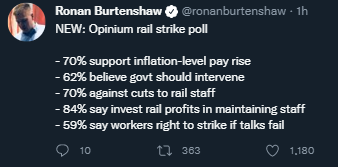
And then the polling has come out to show that the British public are overwhelmingly on the side of the rail workers, meaning once again Starmer has positioned himself far to the right of public opinion.

Outflanking the public to the right

Despite pledging popular renationalisation policies in his leadership election, Keir Starmer has deliberately placed the Labour Party well to the right of the British public on water, energy, and now rail.

Instead of offering the public what they want, Starmer is siding with the capitalist profiteers and insisting that the public are wrong to want things to just be a bit better and fairer for British consumers and British workers.

Starmer's dedicated to the protection of vested capitalist interests, so he's going to keep Labour positioned well to the right of public opinion; offer a bland and uninspiring "more of the same" policy platform; and hope that he can win the next election purely by not being quite as repulsive and divisive as Johnson.

It looks a lot like a deliberate attempt to replay Ed Miliband's catastrophically uninspiring 2015 Tory-lite election campaign, in which Labour decided to pathetically imitate Tory austerity ruination, rather than opposing it and pledging to invest for the future instead.

It seems an absurdly inexplicable strategy to repeatedly chide the public that they're wrong to want things to be a bit better, and then expect them to vote for you regardless.

Unless of course Starmer considers the protection of capitalist profiteering to be so important that he'd risk driving millions of traditional Labour voters away, and throwing an election over it.

And if that's the case, what the hell is this absurd person doing as leader of the Labour Party?


 Another Angry Voice  is a "Pay As You Feel" website. Access to my online writing will always remain free. If you see some value in what I do, please consider supporting my work with a small donation/subscription.


OR

Thursday, 16 June 2022

Something's gone terribly wrong with Labour

Keir Starmer has once again demonstrated Labour's chaotic lurch to the right under his lamentable leadership, this time by forcing Wes Streeting to apologise for expressing a bit of solidarity with striking UK rail workers last week.

Let's not forget that Labour is supposed to be the party of the workers (the clue is in the name). 

It's supposed to defend ordinary people from the greed and exploitation of capitalists and landlords. 

If Labour founding-father Keir Hardie was alive
today, Starmer would no-doubt force him to
apologise for saying things like this
It was founded by socialists and trade unionists, and it's still almost entirely funded by socialists and trade unionists through their membership fees and union subs.

But Starmer sees it as his own personal fiefdom, which he rules over through relentless factionalism; petty diktats; depraved ideological purity tests; constant vote-rigging; forced apologies; and regular witch-hunts against those who refuse to bow down to his authoritarian hankerings.

Starmer started off by hastily driving anyone with a shred of decency out of his shadow cabinet by insisting that they abstain on a couple of truly vile pieces of Tory legislation designed to allow undercover cops to rape women with impunity, and to provide impunity to British soldiers who commit war crimes overseas.

These ideological purity tests did what they were designed to, and drove all of the genuinely left-wing and socially progressive figures out of his shadow cabinet, so he then set about demoting all the so-called "soft-left" figures too (like Dodds and Thomas-Symonds), replacing them with his right-wing allies.

Starmer and his bully-boy enforcer on the NEC David Evans have issued loads of diktats banning local party members from discussing certain subjects, or holding no confidence votes in Starmer or Evans, because if there's one thing that petty tyrants can't tolerate, it's open and free discussion amongst people they believe to be their inferiors.

Starmer forced Alex Sobel (hardly a radical leftist) to issue a grovelling apology for suggesting that he thought capitalism was to blame for climate change, then he cynically rigged the Labour leadership nomination process to make it almost impossible for his successor to be socialist, female, or a person of colour.

Then Starmer positioned himself miles to the right of Tony Blair by going after the anti-war group of Labour MPs, threatening to expel them from the party if they refused to bend to his will. 

Even though Iraq turned out to be an absolutely horrific disaster, meaning Blair really should have listened to the warnings of rebels like of Robin Cook, Tony Benn, Tam Dalyell, Jeremy Corbyn ... he still allowed them to dissent without threatening to expel them from the party like Starmer does to anyone with a different opinion to his own.

And now Starmer's humiliating Wes Streeting, and showing utter contempt for the trade union movement that pays the Labour Party's bills, by demanding Streeting issue a grovelling apology for his expression of sympathy towards striking rail workers!

If Starmer's punishing a right-wing lickspittle like Streeting for coming across as too left-wing, it's beyond obvious that something has gone catastrophically wrong with the Labour Party.

It's been usurped by the political right, and under Starmer's leadership it's being used as a battering ram to undermine, disempower, demoralise, and silence the left, instead of offering a better alternative to this cesspit of Tory incompetence, corruption, and degeneracy.

The workers' party has been taken over by people who favour greedy capitalists over exploited workers; selfish private landlords over suffering tenants; the power of the state over the power of the people; and property rights over people.

It's been taken over by a wannabe-tyrant who refuses to accept any opinion other than his own, and clearly considers the genuine left within his own party to be a much bigger problem than Johnson's malicious, corrupt, and incompetent ghouls in government, who he repeatedly refuses to properly oppose.

I would never have picked Starmer as Labour leader, but I could also never have imagined that things would have degraded so rapidly under his perpetual abstention of a leadership. 

He's more of a right-wing control freak than Blair; he's more obsessed with defending the neoliberal economic order than Brown; he's more other-worldly and unengaging than Miliband; and he's far worse at getting to the point and hammering home the political advantage than Corbyn was!

He's like some kind of Frankenstein's monster composed of all of the worst aspects of other Labour leaders, without any of the good bits. 

Without the charisma of Blair; without Brown's aura of decency; without Miliband's desire to make the Labour Party more democratic and accountable; and without Corbyn's popular policies.

What's more is how utterly dismal Starmer is on policy and strategy.

He seems to be convinced that his strategy of repeating the same mistakes of the past will prove successful this time. 

Attacking the left rather than properly holding the Tories to account delivered Neil Kinnock his absolute pratfall of an election in 1992, and in 2015 Ed Miliband's mistake of pathetically imitating Tory economic insanity rather than opposing it turned what should have been an absolute gimme of an election, into a humbling defeat.

Starmer's going to do both at the same time, as well as insisting that the public are wrong to want energy and water renationalisation, when the sewage scandal and the energy crisis had actually provided him absolutely golden opportunities to offer the public the renationalisations that they've repeatedly told pollsters that they want (and what he'd promised in his leadership election pledges to boot!).

Starmer's just as determined to lecture the public that they're wrong, as he is to ignore the lessons from Labour Party history!

It's absolutely mind-boggling that there are still people within the Labour ranks who insist on trying to gaslight the public into believing that this unlikeable, unengaging, unsympathetic, untrustworthy figure is actually brilliant, funny, charismatic, relatable, and honest, and that we're all at fault for not having noticed yet!

Starmer's been far worse than even his harshest critics could have imagined in 2019, and yet Labour seem determined not to get rid of him, and to go into the next general election with this absolute dud dictating, and foot-stamping, and micromanaging the party into another devastating electoral pratfall.


 Another Angry Voice  is a "Pay As You Feel" website. Access to my online writing will always remain free. If you see some value in what I do, please consider supporting my work with a small donation/subscription.


OR

Friday, 4 February 2022

Seven reasons Rishi Sunak's energy bill mini-loan policy is an insulting joke


Tory Chancellor Rishi Sunak has announced that the energy price cap is going to rise by an astonishing 54%, meaning a £694 hike in the energy bills of ordinary households.

In order to pretend that he's doing something to help, he's announced that energy consumers will be automatically enrolled in £200 mini-loans, which will be subtracted from their inflated bills, but then be paid back in £40 energy bill additions over the next five years.

In this article I'm going to briefly explain why Sunak's absurd energy bill mini-loans are dishonest, inadequate, over-optimistic, complacent, ineffective, economically illiterate, and driven by hard-right capitalist ideology.

1. Dishonest 

Sunak's mini-loans are being presented as a "rebate". This is astonishingly dishonest because rebates (like the massive UK rebate on EU membership fees before the big flounce) are discounts that do not have to be paid back at a future date.

If it has to be paid back at a future date, like Sunak's deluded nonsense, then it's not a rebate at all, it's a loan.

So when the Chancellor of the Exchequer; and a load of Tory MPs; and Britain's woefully biased media hacks keep describing these loans as "rebates", they're being profoundly dishonest.

2. Inadequate

You don't have to be any kind of maths genius to figure out that a £200 loan is insufficient to cover a £694 price hike.

3. Over-optimistic 

Sunak's decision to force a "borrow now, pay later" strategy on all UK energy consumers relies on the very big assumption that energy prices will quickly fall back to lower levels by next year.

But what happens if they don't fall back, and remain high, or even continue inflating even further?

The answer of course is that UK energy consumers would then be facing sky-high energy bills, with repayments on Sunak's mandatory loans piled on the top.

4. Complacent 

Sunak's complacency is obvious if you just care to look at what other European nations are doing in the face of inflating energy prices.

The left-leaning Spanish government have temporarily scrapped energy taxes, banned energy suppliers from cutting off non-paying customers, and introduced windfall taxes on energy company profits.

Meanwhile in France the liberal-capitalist Macron government have imposed energy windfall taxes and limited energy bill rises to 4%.

If the Spanish or French governments had allowed prices to soar by 54% and offered anything as pathetically inadequate as Sunak's mini-loans, there'd be massive public protests, especially in France.

But Sunak complacently expects the British public to just quietly suck it up like good, obedient little plebs.

5. Ineffective

Sunak's shoddy little mini-loans are a spectacularly ineffective sticking plaster on a severed limb sized economic problem.

What's needed is serious consumer protections, and urgent reforms to the UK's absolute shambles of an energy sector.

Here are a few ideas:
  • The Energy Price cap should only have only been increased at the rate of inflation, if at all.
  • There should be new legislation to protect non-paying customers from being cut off.
  • Windfall taxes to be levied on the obscene profits of private energy companies.
  • Energy suppliers that go bust should be renationalised.
  • Energy infrastructure should be brought back under public ownership in order to put the energy needs of the nation above the profit-seeking behaviour of private businesses.
  • The government should implement a Green New Deal to speed up adoption of renewable energy, in order to end the UK's dangerous over-reliance on expensive imported gas.
But instead of any real action to combat the current crisis, or to protect the UKs energy security in the future, all we get is Sunak's insultingly inadequate energy bill mini-loans.

6. Economically illiterate

Anyone who has ever run a business will know that there's absolutely nothing wrong with taking out loans in order to make investments, in things like property, machinery, or training. 

But if you're taking out loans to cover the cost of your day-to-day expenses, like payroll, materials, or bills, then you're in really serious trouble and veering towards insolvency.

Rishi Sunak is so economically illiterate that he thinks that loans to cover expenses are such a good idea that he's going to forcibly sign every energy customer in the UK up to them!

Surely now it's time to turn the persistent myth of Tory economic competence into the joke it should have been ever since they started enforcing their ludicrous and economically illiterate "let's cut our way to prosperity" austerity ruination agenda in 2010?

7. Ideological

Sunak is allowing profiteering energy companies to keep their unearned gains, while insulting the British public with the fake-help of these ludicrously inadequate mini-loans.

His decision to protect capitalist interests while throwing insulting crumbs at the public in order to pretend he's helping is a product of his hard-right capitalist ideology.

The entire purpose of the modern day Tory party is to prioritise the interests of capital above what's best for the British people and the British economy.

Just look at who bankrolls the Tory party operation, and look at all the multi-millionaires in Johnson's cabinet of hard-right ghouls, topped by Sunak himself.

You'd have to be hopelessly naive to expect the Tories not to side with capital, and against ordinary British people, which is why some of us have been consistent in our advice to "Never Trust a Tory".

Conclusion

Sunak's energy bill mini-loans are clearly dishonest, inadequate, over-optimistic, complacent, ineffective, economically illiterate, and driven by hard-right capitalist ideology.

But the Tories firmly believe they can get away with offering nothing but this insultingly inadequate fake-help in the midst of the worst living standards collapse in decades.

After all, the British public have let the Tories get away with an entire decade of economically illiterate austerity ruination, so why on earth would they suddenly rise up and demand change over soaring energy bills and Sunak's woefully inadequate insult of a response?

 
 Another Angry Voice  is a "Pay As You Feel" website. Access to my online writing will always remain free. If you see some value in what I do, please consider supporting my work with a small donation/subscription.


OR

Monday, 18 October 2021

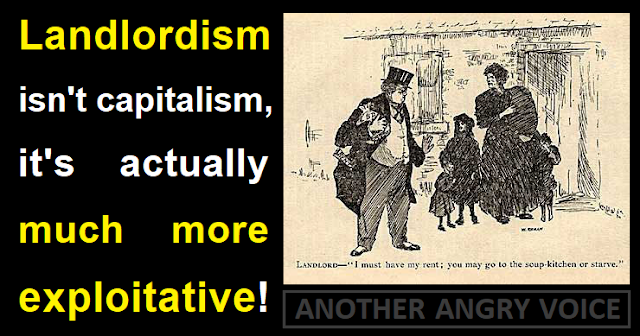
Landlordism is even more exploitative than capitalism!

One of the most commonly-held delusions amongst the property-hoarding class is that being a "landlord" makes them some kind of "capitalist".

It's completely wrong to imagine that landlordism is a sub-branch of capitalism, when it's actually a distinct sphere of economic activity, but it's easy to see how this confusion occurs.

Firstly there's the shockingly widespread misconception that "capitalism" is some kind of synonym for "trade", or "doing business", rather than a specific and defined form of economic organisation involving ownership of the means of production (which it actually is).

Then there's the fact that capitalism and landlordism are both highly exploitative practices that involve profit extraction from other people (employees/tenants), meaning it's easy to mistake one form of living off other people's backs as a version of the other.

The reality of course is that landlordism isn't capitalism, because capitalism is about owning the means of production (materials, facilities, machines) then paying workers below the actual value of their labour in order to extract profit.

I'm no fan of capitalism (to put it mildly) but at least there's some productive output at the end of it!

Landlordism on the other hand creates nothing.

All rentiers do is monopolise existing assets in order to extract unearned profits (whether that's buy-to-let slumlords, or private profiteers monopolising essential services like energy, water, public transport, etc).


Capitalism is a form of parasitism on economically productive activity.

Landlordism is an even purer form of economic parasitism, because it doesn't even produce anything other than unearned profits.

Of course landlords will try to pretend that there is some productive activity involved in landlordism, after all, don't they have to paint and redecorate when old tenants move out?

This is just a con-trick, because if the property was lived in by people who actually owned it, then they'd be much more inclined to invest above the basic bare-minimum, because their motivation is to make their home as comfortable and secure as possible, not to maximise profits by doing things on the cheap, and by cutting corners on long-term maintenance.

It's extremely telling that landlords try to dress up their bare-minimum of investment as some kind of economically productive activity, when it actually represents a reduction in investment on what would probably have occurred had the property never fallen into the hands of economic parasites.

Another common refrain from the idle landlord class is that they're somehow "providing a service" by buying up all the affordable housing, and renting it out to the people they've priced out of the property market!

If rented accommodation is such an essential service, then surely it should be taken under public control, so that it's run for the good of the British economy, and in the best interests of the British people, meaning any profits go back into improving the housing stock, rather than being siphoned off into private pockets?

But the landlordists react in absolute outrage at suggestions the rental market should be nationalised.

How are they expected to survive if they can't idly extract profits merely through ownership of property assets?

How are they expected to survive if they actually have to get a real job, and engage in economically productive activity like the rest of us?

Suddenly the provision of rented accommodation isn't the "important service" they just claimed it was. The only aspect of this "service" they actually attach any real importance to is preservation of the unearned income for themselves!

Of course the landlord class react with hot-headed indignation at those who describe the reality of their grubby, exploitative, unproductive economic parasitism, and desperately try to dismiss this criticism as if it's some kind of radical left-wing conspiracy against noble and honest people like them.

So I'll just leave you with a few quotes about landlordism from people that absolutely nobody in their right mind would ever describe as "leftists":

Winston Churchill
"Roads are made, streets are made, railway services are improved, electric light turns night into day, electric trams glide swiftly to and fro, water is brought from reservoirs a hundred miles off in the mountains - and all the while the landlord sits still. Every one of those improvements is effected by the labour and cost of other people. Many of the most important are effected at the cost of the municipality and of the ratepayers. To not one of those improvements does the land monopolist, as a land monopolist, contribute, and yet by every one of them the value of his land is sensibly enhanced. He renders no service to the community, he contributes nothing to the general welfare; he contributes nothing even to the process from which his own enrichment is derived." [source]

Adam Smith
"As soon as the land of any country has all become private property, the landlords, like all other men, love to reap where they never sowed" [source]

John Stewart Mill
"Only the landowners grow richer, as it were in their sleep without working, risking and economising" [source]

David Ricardo
"The dealings between the landlord and the public are not like dealings in trade, whereby both the seller and buyer may equally be said to gain, but the loss is wholly on one side, and the gain wholly on the other" [source]


 Another Angry Voice  is a "Pay As You Feel" website. Access to my online writing will always remain free. If you see some value in what I do, please consider supporting my work with a small donation/subscription.


OR

Wednesday, 13 October 2021

Who actually owns the UK's water supply?


A significant majority of British people believe that the water supply is so vital that it should be run as a not-for-profit public service, but the Westminster establishment consensus is that in England it should continue to be run as a vast profit extraction scheme operated mainly by foreign governments and overseas corporations.

In this article I'm going to give a basic overview of who actually owns the UK's water supplies.

Scotland, Wales, and Northern Ireland

Scottish Water and Northern Ireland Water are both government owned statutory companies, meaning any profits go straight back into public finances.

Welsh Water is owned by Glas Cymru, which is a not-for-profit company. It has no shareholders, and retains any profits for the benefit of Welsh water customers.

So far so good. Two different models of how water companies can be operated for the benefit of the people, rather than for profit-extraction purposes. 

England

England's water supply is an absolute mess. It's broken up into multiple different regional monopolies, operated by various different private entities.

Research by the University of Grenwich found that privatisation of the water supply in 1989 has cost customers in England £2.3 billion per year more than if it had remained under not-for-profit public ownership.

So who are the owners of the private water companies that are raking in all of this profit at English people's expense?

Anglian Water (£1.4 billion)

Anglian Water supplies 2.6 million homes with water, and compared to a lot of others its ownership structure is fairly simple.

Its parent company is AWG, which a subsidiary of the Osprey Group, which is owned by the following:

Canada Pension Plan Investment Group 32.9% (wholly owned by the Canadian government)
IFM 19.8% (Australian investment fund)
Infinity Investments 16.7% (Wholly owned by the UAE government)
First Sentier 15.6% (Australian investment fund)
Camulodunum Investments 15% (UK investment manager)

So one of England's major water suppliers is 49.6% owned by foreign governments, and 30.6% owned by foreign private investors. Leaving just 15% that's run by a private UK-based investment manager.

Northumbrian Water (£820 million)

Northumbrian water supplies 2.7 million homes with water. Its parent company is NWG, which is wholly owned by the Hong Kong based firm Cheung Kong Infrastructure Holdings.

Cheung Kong Infrastructure Holdings is mainly owned by CK Hutchinson Holdings, which is run by the billionaire Li dynasty. Additionally there are number of other investment funds involved. Some of them are names which will be very familiar by the end of this article.

CK Hutchinson Holdings 72% (Hong Kong investment fund)
Conyers, Dill and Pearman 5% (Bermuda based offshore law firm)
BlackRock 1.1% (US based investment fund)

Other notable shareholders include: Lazard Asset Management (US investment fund), Vanguard Group (US investment fund), Norges Bank (100% Norwegian government owned bank).

United Utilities (£1.86 billion)

What used to be North West Water was merged with the North West Electricity Board to create United Utilities, which supplies water to 7.3 million people. The CEO took home £2.94 million in 2020.

United Utilities is a Public Limited Company (PLC) with a number of institutional shareholders. These are the owners with stakes above 1% (as of October 2021)

BlackRock 8.6%  (US based investment fund)
Lazard Asset Management 7.2% (US investment fund)
Legal and General Investment Management 4.1% (UK investment fund)
Vanguard Group 4.0% (US investment fund)
Norges Bank 2.9% (100% Norwegian government owned bank)
Impax Asset management 2.5% (UK investment fund - biggest shareholder French bank BNP Paribas)
Magellan Asset Management 2.4% (Australian investment fund)
Pictet Asset Management 2.3% (Swiss investment fund)
State Street Global Advisers 2.2% (US investment fund)
M&G Investment Management 2.0% (UK investment fund)
Nuance Investments 2.0% (US investment fund)
Amundi Asset management 1.9% (French investment fund, mainly owned by French bank Crédit Agricole)
Invesco Ltd 1.7% (US investment fund)
Columbia Management Investment Advisers 1.6% (US investment fund - a division of Amerprise, which is based in the US tax haven of Delaware)
Maple-Brown Abbott Limited 1.3% (Australian investment fund)
Ignis Investment Services 1.3% (UK investment fund)
Nordea Investment Management 1.2% (Finnish investment fund)
Aviva Investors Global Services Limited 1.1% (Investment arm of UK insurance group Aviva)
abrdn plc 1.1% (UK investment fund)
Northern Trust Global Investments 1.1% (US investment fund)
HBOS Investment Fund 1.1% (Subsidiary of the UK-based Lloyds banking Group)
UBS Asset Management 1.0% (Investment arm of the giant Swiss bank UBS)

Severn Trent Water (£1.84 billion)

Severn Trent Water supplies 4.5 million households and businesses. Their CEO Liv Garfield took home a whopping £2.807 million despite the company being fined £800,000 for leaking millions of litres of raw sewage into a Shropshire stream in the same year.

It's another Public Limited Company (PLC) with a number of institutional shareholders. These are the owners with stakes above 1% (as of October 2021)

BlackRock 8.1%  (US based investment fund)
Lazard Asset Management 7.4% (US investment fund)
Qatar Investment Authority 4.6% (100% owned by the Qatari government)
Vanguard Group 3.8% (US investment fund)
Legal and General Investment Management 3.6% (UK investment fund)
Aviva Investors Global Services Limited 3.0% (Investment arm of UK insurance group Aviva)
Impax Asset management 2.7% (UK investment fund - biggest shareholder French bank BNP Paribas)
Maple-Brown Abbott Limited 2.5% (Australian investment fund)
State Street Global Advisers 2.3% (US investment fund)
Norges Bank 2.1% (100% Norwegian government owned bank)
Royal London Asset Management Limited 1.7% (UK investment fund)
Amundi Asset management 1.7% (French investment fund, mainly owned by French bank Crédit Agricole)
Invesco Ltd 1.5% (US investment fund)
First Sentier 1.4% (Australian investment fund)
RREEF America LLC 1.3% (US investment fund)
Fidelity International 1.1% (Bermuda-based investment fund)
Janus Henderson Group 1.1% (UK investment fund)

Wessex Water (£550 million)

Wessex Water supplies 1.3 million homes with water.

It's a 100% owned subsidiary of the Malaysian conglomerate YTL Corporation, run by the Malaysian billionaire Yeoh Tiong Lay, and partially owned by the Malaysian government's pension fund.

Southern Water (£830 million)

Southern Water supplies 2.26 million customers. In 2020 they were fined £90 million for dumping untreated sewage into rivers and coastal waters on over 6,900 occasions. In the same year as this record-breaking fine they paid their CEO over £1 million in salary and bonuses.

Southern Water is a Limited Company owned through Greensands Holdings Limited which is based in the tax haven of Jersey, with the following major shareholders.

JP Morgan Asset Management 40% (Investment arm of the US bank JP Morgan)
UBS Asset Management 22% (Investment arm of the giant Swiss bank UBS)
Hermes Investment Management 21% (UK investment fund)
Whitehelm Capital 8% (Australian investment fund)

The Australian investment fund Macquairie has recently bought up a £1 billion stake in Southern Water. They're most famous for asset stripping Thames Water, paying virtually no corporation tax, lavishing £billions in dividends on its shareholders, lumbering it with huge debts, and flogging it off just months before it was prosecuted by the Environment Agency for pollution.

Thames Water (£2.05 billion)

Thames Water supplies 15 million customers, which accounts for 27% of the UK population. They were fined  £2.3 million in March 2021 for pollution, hit with another pollution fine of £4 million in May 2021, and paid an £11 million fine for overcharging customers in July 2021.

Britain's biggest water company is also its most opaquely structured, with strings of similarly named subsidiaries and shell companies falling under the ultimate ownership of Kemble Water Holdings Limited, which is apparently based on a Reading industrial estate.

It's pretty tricky to track down the owners of this £2 billion company, but they include the following major investors:

Church Water Investments Limited 13.9% (CWIL is owned by L3 Investment Holdings, which is owned by L3 Investment Holdco Ltd, which is owned by the UK-based Universities Superannuation Fund - Why they need such an opaque structure to hide their investment in privatised water infrastructure is anybody's guess)
Omers Farmoor Holdings 12.6% (Dutch investment fund)
Infinity Investments 12.6% (Wholly owned by the UAE government)
Wren House Infrastructure Investments 11.1% (A front company for the government of Kuwait)
Trustees of the BT Pension scheme 11.0% (Pension fund of UK telecoms giant BT)
Cicero Investment Corp 11.0% (US-based private equity fund)
QIC Infrastructure Management 6.8% (Australian government-owned investment fund)
Aquila Sonnet Limited Partnership 6.3% (A single purpose investment vehicle, designed to obscure the identities of the six investors)

South West Water (£500 million)

South West Water supplies 1.7 million customers. It's a wholly-owned subsidiary of Pennon Group, which announced pre-tax profits of £157 million in 2021, and they're sitting on cash reserves of over £3 billion. Instead of using this cash mountain to make improvements and stop repeatedly dumping raw sewage into waterways, they're using it to buy up other water companies like Bristol Water.

The CEO of Pennon Group Susan Davy took home £1.724 million in 2020.

These are the main shareholders in Pennon Group (as of October 2021):

Lazard Asset Management 10.0% (US investment fund)
Impax Asset management 5.8% (UK investment fund - biggest shareholder French bank BNP Paribas)
BlackRock 5.2%  (US based investment fund)
Vanguard Group 4.3% (US investment fund)
Norges Bank 4.1% (100% Norwegian government owned bank)
Pictet Asset Management 3.9% (Swiss investment fund)
Legal and General Investment Management 3.1% (UK investment fund)
Amundi Asset management 2.9% (French investment fund, mainly owned by French bank Crédit Agricole)
Invesco Ltd 2.1% (US investment fund)
Royal London Asset Management Limited 2.0% (UK investment fund)
Fidelity International 2.0% (Bermuda-based investment fund)
Columbia Management Investment Advisers 1.7% (US investment fund - a division of Amerprise, which is based in the US tax haven of Delaware)
Aviva Investors Global Services Limited 1.5% (Investment arm of UK insurance group Aviva)
Charles Stanley & Co. Ltd 1.3% (UK investment fund)
HSBC Global Asset Management 1.0% (Investment arm of the British bank HSBC)

Yorkshire Water (£980 million)

Yorkshire Water supplies 4.5 million people and over 100,000 businesses. It's another one with an extremely opaque ownership structure.

Yorkshire Water is run as a wholly-owned subsidiary of Kelda Group. Kelda Group is made up of an intricate network of companies, which includes Kelda Eurobond (which makes vast losses meaning it has to pay no taxes in the UK), before you finally end up at the overall parent company Kelda Holdings, which is based in the tax haven of Jersey.

Kelda Holdings is owned by the following (as of October 2020):

GIC 33.6% (The sovereign wealth fund of the Singapore government)
Gateway HK Water (I and II) + Gateway Infrastructure 30.3% (Three recently formed Hong Kong based private companies, very difficult to find who the ultimate owners are)
Wharfedale Hong Kong Limited 23.4% (Another recently formed Hong Kong based private company)
SAS Trustee Corporation 12.8% (Australian state-owned pension fund)

Conclusion

The people of Scotland, Wales, and Northern Ireland benefit from not-for-profit public ownership.

The water supply of England is used for profit extraction purposes by the following:

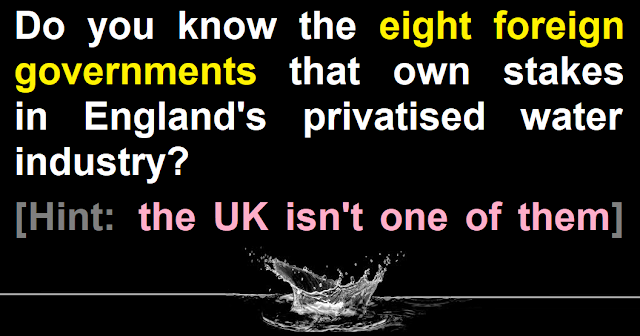
Governments: Australia, Canada, Kuwait, Norway, Malaysia, Qatar, Singapore, UAE

Private companies based in: Australia, Bermuda, Finland, France, Hong Kong, Jersey, Malaysia, Netherlands, Switzerland, UK, US

You'd have to be beyond delusional to think that this chaotic and opaque system of ownership makes any kind of rational sense for English water consumers.

The only reason it would be arranged like this is in order for private companies and foreign governments to extract as much profit as possible out of England's water customers.

How on earth is it justifiable that the governments of eight other nations can hold direct stakes in England's water supply, while the UK government itself insists that it's unfit and improper for the nation to own and run its own water supply?

What kind of person believes other governments are fit to run England's water supply, but their own government isn't?

 Another Angry Voice  is a "Pay As You Feel" website. Access to my online writing will always remain free. If you see some value in what I do, please consider supporting my work with a small donation/subscription.


OR

Tuesday, 28 September 2021

Another 'stunning success' for the Tory rail privatisation agenda


The hated Southeastern rail franchise has finally been cancelled after the private operators were caught stealing £25 million in public funds since 2014.

Despite a long track record of delays, cancelled services, appalling working conditions, strikes, and lamentable customer service, this woeful franchise had been repeatedly extended by the Tory government since 2014, but the axe has finally fallen to the relief of passengers across the south east.

It turns out the private profiteers were running the services so inefficiently that the only way they could even spin a profit was to embezzle public cash!

And similar to the failure of all the other private rail franchises over the years, the public sector is going to have to step in at the last minute to take over operations.

The most absurd example being the way private operators have abandoned the flagship north east mainline franchise three times, with the public sector taking over at the last minute each time, running the service better, and gradually returning profits to the public finances, only for the Tories to hand it over to another bunch of profiteers who cut and run again, as soon as it becomes unprofitable to them.

This endless cycle of private operators extracting the profits, and public cash being used to clear up their mess is entirely consistent with the Tory ideology of "privatise the profits, nationalise the losses".

As a result of this spectacularly failed rail privatisation agenda, not only does the rail network cost more in subsidies to private franchises than it did to run the entire rail network when it was privatised in 1994, the government has built up a secret £50 billion+ black hole of rail debt from renting the track out to these profiteers at miles below the actual cost of maintaining them.
 
An overwhelming majority of the public want to see the rail network renationalised, and run as an integrated not-for-profit public service.

Yet the Tories persist with this shambolic mess of private profiteers extracting profits, then offloading operations onto the public whenever the profitability dries up.

Labour should be absolutely hammering the Tories over this, not just on the principle that rail privatisation has proven to be an absolute disaster, but for the sheer incompetence of allowing a private rail operator to steal £25 million from under their noses.

But unfortunately Keir Starmer is too busy waging internal factional war against his own party to care about establishing a critical narrative, and his shadow finance minister Rachel Reeves has only just been pledging her undying loyalty to the interests of capitalist profiteers, by swearing she'll ignore economic common sense, and the will of the British people, when it comes to the need to renationalise vital national infrastructure.

And to make matters worse the Tory Transport minister Michael Green Grant Shapps is seeking to protect the shambolic rail privatisation agenda by hiding it behind a fake renationalisation, whereby private operators keep extracting their publicly subsidised profits, but under a unified brand of "Great British Railways".


 Another Angry Voice  is a "Pay As You Feel" website. Access to my online writing will always remain free. If you see some value in what I do, please consider supporting my work with a small donation/subscription.


OR

Sunday, 8 December 2019

Sources for "We can't afford not to" infographic


OK, here is some source material on the infographic, so you can know for sure that I'm not just making it up.

Source one: Railways

Here's the original source: New chief's challenge to get Railtrack back on track - Financial Times

Here's my article explaining more about what this means: Tory rail privatisation and the £50 billion black hole of debt.

It's also worth considering that despite this hidden debt-hiding subsidy, the private franchises also receive more in subsidies per year than the annual cost of running the entire British Rail network, tracks and all, before privatisation in 1994!

Source two: Broadband
Ironically the CEBR report into the economic benefit of super-fast broadband was commissioned by the private company that's done such a lamentable job of rolling it out so far (BT Broadband). The UK has below 10% access, while advanced economies like South Korea and Japan are up to 98% and 97% already.

Source: British Broadband

Source three: Royal Mail

Here's the Daily Mail article explaining this extraordinary Royal Mail property portfolio under-valuation: Royal Mail 565% mark up on land sales

Here's my article: The Royal Mail property privatisation scam is really paying off (at the public expense)

Source four: Water companies

You can read the damning University of Grenwich report into water privatisation here: Privatised water: a system in need of repair


 Another Angry Voice  is a "Pay As You Feel" website. You can have access to all of my work for free, or you can choose to make a small donation to help me keep writing. The choice is entirely yours.


OR