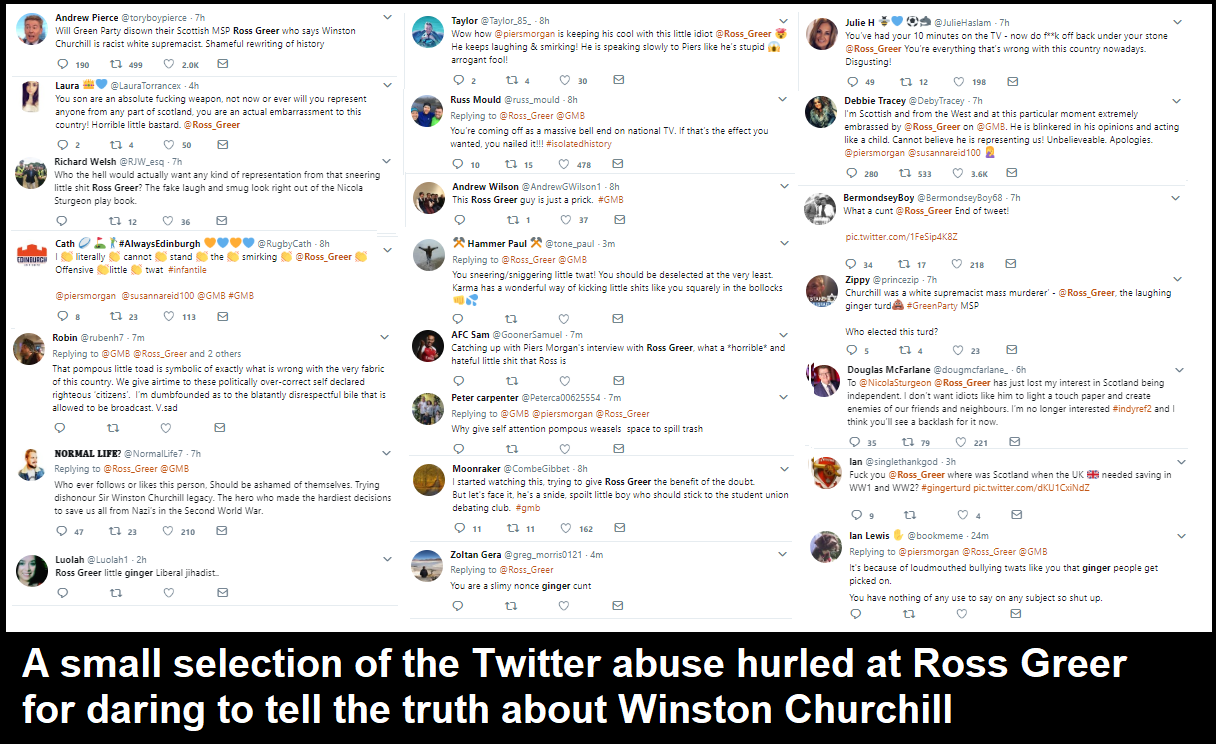
Who is Ross Greer?
Well according to Twitter he's a "laughing ginger turd", a "horrible little bastard", an "arrogant fool", a "pompous little toad", a "smirking offensive little twat", an "absolute fucking weapon", a "sneering sniggering little twat", a "horrible and hateful little shit", "a silly ginger cunt", a "little idiot", a "snide spoilt little boy", an "ugly ginger little snowflake cunt", a "little liberal ginger jihadist", a "pompous weasel", a " stupid little dumb shit ginger", a "massive bell end", a "disrespectful ginger mutant", "the reason ginger people get picked on", a "slimy nonce ginger cunt", "just a prick", and "everything that's wrong with this country these days"!
Blimey you might think. He must have done something pretty bloody bad to trigger such a massive outpouring of hate.
But you'd be wrong. All Ross Greer tried to do was to provide a bit of historical perspective on the legacies of Winston Churchill by talking about issues like Churchill's contempt for the working classes and his role in the Bengal famine.
However the problem with attempting to use facts and evidence to critique prevailing narratives like the lionisation of Churchill is that in modern Britain an awful lot of people get extremely angry and offended when confronted with facts that they don't like.
Of course Churchill deserves credit for getting some things right. When the Tory party and almost the entire British establishment class became utterly fixated by the lure of fascism in the 1930s Churchill was one of the few amongst them who defied this shocking trend because he rightly saw fascism as the danger it was.
And once he became Prime Minister Churchill recognised the crucial strategic importance of bringing both Russia and the United States into the war on Britain's side.
A more ideologically driven anti-communist (of which there were very many in the British establishment at the time) could have simply watched Russia fall under Nazi control rather than actively supporting the Soviet Union with the Arctic Convoys in order to keep Hitler's forces divided and fighting on multiple fronts as Churchill did.
Churchill was a sadistic Tory. He set the British army on striking workers in Scotland and south Wales, he had racist views on imperialist conquest, he was utterly indifferent to the starvation of millions of people in Bengal to the point of joking about why Gandhi hadn't died in it, he sent the black and tans to Ireland, before the war he'd been a supporter of poison gas and concentration camps, and after the war his government brutally repressed the Mau Mau rebellion in Kenya through collective punishment, torture and castration.
But on the other hand when fascism was so trendy that his Tory colleagues were signing up in droves to anti-Semitic groups like the Right Club, and the royal family were indoctrinating the young Elizabeth to give Nazi salutes in their palace gardens, Churchill was one of the few amongst his peers to buck that horrifying trend.
The man was an enigma who is understandably glorified by many as a great war leader, but equally understandably detested by others because of his brutality and sadism.
And as Churchill himself once said "The truth is incontrovertible. Malice may attack it, ignorance may deride it, but in the end, there it is".
But by telling the truth about some of Churchill's darker legacies on national television, the relatively obscure MSP Ross Greer has triggered an absolute tsunami of hatred and abuse from people who are offended by his facts.
Just look at Piers Morgan's conduct during the interview.
Instead of following a reasonably impartial line of questioning Morgan worked himself up into such a fit of rage that he couldn't even listen to the words that Greer was saying.
And this extraordinary adult tantrum was performed by a man who routinely denounces people on the left as being over-sensitive "snowflakes" who get offended by reality!
Suzanna Reid's behaviour was perhaps even more extraordinary than Morgan's when she brazenly straw-manned Greer's argument by plucking a comparison with Hitler out of thin air, and then described Greer's facts as "offensive".
It's not our TV presenters' role to invite people on their shows just to shout them down, lie about their argument, and dismiss their facts as "offensive". That's more of a circus than anything resembling informed debate.
And if our television presenters behave in this extraordinary manner, is it any wonder that members of the public also get so offended by facts that they don't like that they take to Twitter to hurl torrents of personal abuse at the deliverer of said facts?
Amongst the torrents of witless abuse one criticism of Ross Greer was particularly telling. After telling Ross to "fuck off" one of the triggered snowflakes claimed that Greer is "everything that's wrong with this country nowadays".
In reality the real problem with this country is glaringly obvious.
The problem is that there are huge numbers of people out there who get unbelievably angry at facts they don't like, who spew torrents of hate at anyone who dares talk about the facts they don't like, and who vote for dumb shit like giving the Tory party the green light to conduct a "make it up as we go along" Brexit farce because they absolutely refuse to listen to the facts that they don't like.
The problem with modern Britain isn't that Churchill was a racist and sadistic imperialist, because that's now history.
Neither is the problem that some people want to introduce a tiny bit of historical balance by highlighting the fact that as well as being the war leader who led Britain in the fight against Nazism, Churchill was also a racist and sadistic imperialist, because that's simply the truth.

The problem is that we're becoming a nation full of emotionally unstable and over-opinionated adult toddlers who feel entitled to publicly abuse anyone who offends them with facts they don't like.
And the torrents of abuse aimed at Ross Greer suggests that this over-sensitive snowflakery isn't actually a left-wing thing either, coming mainly from right-wingers and ultranationalists.
Maybe this lot actually want to live in a country where it's considered normal behaviour for people to online bully a person to the extent of furiously smearing him as a paedophile, simply because they find his facts offensive?
But the damage these tantrum-throwing adult-toddlers are doing to the standard of political discourse, and to the nation as a whole, is pretty damned obvious to the rest of us.
Another Angry Voice is a "Pay As You Feel" website. You can have access to all of my work for free, or you can choose to make a small donation to help me keep writing. The choice is entirely yours.
When the Scottish parliament debated the despicable Tory rape clause the Scottish Tory leader Ruth Davidson advised the UK public to vote against the Tories if they find the rape clause abhorrent.
To get an idea of how abhorrent the Tory rape clause is, consider the fact that it even managed to unite the Scottish Labour Party and the SNP in opposition to it (getting Scottish Labour to agree with the SNP on anything is no mean feat). The Scottish Greens and the Lib-Dems also strongly opposed it.
During the debate the Scottish First Minister Nicola Sturgeon said "no woman anywhere should have to prove she's been raped in order to get tax credits for their child. I can't believe in 2017 that I'm having to stand up in the Scottish Parliament and make that argument".
The Scottish Labour leader Kezia Dugdale called the rape clause "an absolutely sickening state of affairs" and quoted from an email from a rape victim in her condemnation of the policy.
The Lib-Dem MSP Alex Cole-Hamilton said that the policy of compelling women to provide evidence that they have been raped in order to obtain Tax Credits for their children "has no place in a civilised society".
The Green MSP Ross Greer said that "when you cut through the tank-riding, bagpipe-playing bravado, Ruth Davidson is just another cruel member of a cruel party".
The whole idea of limiting Tax Credits is abhorrent in itself, especially given the severe wage repression that UK workers have suffered since the Tories came to power in 2010. The majority families receiving tax credits these days are working families, not the unemployed.
The Tory welfare cuts that the abhorrent rape clause relates to will end up driving another 250,000 UK kids into poverty, and that's on top of the 400,000 extra kids growing up in poverty since 2010.
When the issue was voted on the only MSPs to vote against the motion to condemn the rape clause were the Tories. All of the other parties voted in favour. The motion to condemn the rape clause was passed by 91 votes to 31.
During her evasive defence of the rape clause policy (in which she evaded using the word rape) the Scottish Tory leader said that "if people across the UK do not support it, then there is an option on June the 8th to ask someone else to have a go".
In other words, if you find the rape clause abhorrent, you should vote against the Tories.
So take it from Ruth Davidson. If you have a shred of human decency, then make sure to vote against the Tories on June 8th no matter where you live.
Another Angry Voice is a "Pay As You Feel" website. You can have access to all of my work for free, or you can choose to make a small donation to help me keep writing. The choice is entirely yours.
A look at the facts makes the case for a second Scottish independence referendum seem irrefutable. The only debate being over what form this second referendum will take.
During the 2014 referendum debate the Unionist No campaign fearmongered that voting Yes would cause Scotland to lose their place in the European Union.

"What is the process for removing our EU citizenship? Voting yes" the Tory funded unionist campaign shrieked, yet now Scotland is being dragged out of the European Union against the will of their electorate who voted 62% - 38% in favour of Remain.
Nobody can argue that there hasn't been a dramatic change in material conditions since the last referendum, and nobody can argue that the unionist campaign fearmongering was justifiable given that the consequence of Scotland voting No delivered the exact consequence they attributed to a Yes vote.
Anyone arguing that there shouldn't be a second referendum in light of the dramatically changed circumstances and the outrageous campaign lies last time around, is basically saying that they don't want another referendum because this time they know full well their side is going to lose.
The Tory perspective

The Tories know that they lied through their teeth in order to secure victory in the 2014 independence referendum, and that it doesn't matter how much the biased mainstream media media back them in a second referendum, only the most fanatical of unionists and fearty of pensioners would believe their propaganda second time around.
The open contempt of the Tories towards Scotland couldn't be clearer. They voted down all the Article 50 amendments, including the one to ensure that the Scottish parliament is consulted on Brexit.
Theresa May wants the Brexit process to be conducted solely by English Tories, and the English right-wing press are baying with delight at the total sidelining of Scotland and Scottish interests.
It's such an ugly and shambolic mess that they know they can't possibly win second time around, which is why Theresa May and the Tories will likely do everything in their power to try to stop a second independence referendum from actually happening.
The SNP perspective
The SNP and the pro-independence Scottish Greens have a majority in the Scottish parliament. Together they could pass legislation for a second referendum and force the Westminster Tories into a lose-lose situation.
Either the Tories would allow another official independence referendum, which they'd likely lose given their open contempt towards Scotland and the ongoing Brexit shambles they created, or they try to deny the Scottish public a second referendum which would be a total PR disaster for them. The Scottish government could simply run their own referendum as an "advisory referendum" (like the Brexit vote) and then endlessly claim "will of the people" when they win.
If the Tories try to stop the Scottish government from holding an advisory referendum they'd definitely lose it. English Tories are trying to silence Scotland - Vote Yes. There's absolutely no way the even the Tory propaganda machine could compete with that, especially since all of their efforts to delegitimise the unofficial referendum would end up significantly lowering the turnout amongst Tory/UKIP voters and the rest of the unionists.
The Labour/Lib-Dem perspective
Labour are dying in Scotland. The 2015 wipeout where they lost 40 of their 41 Scottish seats in the Westminster parliament was the most comprehensive and most humiliating electoral capitulation I've ever seen in my life.
From being the most powerful party in Scotland for generations Labour have slumped to third behind the Tories! If there were an election tomorrow 15% of the vote would be a miracle for Scottish Labour, and the downwards trajectory doesn't even seem to be slowing down.
The Lib-Dems are dying in Scotland too. Propping up David Cameron's government for five years and then french kissing the Tories during the Independence referendum was plenty enough to chase well over half of their voters away. They lost 10 of their 11 Scottish seats at Westminster and they're now the 5th party in the Scottish parliament behind the Greens.
In my view there's only one way Labour and the Lib-Dems can save themselves now. They have to push as hard as they can for a third "Devo Max" option on the ballot to make it a three way choice to be ranked in order of preference.
- Full Independence (supported by SNP and the Scottish Greens)
- Devo Max (supported by Labour, Lib-Dem)
- Do what you're told by England (supported by Tory, UKIP)
Even if the final result is full independence rather than Devo Max, Labour and the Lib-Dems could avoid the severe reputation damage of associating themselves with English Westminster Tories, UKIP, Unionist sectarians, Britain First and the like.
Even this strategy is fraught with risks, but one thing's for sure; if Labour and the Lib-Dems display the same abject strategic ineptitude of passionately embracing full-on Tory unionism again, they'll be well and truly finished, so Devo Max (enough freedom from Westminster for Scotland to stay in the Single Market while England leaves perhaps?) is just about the best hope they've got.
The Yorkshireman's perspective
I supported Scottish independence the last time around, and I'll likely support it again, although if Labour and the Lib-Dems get Devo Max onto the ballot paper I'd certainly give it fair consideration before making up my mind completely.
As far as I'm concerned Scotland are getting totally shafted by a corrupt, self-serving and astoundingly dishonest bunch of right-wing Westminster elitists, and it's sickening the way the right-wing little Englander propaganda rags are actually gloating and sneering about it.
If the Scottish people stand up and say "we're not taking this any more" I'll support them because it's better to at least see some of us set free from the suffocating Tory stranglehold than none of us at all.
Another Angry Voice is a "Pay As You Feel" website. You can have access to all of my work for free, or you can choose to make a small donation to help me keep writing. The choice is entirely yours.
The idea of Land Value Tax (LVT) Land Value Taxation is a method of raising public revenue by means of charges on the value of land. LVT is widely regarded as a very efficient form of taxation, not least because it's pretty much impossible to avoid/evade.
Land monopolists
Throughout history one of the most commonly proposed solutions to the problem of land monopolists is forced redistribution, where the land is simply taken by force and redistributed to the community, but LVT advocates take a different approach. They propose that that wealthy landowners who monopolise land shouldn't have their land taken by force, but that they should pay a tax to the community.
LVT would act as an incentive for them to either put the land to productive use in order to cover the cost of the tax, or to transfer ownership of the land to someone else who would put the land to better use.
Advocates
The idea of taxing the value of land has been around for thousands of years. The Apastamba Dharmasutra is one of the oldest Hindu documents in existence and in its section on property and taxes it states that "If any person holding land does not exert himself and hence bears no produce, he shall, if rich, be made to pay what ought to have been produced", which is an expression of the view that tax should be applied to the potential value of the land, not to the actual produce of the land.
The most famous LVT advocate was the 19th Century American economic philosopher Henry George. George was clearly influenced by the likes of Jean-Jacques Rousseau who decried the inequalities caused by land monopolisation in the 18th Century:
"The first man who, having fenced in a piece of land, said 'This is mine' and found people naïve enough to believe him, that man was the true founder of civil society. From how many crimes, wars, and murders, from how many horrors and misfortunes might not any one have saved mankind, by pulling up the stakes, or filling up the ditch, and crying to his fellows: 'Beware of listening to this impostor; you are undone if you once forget that the fruits of the earth belong to us all, and the earth itself to nobody'." Rousseau
Other early LVT advocates include the physiocrats (most notably Anne Robert Jacques Turgot and François Quesnay) the British economists Adam Smith (probably the second most egregiously misrepresented economist in history behind Karl Marx) and David Ricardo and the British-born US revolutionary Thomas Paine.
Modern advocates come from across the political spectrum. The Green Party have been long-term LVT advocates, the Corbyn-McDonnell Labour leadership are much more open to the prospect than any Labour leadership in decades. On the right, the free-market fanatic Milton Friedman advocated LVT saying "There's a sense in which all taxes are antagonistic to free enterprise – and yet we need taxes. ...So the question is, which are the least bad taxes? In my opinion the least bad tax is the property tax on the unimproved value of land".
Benefits
There are many potential benefits to Land Value Tax. It would discourage rentierism and land speculation, improve land use, raise wages and eliminate the need for taxes on productive activity. One of the biggest benefits of all is that it's a tax that would be almost impossible to avoid/evade because it's simply not possible to move vast tracts of land to tax havens like the British Cayman Islands.
The economist Fred Foldvary states that LVT encourages landowners to develop vacant/underused land or to sell it, and that it deters speculative land holding, dilapidated inner city areas return to productive use, reducing the pressure to build on undeveloped sites and so reducing urban sprawl.
One of the main benefits of LVT is that it would allow taxes on productive activity to be reduced or abolished. The idea of using a land tax to reduce or eliminate income and consumption taxes would clearly be to the benefit of millions of working people who own little or no land, but the wealthy landowner class obviously wouldn't like the idea at all.LVT is rightly regarded as one of the most efficient taxes imaginable because it doesn't deter productive activities by taxing them and because it would be almost impossible to avoid.
A fairer system
A tax system that targets the asset-rich rather than the hard-working, and that is pretty much impossible to avoid/evade would clearly reduce inequality and improve social mobility. People who work hard would be able to keep more of their income, while those who generate their wealth by idly monopolising land would have to pay tax to the rest of society for the privilege.
The current system of imposing taxes on income and consumption instead of land value clearly benefits those who derive most of their wealth from property and rent, and who have the financial means to pay tax advisers to hide their incomes in tax-havens.
Just look at the way the Grosvenor dynasty managed to avoid paying £3.6 billion in Inheritance Tax through the use of trust funds so that the young Hugh Richard Louis Grosvenor could inherit a £9 billion property empire from his father.
Society is set up in a way in which the poor and ordinary have to pay taxes on their income, and tax on their consumption, and another load of tax if they're lucky enough to inherit some wealth, meanwhile the tiny super-rich minority repeatedly sidestep paying their share of tax.LVT would massively reduce the iniquity of the tax system. If you own land, you pay tax on it. It doesn't matter whether the landowners register themselves as a company in a tax haven or not; it doesn't matter if the land is owned through an elaborate network of off-shore trust funds; if they own land in the UK they need to cough up the tax. If they don't pay the tax, the land can be incrementally taken in lieu of payment and redistributed to people who will bother to pay the tax.
Resistance of the land-rich
Given the incredible power of the inherited wealth aristocracy in the UK, the prospects of a fair land tax system being introduced here look very slim indeed.
The British political class is absolutely riddled with landowning aristocrats, especially the ruling Tory Party and the unelected House of Lords. The prospect of a Tory government introducing LVT is absolutely laughable (Tory MPs have twice wrecked Labour Party efforts to introduce LVT, once in 1931 and again in 1951).
The prospect of getting LVT through the House of Lords is not quite as ludicrously unlikely as the Tories introducing LVT, but Britain's bloated and unelected upper chamber is utterly riddled with wealthy landowners who would obviously be inclined to protect their own self-interest by fighting tooth and nail to scupper any proposed LVT legislation.
There are clearly a great number of unelected Lords who would prefer to see the burden of taxation put onto workers and productive businesses instead of onto their property empires.
The mainstream media is also heavily dominated by billionaire tax-dodgers with vast property portfolios. Any politician proposing LVT would have to expect a vicious propaganda war to be waged against them by the likes of Jonathan Harmsworth (Daily Mail, Metro), the Barclay Brothers (Telegraph, Spectator) and Richard Desmond (Express, Star).
Landowner subsidies
The introduction of a Land Value Tax would have loads of social and economic benefits, but it has been fiercely resisted by the powerful landowner class because they know that they'd be unable to avoid paying it. In fact the privileged European landowner class have resisted Land Value Tax so successfully that they've actually managed to establish for themselves a system of taxpayer funded Landowner subsidies!
In the past farmers received subsidies for their produce, which is problematic in its own way, but kind of makes sense. Nowadays there is no necessity for them to actually produce anything at all, the EU pays out vast subsidies to landowners simply for owning the land.
The UK electorate has voted to leave the EU, but thanks to the extraordinarily reckless lack of a government contingency plan for Brexit and the interminable foot-dragging over Article 50 we're still in it.
When the Tory government does eventually get around to developing an actual plan of action and then leaving, they've already made it clear that the taxpayer funded handouts to landowners are going to continue if not increase. It would be crazy to expect anything different from a political party that counts inherited wealth aristocrats and farmers as two of its most loyal demographics.
Instead of having a fair tax system based on taxing wealth, we've got a system based on taxing consumption and labour in order to actually hand out subsidies to idle land monopolists!
Henry George's Land Value Tax is a great idea because it taxes the super-rich on wealth that they simply cannot hide, but the European landowner class are so powerful that they've not only successfully resisted Land Value Tax, they've actually had politicians devise a polar opposite system to further entrench their privilege by diverting the money raised from taxes on consumption and labour into lucrative subsidies to be showered on wealthy landowners whether they put their land to productive use or not!
LVT and Basic income
The concepts of Land Value Tax and Basic Income often go together. In 1797 Thomas Paine wrote that every person should be entitled to a basic subsistence income funded by a tax on land "as a compensation in part for the loss of his or her natural inheritance by the introduction of the system of landed property".
The majority of modern-day Basic Income advocates suggest that it should be funded through some form of Land Value tax.
If you want to know more about Basic Income check out the following articles:
Progressive politics
Any political party with a genuine interest in the development of a fair and efficient tax system should at least consider the benefits of LVT.
The benefits would go much further than just making sure that the wealthiest in society actually pay tax, it would also significantly reduce the problem of land speculators hoarding land and inflating property prices, and it would drive the economy by encouraging people to put land to good use, and by removing taxes on genuinely productive activities.
The first step towards a fairer system is the abolition of the ludicrous system of taxpayer funded subsidies for land monopolists, and the second step it to set about reducing taxes on productive activities and their replacement with LVT.
As far as I'm concerned, any political party that supports landowner subsidies and rules out LVT cannot possibly be considered progressive. If any political organisation insists that it is the responsibility of the landless to subsidise the land monopolists, rather than the responsibility of landowners to compensate society for monopolising the land, there's absolutely no way they can be considered progressive.
Another Angry Voice is a "Pay As You Feel" website. You can have access to all of my work for free, or you can choose to make a small donation to help me keep writing. The choice is entirely yours.
The result of the Scottish Parliamentary election was a clear victory for the SNP, who will form their third consecutive government. The Scottish Green Party did very well to significantly increase their representation, including the election of the land reform campaigner Andy Wightman and Scotland's youngest ever MSP Ross Greer.
The Liberal Democrats managed to avoid even more losses, but the biggest story was the collapse in the Labour Party vote from 2011, and the significant increase in the Tory vote. Apparently the 2016 Scottish Parliament election is the first non-EU election since the 1930s in which the Tories have won more Scottish seats than Labour.
Even before the first results were announced bitter Blairite politicians like the former Dunfirmline and West Fife MP Thomas Docherty were chelping from the sidelines that Labour's catastrophic results in Scotland were all the fault of Jeremy Corbyn.
It's absolutely staggering to see someone like Thomas Docherty trying to blame Labour's Scottish Parliament collapse on Jeremy Corbyn when he knows perfectly well that the damage was done during Ed Miliband's leadership. Can he really have forgotten that he was one of the 40 Scottish Labour MPs to lose their Westminster seats during the 2015 General Election massacre?
Can Docherty really have forgotten that this catastrophic performance (the worst collapse in British electoral history) came about as a result of Ed Miliband's strategically inept decision to push Ed Balls' ludicrous "austerity-lite" agenda in Scotland (which allowed the SNP to gleefully present themselves as the only alternative to Tory austerity). Such an inept campaign strategy would have been bad enough in isolation, but after Labour spent a couple of years publicly French-kissing the Tories during the independence debate, it was positively suicidal.
Expecting Jeremy Corbyn to be able to instantly undo damage like that would be wishful enough, but when he's lumbered with an extremely limited Scottish Labour leader like Kezia Dugdale, expecting any kind of phoenix-like Scottish Labour recovery isn't just wishful thinking, it's downright delusional.
The SNP winning a third term and the election of several more Green MSPs are definite positives from the 2016 Scottish Parliament election, but the strong performance of the Tories in Scotland really is concerning. Back in 2015 the English electorate punished the Lib-Dems for propping up David Cameron's malicious and incompetent government by ...err ... replacing most of the Lib-Dem MPs with Tory ones! This time around it's the Scottish electorate punishing Labour for the way they cosied up to the Tories during the independence referendum and parroted Tory economic policy during the 2015 General Election campaign by ... err ... allowing the Tories to overtake Labour and become the official opposition in the Scottish parliament!
Anyone who was expecting Jeremy Corbyn to somehow find a magical fix to repair the collapse in Labour support in Scotland must be delusional, but then it's pretty obvious that the bitter Blairites knew perfectly well that a miraculous recovery in Scotland would have been completely impossible, no matter who was in charge, but they simply can't resist attacking Jeremy Corbyn and trying to prescribe the centre-right Blairite snake oil that destroyed Scottish Labour as the miracle cure to save Scottish Labour.
Another Angry Voice is a "Pay As You Feel" website. You can have access to all of my work for free, or you can choose to make a small donation to help me keep writing. The choice is entirely yours.

During the 2015 General Election campaign Scotland was awash with infographics advising the Scottish electorate to vote SNP in 2015, and SNP/Green/SSP in 2016. Unsurprisingly after their landslide triumph at the General Election this message of pro-independence solidarity has morphed into a "both votes for the SNP" campaign in 2016, with staggering levels of vitriol being spat by a vocal minority of SNP supporters at anyone who suggests that "list" votes might actually be better used in support of other pro-independence parties such as the Scottish Greens.
It is beyond doubt that the SNP are going to win a majority in the Scottish parliament, the only question is how big their majority is going to be. The SNP leader Nicola Sturgeon is the most popular living person in Scotland, and the SNP administration in Holyrood has been the most trusted government in the whole of Europe. The majority of polls predict that the SNP will win almost every constituency seat in Scotland, leaving the other parties to scrabble around for the regional "list" seats that top up the Scottish parliament to make it a a much more proportionally balanced chamber than the staggeringly unrepresentative House of Commons.
"List" seats
The way the proportional "list" seats are calculated means that if the SNP win the huge majority of constituency seats they are predicted to, they are going to lose an awful lot of their "list" seats. The largely pro-SNP Wings Over Scotland site predicts that as a result of the SNP looking set to win so many constituency seats they will likely lose some 11 of their 16 list seats. The SNP will still have enough MSPs to form a majority government, but significantly more of their MSPs will have constituency seats and fewer will be list MSPs.
The Wings Over Scotland analysis shows that in most of the Scottish regions the SNP will win zero "list" seats despite taking vast numbers of "list" votes. This happens because the number of list votes is divided by the number of seats already won plus one, so in a region like Mid Scotland and Fife where the SNP look likely to win all nine constituency MSPs, their list vote will be divided by 10. This means that a list vote for any other party would carry ten times as much weight as a list vote for the SNP.
The Wings Over Scotland analysis shows that the vast majority of constituency seats will go to the SNP, while the "list" seats look set to be split between Labour, the Tories and the Scottish Greens.
Constituency seats
SNP 69 (+16)
Lib-Dem 2 (=)
Conservative 2 (-1)
Labour 0 (-15)
Green 0
"List" seats
Labour 24 (+2)
Conservative 17 (+5)
Green 9 (+7)
SNP 5 (-11)
Lib-Dem 1 (-2)
Independent 0 (-1)
It is of course impossible to predict with any certainty whether such a huge SNP landslide victory in the constituency seats will happen, or whether Labour, the Lib-Dems and the Tories will unexpectedly scrape a few extra constituency seats. However what is certain is that "list" votes for the Green Party are far more likely to return additional pro-independence MSPs than "list" votes for the SNP.
A Pro-Independence parliament
Given that it is inevitable that the SNP are going to lose a lot of their list seats as a result of winning even more handsomely in the constituency seats, it makes sense for pro-Independence voters to lend their "list" vote to the Scottish Greens in order to prevent as many "list" seats as possible from being soaked up by the anti-Independence parties.
It's beyond doubt that the SNP will form the next Scottish government, but the balance of pro-independence and anti-independence MSPs is still at play. An SNP majority plus ten Green MSPs would have a much stronger pro-independence platform than an SNP majority plus two Green MSPs.
Limited opposition
Whatever happens in the Scottish elections, opposition to the SNP is going to be limited and divided.
Scottish Labour are in an absolute mess, and look likely to lose all, or almost all of their constituency MSPs. They really should have learned that cosying up to the Tory party during the independence referendum was a catastrophic mistake, and that the Scottish electorate are completely sick of centre-right Blairism, however somehow they saw fit to elect Kezia Dugdale as their leader, making a Labour resurgence in Scotland look about as likely as Irn Bru suddenly becoming the national drink of England.
The Lib-Dems used to do pretty well in Scotland, but they've screwed themselves even worse than Labour with their double dose of collusion with the Tories. Not only did the Lib-Dems cosy up to the Tories in the Independence debate, they also spent five years propping up David Cameron's malicious Westminster regime. If the Lib-Dems somehow manage to hang onto the five Scottish parliament seats they have it'll be a massive triumph for them.
One of the most shocking aspects of the collapse in support for Labour and the Lib-Dems due to their dalliance with the Tories is that the Tories look set to be one of the two main beneficiaries in the Scottish parliament elections, picking up a few extra list seats as a result of the D'Hondt proportional election method.
The only other party with realistic ambitions of taking more than a single seat in the Scottish election are the Scottish Greens. Anyone who would like to see a pro-independence opposition party pulling the SNP towards the left should seriously consider giving their "list" vote to the Scottish Greens. It's unlikely that they will win enough seats to overtake Labour and the Tories to become the official opposition, but just a few tens of thousands of votes extra could help them win four or five times as many MSPs as they currently have.
Conclusion
I'm not in the habit of telling people how to vote, so I'm certainly not going to insist that voting Green with your "list" vote is a better idea than voting SNP or even giving Labour the benefit of the doubt because things look different under Jeremy Corbyn's leadership. However, barring a spectacularly improbable collapse in 1st vote support for the SNP, it is unquestionable that the majority of "list" seats looks set to be carved up between Labour, the Tories and the Scottish Greens, so a "list" vote for one of those parties is certain to carry much more weight than a "list" vote for the SNP because of the way "list" votes are divided according to the D'Hondt method. To argue against that is to argue against maths.
Another Angry Voice is a "Pay As You Feel" website. You can have access to all of my work for free, or you can choose to make a small donation to help me keep writing. The choice is entirely yours.
The Private Finance Initiative (PFI) has proven to be a disastrous policy for pretty much everyone apart from the profiteering corporate beneficiaries and the consultancy firms that rake in cash by helping them draw up their rip-off one-sided deals to extract vast sums of money from the taxpayer.
The idea of PFI is that instead of the government funding infrastructure projects directly (using their access to very cheap finance) they get the private sector to borrow the money at much higher market rates, then rent the infrastructure off the private sector on long-term contracts that end up costing many multiples of what the thing would have actually cost to build.
PFI is like the government turning to those parasitical Hire Purchase companies to buy things slowly at five times the price, rather than getting a low interest loan to pay a realistic upfront cost for what they're buying.
In 2011 The Parliamentary Treasury Select Committee finally got around to admitting that PFI is as an "extremely inefficient method of financing [public infrastructure] projects", yet one government after another has continued using them because, although they are a rip-off, they provide a means of hiding public spending off the public balance sheet by loading current infrastructure investment costs onto future generations.
The Tories began introducing rip-off PFI deals in the early 1990s and New Labour continued rolling them out because it helped them hide chunks of public spending off the public balance sheet in order to stick to Gordon Brown's absurd and arbitrary "Golden Rule" that public borrowing shouldn't exceed 40% of GDP (a rule the was quickly forgotten about when they found £1.5 trillion to bail out the banks that had gambled themselves into insolvency).
One of the recurring themes with PFI is that the opposition parties criticise it, then as soon as they're in power they begin using it to their own advantage. When the Tories introduced it in the early 1990s Labour politicians like Harriet Harman and Alistair Darling condemned it as a form of stealth-privatisation that burdens future generations with the costs of current investment. When New Labour took power these concerns were instantly forgotten about. Towards the end of New Labour, when they were signing up to one rip-off PFI contract after another, the shadow chancellor George Osborne began whinging on about PFI being a rip-off. When George Osborne and the Tories were enabled into power by the Lib-Dems, he simply re-branded PFI as PF2 and continued using the same kind of rip-off financing deals to load current infrastructure costs onto the shoulders of future generations.
Another recurring theme with PFI is the procession of disastrous projects. From NHS trusts crippled under the financial burden of servicing their PFI debts to local councils being forced to pay £millions in rent and service charges on completely empty PFI schools, PFI keeps proving to be a disaster to everyone but the corporate profiteers.
The latest in this long line of monumental PFI cock-ups is the closure of 17 PFI built schools in Edinburgh over safety concerns, which has left some 9,000 students stranded. The decision to indefinitely shut the schools came after the PFI consortium that operates the schools admitted that they couldn't ensure the structural safety of the buildings after serious structural issues were uncovered during repair work to Oxgangs Primary School where a huge section of wall collapsed in January 2016.
The Edinburgh Schools Partnership consortium (Amey, Miller Construction & Bank of Scotland) who are responsible for this fiasco released a public statement that made it sound like they were doing the public a favour by investing why the schools they built are so structurally unsound that they have a tendency to collapse! They shouldn't just be accepting "full financial responsibility for investigating and resolving these issues", they should be accepting full financial responsibility for the alternative childcare arrangements made by the parents of the 9,000 kids who can't go to school because the profiteers who built and operate their school buildings have no idea if they're going to fall down or not.
It's easy to blame New Labour for this situation in Edinburgh because all of those buildings were built on their watch as part of a £360 million PFI, but it's important to note that the SNP government in Scotland has done their own huge splurge of PFI spending too:
● The Aberdeen western peripheral route: Capital cost £469m, cost of PFI payments £1.45bn
● City of Glasgow College campus: Capital cost £193m, cost of PFI payments £604m
● Scottish Blood Transfusion Service HQ: Capital cost £33.3m, cost of PFI payments £100m
● Anderson high school, Shetland: Capital cost £41m, cost of PFI payments £102m
The Tories invented PFI; New Labour created far more PFI debt legacies than any other party during their 13 years in power; the Lib-Dems enabled the Tories back into power and helped them continue using PFIs; and the SNP have signed up to all kinds of rip-off PFI deals since they came to power in Scotland too.
It turns out that the Green Party are the biggest political party in Scotland to actually oppose these appalling rip-off PFI deals. The Green candidate for Lothian Andy Wightman is calling for a full review of all PFI contracts in Scotland. Here's what he said:
"The Edinburgh school fiasco opens up a massive can of worms as to what the true legacy is of years of private financing of core public services. That is why Green MSPs, in the new parliament, will be demanding a root and branch review of all PPP/PFI contracts."
The SNP look set to win a landslide victory in the 2016 Scottish Parliamentary elections, so it looks like PFI will be there to stay. Given their pro-PFI histories it seems very unlikely that the Tories, Labour or the Lib-Dems would be able to effectively hold the SNP government to account on PFI, so if I was a Scottish resident I'd definitely be looking into who my local Scottish Green candidate is at the very least.
Another Angry Voice is a "Pay As You Feel" website. You can have access to all of my work for free, or you can choose to make a small donation to help me keep writing. The choice is entirely yours.