Showing posts with label Inflation. Show all posts

Wednesday, 20 October 2021

How social media platforms reward misinformation-spreaders


Dan Hodges is the anti-left polemicist who wrote the Daily Mail's grotesque "Labour Should Kill Vampire Jezza" article, just ten days after Labour MP Jo Cox was brutally murdered in the street in 2016.

Dan's absolutely notorious for his ability to find the wrong take on pretty much any subject, and many have even argued that he's actually delivering some kind of absurd wrong-on-purpose performance piece designed to create as much reaction as possible.

You may well ask why on earth anyone would want to make themselves look like a venal, mindless idiot on purpose, just for attention?

The reason of course is that social media sites are designed in such a way that the loudest, crudest, most attention-seeking idiots actually get rewarded by the algorithm, as a result of the reaction to the bile and misinformation they spew.

These grifters either get their content positively shared by users who have had their minds rotted away by years of exposure to the venal radical right culture war bollocks, or it gets amplified by masses of reasonable people trying to point out how wrong and/or completely unreasonable they're being.

The golden ticket for attention-seeking grifters is the kind of post that does massive numbers from both of these target audiences, like that dreadful GB News hack who was invited onto the BBC to argue in favour of drowning migrants, which caused the extreme-right demographic to gleefully retweet clips of it, and liberal icons with vast social media followings like Gary Lineker to spread it further and wider by retweeting it in order to say how much they disagreed with it.

This kind of polemical attention-seeking grift is the entire modus operandi of GB News, and it's absolutely no surprise that Dan Hodges has got himself involved with their professional grifting operation.
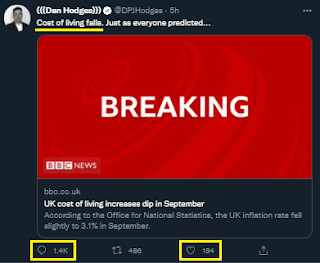
 
In some cases the traffic is entirely made up of condemnation, as with Dan Hodges' economically illiterate interpretation of a BBC News item about a tiny fall in the rate of inflation, which he tweeted with a caption reading "Cost of living falls, just as everyone predicted".

Over a thousand people responded with comments pointing out that Hodges was completely misrepresenting the meaning of the story, either through economic illiteracy, or out of a desire to deliberately spread misinformation.

It's absolutely obvious that a fall in the rate of inflation from 3.2% to 3.1% is not wonderfully good news for the British people, or for the government, when the inflation target is 2%, and the Bank of England rate of interest is a paltry 0.1%, but who cares about facts and evidence, when Dan can just claim the article he's sharing means the opposite of what it actually says?

A fall in the rate of inflation, is simply not the same thing as inflation falling (deflation), and it's no wonder that public understanding of economic issues is so poor, when high profile commentators like Dan Hodges spread economic misinformation like this with impunity.

After such a large backlash, anyone with a shred of decency would delete the post and put up an apology, but attention-seekers who value their social media numbers above their reputation would never erase such a post, because 1,400+ negative replies, and 400+ negative quote tweets all still point to the Twitter account of Dan Hodges.

For being totally wrong about something, Twitter rewards him with thousands of links pointing to his profile, and the algorithm even begins automatically offering his account as a 'suggested follow' to people who got involved in the conversation about how wrong he was!

Why on earth would Dan Hodges delete his reward for spreading misinformation?

And it's clear that he knows it's misinformation too, because his follow up Tweet admitted that he got it wrong, then smugly implied that the people at fault are actually the ones who got "agitated" by his misinformation (which produced himself another reward of hundreds more negative replies and negative quote tweets).

Dan Hodges publicly admits that he knows that it was wrong, but he's leaving it up anyway, meaning there's no way it can now be interpreted as anything other than deliberate misinformation.

And he's actually gloating at all the people who have called him out, and revelling in all the attention and free publicity!

If social media sites like Twitter actually cared about confronting misinformation, they'd allow users the means to effectively report misinformation (crowdsourced peer review), reduce the visibility of misinformation-spreading accounts, and improve the visibility of accounts that routinely tell the truth and cite their sources.

Instead, social media algorithms reward misinformation-spreaders by treating all the criticism of their misinformation as if it's people merely sharing and replying to something that's "interesting"!

We're well into the second decade of the social media age, and none of the social media platforms have even attempted to try to effectively resolve this rewarding misinformation problem.

In fact Facebook has even developed a bizarre "violations" system designed to reduce the visibility of accounts that cite evidence and sources, whilst allowing outright liars to get off scot free!

This failure to address the rewarding misinformation problem means the rabble-rousers, hate-mongers, attention-seekers, and misinformation-peddlers are obviously going to continue gaming poorly-designed algorithms to bag themselves ever more social media prominence.

In a system in which the more wrong, more venal, and more provocative the content, the higher the reward, it's natural that amoral attention-seeking grifters like Dan Hodges would continue to work the system to their advantage, isn't it?


 Another Angry Voice  is a "Pay As You Feel" website. Access to my online writing will always remain free. If you see some value in what I do, please consider supporting my work with a small donation/subscription.


OR


Monday, 11 June 2018

The Tories can't blame anyone else for the High Street apocalypse they're created


After the department store House of Fraser's announced that they're shutting down half of their outlets a load of Tory apologists suddenly began astroturfing the Internet to posit the most absurd excuses for it.

One of the most common excuses was that department stores like House of Fraser simply can't compete with online retailers like Amazon and Ebay.

The obvious flaw in this line of defence is that there's nothing more inherently efficient about online retailers, especially given the extra transportation overheads of running millions of deliveries to customer's houses, often several separate deliveries per order!

Of course online retailers are often cheaper than high street stores, but the price difference has little to do with inherent efficiency, and a lot more to do with the fact that they've been getting away with paying almost zero tax on their British profits for the last decade.

This taxation disparity is a problem that is attributable to the Tory government that has not only failed to rectify the problem in their 8 years in power, but has also repeatedly intervened to obstruct international efforts to clamp down on the worst tax-dodgers of all.


Another factor that critically undermines this "natural consequence of online retailing" argument is the subsequent total collapse of Poundworld just a few days later.

It's easily possible to argue that people are more likely to buy their kitchenware, clothing, and furniture online these days, but surely nobody is going to attempt to argue that the online marketplace has undermined Poundworld's ability to hawk cleaning products, stationary, cheap Chinese tat, and Jammie Dodgers.

The real reasons for the Tory High Street apocalypse are glaringly obvious.

Firstly the sustained period of Tory wage repression since 2010 has absolutely battered people's disposable income. The less money they have in their pockets, the lower economic demand becomes. And the lower economic demand falls, the harder time retailers have selling their wares, whether at the top end of the High Street, or the bottom.

Then there's the Brexit chaos the Tories have delivered. The post-referendum 15% drop in the value of the Pound was felt almost immediately by anyone with overseas interests, especially in the importation market. It's taken longer for this collapse to filter through to the High Street in the form of price inflation, however the effects are becoming real and obvious, even to the most committed of Brexit enthusiasts.

And let's not forget the tax-dodging activities of the online retailers that the Tories have turned such a consistent blind eye to over the last eight years.

All in all the Tory High Street apocalypse has been clearly and undeniably caused by the Tory fixation with hard-right economic dogma, and the absolute shambles they've made of Brexit. But as usual, their sycophantic supporters are desperate to cast around for someone else to blame other than their beloved Tory lords and masters.

This time blaming Labour is pretty much out of the question since it's been almost a decade since they held power, and there's no clear way of blaming the EU either, so they've fallen back on that age old excuse of "market forces", as if the "market" is some kind of monolithic unchangeable force, rather than something that needs to be constantly directed and constrained by effective government policy.

If one part of the market is spectacularly undermining another because of the vast and unfair tax advantages you've allowed them to benefit from, there's nothing inevitable about it at all.

Any sane government would intervene to level the playing field, but the Tory refusal to intervene is indicative of the myopic hard-right economic fanaticism that infests their party.


The Tories exist in a world of simplistic hard-right mantras: "public ownership - bad", "private sector - good", "workers' rights - bad", "corporate deregulation -good", "government intervention - bad", "immensely powerful monopolies - good".

The Tories have created the High Street apocalypse, and their unyielding fixation with hard-right anti-interventionist dogma means they're utterly unwilling to do anything at all to stop it. 

All they'll ever do is make pathetic excuses and seek to cast the blame elsewhere.

 Another Angry Voice  is a "Pay As You Feel" website. You can have access to all of my work for free, or you can choose to make a small donation to help me keep writing. The choice is entirely yours.


OR

Monday, 20 November 2017

Brexit has already cost the average British worker the equivalent of a week's wages


Ever since the EU referendum Brexiteers have continually promoted the myth that Brexit is not going to be a disaster because the "project fear" predictions of the Remain campaign supposedly didn't come true after the referendum.

The main problem with this myth of course is that the predictions of an economic downturn have largely proven quite accurate since the Brexit vote. 

It's clear that what has actually happened to the economy in the wake of the Brexit vote actually lies pretty much in the middle of what the various Brexit forecasts predicted (see image).

It's also worth remembering that many of the pre-Brexit forecasts were built on the (somewhat naive) assumption that David Cameron would stick to his word and trigger Article 50 on the day after a Leave vote.


So when Cameron didn't actually do that, he dramatically softened the immediate economic impact of Brexit by deferring a significant measure of the economic damage (thus helping to generate the seemingly ubiquitous 'Brexit isn't so bad' trope).

Even though Cameron handed the Brexiteers a huge propaganda boost by renageing on his empty threat to trigger Article 50 on the day after the EU referendum, the Brexit vote still caused a significant measure of economic damage.
 

The immediate slump in the value of the Pound took time to filter through to millions of ordinary British workers through rising inflation, but those who live, study, or have business elsewhere in the EU suffered an immediate 10%-15% collapse in their living standards (think of the adverse effect of the £ slump on UK pensioners in Spain who saw the value of their pensions decline dramatically, or UK based businesses reliant upon imports from the EU).

We already know that since Brexit the value of the pound has collapsed, inflation has risen significantly above the Bank of England interest rate, the real value of UK workers' wages has declined dramatically, and the UK has slumped to the lowest growth rate in the EU.

Now a study from the Centre for Economic Performance and the London School of Economics has calculated the scale of the damage for ordinary working people.

According to their calculations, the post-Brexit rise in inflation has caused price increases of £404 per year for the average household.

If the damage is calculated in terms of the reduced real value of workers' wages, it's equivalent to a £448 per year pay cut for the average worker, which is the equivalent of losing an entire week's salary.

 
The extraordinary thing is that Brexit has already collapsed the UK growth rate, caused a significant rise in inflation, and trashed the real incomes of millions of ordinary British workers, yet it hasn't even happened yet!

Had David Cameron triggered Article 50 on June 24th like he said he would, the UK would already have had to have concluded the Brexit negotiations by the end of 2017 so as to leave time for the ratification process (any EU-UK deal is subject to democratic approval in the parliaments of all EU member states).

So given that Brexit has robbed millions of workers of the equivalent of a whole week's wages, and that the impact on the wider economy is right in the middle of the forecasts, isn't it about time that we lob these dishonest "Brexit isn't so bad", "Remain were pushing project fear lies" tropes into the dustbin (a bin that is already pretty damned full of other Brexiteer lies)?

But even as we're lobbing this dishonest Brexiteer trope in the bin, they're coming up with a new propaganda narrative aimed at pinning the blame for the Brexit damage onto pretty much anyone who is opposed to their own fanatical "no deal" interpretation of the Brexit vote.

The Brexiteers accused Remainers of lying and fearmongering when the economic predictions showed that Brexit would be bad for the UK economy and bad for ordinary British workers, and now that these predictions are demonstrably coming true, they're now seeking to pin the blame for their own mess onto the very people who predicted these negative outcomes in the first place!


The problem of course is that it's ridiculously difficult to reason people out of a belief that they didn't reason themselves into in the first place. So people who are ideologically committed to Brexit will shrug off the erosion of their own wages, and accept the Brexiteer propositions that the blame for any negative outcomes lies with anyone but the Brexiteers themselves (Remainers, the EU27, the courts, the opposition parties, academics who dare to critique the Brexit process, the left-liberal elements of the press, economists and other experts ...).

To many people Brexit is like a religious cult based on the unquestionable assertion that "Brexit is good", so even if they're shown how it isn't good, they'll tinker around with ancillary beliefs until they develop a convenient excuse.

Just as the religious cult leaders might absolve the gods of blame for the devastating flood/drought/famine by claiming it's vengeance for the people not praying hard enough, the leaders of the Brexit cult are beginning to insist that Brexit isn't to blame for the low growth/high inflation/collapsing wages, but that the public are to blame for not believing in Brexit fervently enough!

We know that Brexit is already harming the UK economy and the lives of millions of ordinary workers, and we know that the damage will be very much worse if the hard-right Tories get the ruinous "no deal" Brexit they're craving. So the only way of stopping this extreme Brexit disaster from happening is by breaking people out of the Brexit cult, which is clearly easier said than done.


 Another Angry Voice  is a "Pay As You Feel" website. You can have access to all of my work for free, or you can choose to make a small donation to help me keep writing. The choice is entirely yours.


OR

Tuesday, 25 April 2017

Should rented accommodation be "fit for human habitation"?


In January 2016 the Labour Party tried to add an amendment to the Tory Housing and Development Bill in order to ensure that all rented properties are "fit for human habitation" but Tory MPs (1/3 of whom are landlords) voted the amendment down.

It doesn't seem like too much to ask to specify that if you're going to rent out a house for people to live in, that house should be in a fit state to be lived in, but apparently that's too damned much for the Tory party and their financial backers.

It beggars belief that anyone would try to argue the case that there shouldn't be a rule to prevent unscrupulous slumlords renting out properties that are unfit for people to live in, but that's precisely what the Tory government and their tribalist followers did at the time they shot the Labour Party amendment down.

If you live in rented accommodation you'd have to be completely crackers to vote for a party that voted down a move to ensure that unscrupulous landlords have no right to exploit the housing shortage by renting appalling places to tenants with nowhere else to turn.

Another factor to consider is that since 2010 the Tories have overseen the lowest level of new house building since the 1920s and at a time of soaring demand too (net migration when Theresa May was Home Secretary soared to its highest levels ever). Unsurprisingly this combination of factors helped inflate the housing bubble and push the possibility of home ownership beyond the means of huge numbers of people.

You would have thought that the least the government could do under such circumstances would be to protect the rights of people who are trapped in the private rental market because house prices have soared to their most unaffordable levels ever under their watch, but no.

The Tories are on the side of the worst kind of exploitative buy-to-let slumlords, not yours.

If you live in rented accommodation you'd clearly have to be out of your mind to vote Tory.


 Another Angry Voice  is a "Pay As You Feel" website. You can have access to all of my work for free, or you can choose to make a small donation to help me keep writing. The choice is entirely yours.


OR

Thursday, 27 March 2014

Universal Basic Income from a libertarian perspective - A labour market analysis


In this article I'm going to consider Universal Basic Income (UBI) from a libertarian perspective, focusing mainly on analysis of the labour market, rather than the much more common libertarian "small state" argument in favour of UBI.

The crux of the article

The current labour market is terribly unfree as it is because it relies on coercion, workfare, sanctions, draconian anti-labour legislation etc.

The introduction of Universal Basic Income would would create a much freer labour market (no more threat of destitution, sanctions or forced labour schemes, and much freer labour contracts between employers and employees), but this increased freedom for the majority would come at the expense of necessary measures in order to control inflation (which would rapidly destroy the project if left unchecked). 


The reduction in aggression against the majority of workers would outweigh the infringements on the current rights that rentiers have to exploit access to basic commodities in order to extract profit for themselves (which it can be argued is another form of aggression against the majority anyway).

What is libertarianism?

Libertarianism covers a wide range of political stances, from
left-libertarianism through to anarcho-capitalism. The thing they
have in common is that they promote freedom (although in
completely different ways).
Many people are under the mistaken impression that the word "libertarian" refers exclusively to an extreme form of US free market fundamentalism associated with Ayn Rand, the Tea Party and the like. However the right-wing fringe in the US appropriated the word for their own use with little regard to the other inherent meanings it had before.

The origins of libertarianism can be traced to the 18th and 19th Century anarchist and and socialist movements in Europe, however it was quickly embraced and integrated into
laissez-faire capitalist theory too.

One of the most famous left-libertarians was the American Henry George (1839-1897), who opposed rentierism, and argued in favour of Land Value Tax. Many Georgists have argued that the proceeds from Land Value Tax should be used to fund a citizens income, or Universal Basic Income.

Left-Libertarianism is not as famous as its rabid Ayn Rand inspired American cousin, but it is an increasingly popular political stance, and one which I personally embrace.

What is Universal Basic Income
[Main article]

If you're not fully versed on what Universal Basic Income (UBI) is, I suggest that you read my introductory article before coming back to finish this one. If you haven't got time for that, or you are reasonably clued up about what UBI is, I'll just provide a short summary.

UBI is an unconditional payment that is made to every qualifying individual within an economy. There is no means testing at all, other than determination that the individual is eligible (a citizen in the economy for example). Ideally the UBI is set at a rate which is sufficient to ensure that all recipients have access to basic human necessities (a home, sufficient food and water, basic energy needs ...).

This concept is generally appealing to libertarians on a basic level because it dispenses with almost all forms of state means testing, meaning a smaller, and less obtrusive state. In this article I'm not going to focus on this compelling "smaller state" argument for UBI, in favour of considering the libertarian case for UBI from a labour market perspective.

What makes the current labour market so unfree?

[Main article]

Labour is a fundamentally important factor in any economy. Orthodox economic theories tends to treat labour as if it is just some other kind of basic commodity, however, if it is to be referred to as a commodity at all, it must be recognised as a very special and distinct form of commodity, one that can be created at will, and which takes myriad potential forms.

The neoclassical orthodoxy fails to treat the labour market as utterly different to other commodities markets and it also fails to recognise the unequal nature of the market in labour, where the employer at a huge advantage over the employee. There are innumerable factors that put the buyer at an advantage of the seller in the labour market, but perhaps the most significant is the creation of false abundance via political policies aimed at retaining a constant pool of unemployment, the "reserve army of unemployment" as Marx defined it in the 19th century, or the "price worth paying" as it was described by former Tory Chancellor Norman Lamont in 1991.

In 1918 Bertrand Russell argued against this inequality in the labour market, proposing a kind of basic income so "
the dread of unemployment and loss of livelihood will no longer haunt men like a nightmare".

The constant threat of destitution is a powerful means by which employers can drive down wages and working conditions, putting them at an unfair price advantage over the worker. If the scale of unemployment has been brought about via deliberate economic policies based on the equilibrium rate of unemployment, this is a clear case of the state trampling all over the libertarian non-aggression principle.
If government policies result in your labour being coerced from you at a lower rate than you would be willing to sell it, solely because you fear destitution if you don't work for low wages, you're suffering aggression at the hands of the state.
 
The spectre of unemployment and impoverishment created by economic policies aimed at maintaining "extra capacity" in the labour market is not the only current example of aggressive coercion in the labour market.

Workfare blatantly violates the libertarian non-aggression principle
[Main article]

One of the starkest examples of a labour policy which violate the libertarian non-aggression principle is the kind of mandatory unpaid labour schemes for the unemployed collectively termed "Workfare".

These schemes coerce the unemployed, under threat of absolute destitution, into giving up their labour for free, often to highly profitable corporations.

It's bad enough that the state uses the threat of destitution
(via welfare sanctions) to undermine the aggregate value of labour, but that ministers of the government openly declare that they believe that the state has "a right" to extract the labour of the individual for no wage at all, demonstrates an extremely illiberal attitude towards the labour rights of the individual.

These mandatory unpaid "Workfare" labour schemes demonstrate beyond doubt that the ministers involved in administering these schemes believe that the labour of the individual actually belongs to the state.

If your government acts as if it believes that your labour is a commodity which belongs to the state, and which can be extracted and distributed for free to favoured corporations, the labour market isn't just unfree, it is grotesquely authoritarian.
 

How would UBI make the labour market freer?

If every individual received an unconditional basic income sufficient to meet their fundamental human needs (housing, food and water, energy, health care ...) the threat of destitution would cease to necessitate people into accepting wages and working conditions they deem unfair.

An unconditional basic income would also render totally unworkable the draconian regime of "Workfare" labour extraction schemes enforced via draconian welfare sanctions regimes. If the individual has a right to an unconditional subsistence income, the state loses the power to coerce and intimidate the individual into giving up their labour for free with threats of destitution, starvation and homelessness.

Even if we accept the wrong-headed idea that labour is a basic commodity with a defined value (the national minimum wage for example), we have to accept that coerced unpaid labour represents theft, and a clear violation of the libertarian non-aggression principle. Universal Basic Income would render this form of theft by the state totally unworkable, because the state would have no right to revoke the unconditional incomes of those that won't comply with their unpaid labour extraction schemes.

How a freer labour market could benefit society and the economy

I've explained a how UBI could benefit society and the economy in the primer article on the subject, so I'll try to be concise here.

The free labour market that UBI would create if administered correctly, would benefit society by alleviating extreme poverty, which would lead to a fall in poverty related social problems such as crime and poverty related ill-health.

Another benefit to society would be that the existence of UBI would push up the cost of employing people to do undesirable jobs (disgusting, dangerous or debilitating work), meaning that in turn there would be much greater financial incentives for companies to invest in technology to automate such work. The development of technology to eliminate undesirable jobs would benefit society and the economy (fewer people working in undesirable jobs, greater demand for high-tech solutions).

UBI trials have shown that people generally don't stop working and laze about once their basic necessities are provided, in fact UBI works as an economic stimulus, because people have more time to invest in starting their own businesses, and the public has more money to spend on consumption. The only demographics to substantially reduce the hours they work are mothers with young children and young people in education, it is arguable that these reductions are actually beneficial in socio-economic terms.

Why is controlling inflation so important?

Controlling price inflation would be absolutely crucial to the success of any Universal Basic Income project because without measures to stop the inflation of basic necessities (rent, utilities, food ...) the gains that UBI would provide would soon be eroded away as price rises diminish the value of the basic income payment so that it is no longer sufficient to cover the basic costs of subsistence.

If inflation is allowed to run rampant, the benefits of Universal Basic Income would soon be transferred from the ordinary citizen that receives it, to the rentiers that take advantage by hiking the prices they charge for the provision of basic commodities and services.

Controlling Rentierism


If the rentiers are allowed free rein to profiteer from basic income provision, they will simply inflate their prices in order to soak up the entire value of basic income to cover the cost of some necessity of life (rent, transport, childcare, energy consumption). If the parasitic behaviour of rentiers is not controlled, all of the socio-economic benefits would soon be siphoned off as into the bank accounts of the most ruthlessly self-interested rent seekers. Essentially Universal Basic Income would turn into a government subsidisation scheme for the most ruthlessly self-interested, which is precisely the kind of system we have now, which is one of the main reasons people have been proposing the introduction of UBI in the first place.

The only practical way to stop this kind of rent seeking behaviour from destroying UBI would be to introduce some form of market regulation to prevent landlords, utilities companies, childcare providers and the like from massively inflating their prices in order to soak up the economic benefit of UBI for themselves.

There's no such thing as a perfectly free-market economy

Anyone that believes that there is such a thing as a perfectly free market is living in the same cloud-cuckoo land as those that believe a totally state controlled economy is a possibility.

What is up for debate is how more market freedom can be created. The orthodox neoliberal would argue that greater market freedom is produced through deregulation, but the huge growth in inequality, the ever increasing size of economic crises and the rise of vast "too big to fail" oligopolies since the neoliberal craze of privatisation and deregulation became the economic orthodoxy in 1980s, suggests that they are wrong. Deregulation and privatisation have increased the freedoms of corporations and the super-rich at the expense of the majority, who have seen their share of national incomes eroded away dramatically since the late 1970s despite rising productivity.

Others might argue that the best way to stimulate market freedom is through the creation of a "fair market", through carefully planned market regulation. Rules to prevent (and properly punish) anti-competitive practices such as price rigging, formation of oligopolies, monopolies and cartels, financial doping, insider trading, political patronage, front running, information asymmetry, dividing territories, corruption and outright fraud, would create a freer and safer market for individuals and small businesses, which would increase competition and efficiency, but at the cost of the freedoms of those that currently profit from the use of anti-competitive practices.

The same kind of debate can be had over the introduction of rules
(rent caps, inflation controls on basic commodities and services ... ) to prevent the rentier class form extracting the benefit of Universal Basic Income for themselves. The infringement of their "right" to gouge as much profit as possible out of basic commodities and services, would have to be weighed against the greater economic freedoms afforded to the majority.

Essentially it boils down to the question of which is the most important; freeing up the currently unfree labour market or the continuation of free market in the provision of fundamental commodities and services?

Providing more freedom in which of these markets would create the biggest increase in aggregate freedom, and which would be most compliant with the libertarian non-aggression principle? In my view the answer is obvious. The freedom of the majority outweighs the freedom of the minority.

Other libertarian arguments for UBI aside from the labour market analysis

Before I conclude I'd like to state that this labour market analysis  is far from the only libertarian argument
for the introduction of Universal Basic Income.

Other arguments include the most common "small state" argument because universal welfare would reduce the size of the state by reducing the number of functions of the state. Another argument can be made that since there would be no means testing, UBI would provide greater freedom from intrusion by the state into the private lives of the individual.

Perhaps the most compelling libertarian argument in favour of Universal Basic Income is that perhaps freedom from destitution in itself is the most important liberty, because without freedom from destitution the individual is often left facing either the suffering of destitution, or the suffering of wage slavery.

Conclusion


Labour is a fundamental element of any economy (be it capitalist, state socialist or anywhere in between). and an unfree market in labour is fundamentally incompatible with libertarianism.

If the deliberate economic policies of the political establishment in your country mean that your labour can be coerced from you at a lower rate than you would be willing to sell, simply because of the threat of absolute destitution, this is clearly an act of aggression on the part of the establishment.

If your government acts as if it believes that your labour is a commodity which actually belongs to the state, and can be extracted from you for no recompense at all, this is an even more vile example of state aggression.

The introduction of Universal Basic Income would put an end to both of these forms of labour market aggression, but in order for it to work measures to prevent rentiers from profiteering by inflating the prices they charge for basic human necessities would need to be introduced. Thus the debate is not over whether UBI is compatible with libertarianism (it clearly is) but whether the benefits from the greater freedoms in the labour market would outweigh the necessary losses in freedom of rentiers to profiteer from the provision of basic human needs, which would be necessary in order to prevent the whole project collapsing into inflationary chaos.

In my view the freedoms of the majority should outweigh the freedoms of the minority, and in any case, the current freedom to profiteer from the provision of basic human necessities that the rentier class enjoy can actually be viewed as a form of aggression in its own right. Why should the profits of the minority take precedence over the basic human needs of the majority?


 Another Angry Voice  is a "Pay As You Feel" website. You can have access to all of my work for free, or you can choose to make a small donation to help me keep writing. The choice is entirely yours.


Flattr this


MORE ARTICLES FROM
 ANOTHER ANGRY VOICE 
         
What is ... Universal Basic Income?
                 
What is ... Neoliberalism?
           
Why do right-wing people support "Workfare"?
                        
What is... Fiscal Multiplication?
                     
The economic case against tax-dodging
                      

Equilibrium Unemployment
                          
The AAV political stance
                
Too big to fail"? - Nope, "Too big to jail"
                 
          
The Tory ideological mission


Tuesday, 22 October 2013

How to get rich in Tory Britain


The economy is still in recession for the vast majority of us, but a tiny economic minority are getting rich faster than ever, and the Tories are convinced that this enrichment of the minority equates to an "economic recovery". In this article I'm going to give you a sure-fire tip for escaping your worsening economic circumstances and getting rich too.

The reason that the economy is still in recession for the majority of us is an economic policy called income repression, which is being administered by the Chancellor of the Exchequer George Osborne. If you have a job that pays less than a six figure salary, the chances are that you are getting poorer, because every single month since the Tories came to power, the average wage has grown at a slower rate than the rate of inflation. This means that your purchasing power has been diminished every single month and you are getting poorer and poorer in real terms.

People on low wages have been affected particularly badly, because as well as their wages shrinking in real terms, George Osborne and the Tories are also repressing in-work benefits such as Working Tax Credits, Child Tax Credits, Income Support, Council Tax Relief, Statutory Sick Pay, Maternity Pay and Paternity Pay. These dramatic cuts in the social security payments that are used to top up poverty wages are driving millions of low-income workers into even greater poverty.

Some of the poorest working people have experienced terrible poverty on Zero-Hours Contracts (which have spread like wildfire since the global financial sector meltdown), growing numbers of people are working for less than the minimum wage and many tens of thousands of people a month have been compelled under the threat of absolute destitution to work for nothing more than their benefits at highly profitable corporations under Iain Duncan Smith's Workfare compulsory labour schemes. One of the side effects of these unpaid workfare schemes is that they further drive down wages and working conditions for other working people, especially in the retail, elderly care and low-skilled manufacturing and service sectors.

The number of children living in poverty has risen by 300,000 in just one year and the disabled, the unemployed, pensioners and students from poor and ordinary backgrounds have also taken an economic battering in the last three years of Tory rule.

Everyone who is not experiencing massive wage inflation is being hit by the effect of high inflation. It should be absolutely obvious that the official inflation statistics are misleadingly low. House prices in London are growing more per day than the average worker earns for a whole day's work, rents are up, utility bills are skyrocketing, public transport, food, fuel and childcare have all risen in cost much faster than inflation, yet the official inflation statistics are manipulated to show a relatively low level of general inflation. Then there's hidden inflation, the fact that your mayonnaise jar or cereal packet just got smaller but the price stayed the same, and the fact that your beef burgers and lasagnas have been filled out with cheap horse meat from Romania, instead of British beef. 


Whilst this has been going on, George Osborne has been slashing taxes for corporations and the super-rich. His unprecidented cuts in the rate of corporation tax have created an artificial boom in corporate profits, fueling record dividends and the obscene inflation of corporate pay. The directors of the FTSE100 companies took home an average 33% pay rise in 2010, a 49% pay rise in 2011 and another 27% pay rise in 2012. On top of all of these extra earnings, George Osborne also handed them a lucrative tax cut in April 2013, meaning that the 13,000 income millionaires in the UK get an average £100,000 boost in their spending power.

Then there's Quantitative Easing; the £375 billion Bank of England money creation scheme that provided 40% of the extra spending power to the 5% of richest households, and eroded away the wealth of people with savings and pension schemes. This isn't just idle speculation, the Bank of England's own research confirms it.

Well, I guess you're eagerly awaiting the economic tip I teased you with in the intro, so here it is.

I've spotted a correlation between a certain type of person and good economic fortune under George Osborne's stewardship of the economy. 


George Osborne's father-in-law benefited for a massive reduction in the corporation tax rate for fracking companies, because he works as a lobbyist for numerous energy companies with financial interests in the fracking business. Then the Hedge Fund that employs George Osborne's best man was awarded £50 million worth of undervalued shares in Royal Mail, landing them a whopping profit of £25 million within a week as the shares rose up towards their true market value.

It seems that being a guest at George Osborne's wedding is a key to economic success in "austerity Britain".

You probably think that there's a glaring logical flaw in my advice; the fact that you weren't a guest at George Osborne's wedding in 1998. But don't worry, that's not a problem. In April 2013 the Tory party retroactively changed the law of the land in order to avoid compensating the victims of Iain Duncan Smith's unlawful mandatory unpaid workfare schemes. This means that Tories like George Osborne are quite willing to accept retroactive revisions to reality, so all you need do is retroactively declare that you were a guest at George Osborne's wedding in 1998 and then call him to demand your share of the economic favours he's handing out.


 Another Angry Voice  is a "Pay As You Feel" website. You can have access to all of my work for free, or you can choose to make a small donation to help me keep writing. The choice is entirely yours.