Showing posts with label Budget. Show all posts

Thursday, 28 October 2021

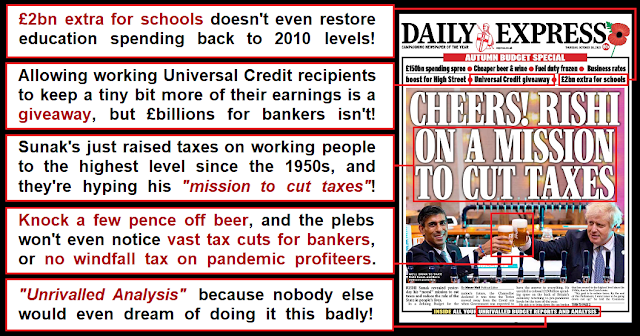
Analysing the Daily Express budget analysis


These days the Daily Express is basically nothing more than a pravda propaganda rag for the Tory party, so you'd have to be pretty naïve to expect anything other than heavy pro-Tory bias in their Budget analysis, but in 2021 they went the extra mile with a quite astonishing front page.

Rishi Sunak has just raised the UK tax burden to the highest level since the post-WWII recovery period in the 1950s!

He even admitted it in his budget speech, using the passive voice to say that  "taxes are rising to the highest level of GDP since the 1950s", as if the taxes are somehow rising of their own accord, rather than him being the person who is raising them!

Yet the front page of the Express blares Cheers! Rishi On A Mission To Cut Taxes

He's just raised taxes to the highest rate in over half a century, but hooray for his future ambition to cut taxes!

The disjunct between the reality and the presentation is absolutely laughable.

There are an awful lot more issues in the small print too (too many for me even to fit into the article header infographic!).

2 Billion extra for schools This might sound great if you've been living in a sensory deprivation chamber for the last 11 years, but in reality it's not enough to even return per-pupil funding back above 2010 levels this year, next year, or the year after. 

It'll finally catch up in 2024/25, meaning that an entire generation of school kids will have had their education hindered by massive budget cuts for no discernible reason whatever. Yet the Express somehow consider this decade and a half of wanton destruction of our nation's future economic potential as a cause for celebration!

£150 billion spending spree Hang on. We just suffered a decade of austerity cuts because public spending in the wake of a crisis was supposedly terribly bad, yet the debt's gone up dramatically since 2010, and now we're supposed to celebrate £150 billion in post-crisis spending as if the last 11 years simply didn't happen?

If spending in the wake of a crisis is good, then that obviously means a decade of Tory austerity extremism was pointless, ruinous self-harming, economically illiterate, and extremely bad, doesn't it?

Business Rates Boost For High Street  Everyone knows that tax-dodging online retailers have been dramatically undercutting High Street outlets for the last decade, and that giant out-of-town supermarkets are now soaking up entire family shopping budgets that used to be divided amongst perhaps a dozen different small independent High Street businesses.

Nothing's been done about this until it's far too late, and now High Streets across Britain have been reduced to derelict ghostly shadows of their former glories, occupied mainly by boarded up premises, thrift stores, gambling outlets, and charity shops.

There's some limited help on the table now, especially for the likes of pubs, restaurants, and tea rooms, but it's far too little, far too late.  The lockdown measures have absolutely hammered the majority of the retail economy by forcing them to close their doors, while online retailers and supermarket giants were allowed to continue operating, soaking up £billions in artificially inflated profits. 

There's no effort to rake any of these artificial gains back, and nor will there ever be with a Tory rich-boy like Sunak running the show.

Universal Credit Giveaway The framing here is absolutely insidious. What Sunak's actually done is ever-so-slightly reduced the amount that the state confiscates out of low-earners' wages through reduced social security payments.

Under the Tory-designed Universal Credit system the government used to confiscate 63p in every additional pound a low income worker earns, but Sunak's reduced the confiscation rate to 55p in the pound (which is obviously still more than half!). 

Somehow confiscating a tiny bit less of low-income workers' wages is a giveaway, but the £billions he's handed to bankers by cutting the Surcharge Tax to 3% isn't a giveaway.

In fact it somehow doesn't even warrant a mention!

"By the end of this parliament I want taxes going down, not up" Somehow the Express is celebrating this statement from Rishi Sunak as if it's some almost divine political objective, rather than one of the key strategies of Tory electoral politics:

Front-load all the tax-hikes and attacks on people's incomes into the years after winning power, then ease the boot of people's necks a little bit prior to the next election so they feel like things are getting better and vote Tory, and repeat, and repeat, and repeat.

It's an expression of standard, cynical, short-term electoral political strategy, not some kind of saintly moral mission!

Cheers! Rishi The main headline, and the picture of Johnson and Sunak (who doesn't even drink) holding pints are an example of the oldest trick in the budget book.

Place a slight cut in the price of a pint at the forefront of the budget, in order to distract the plebs from the horrifying details you don't really want them thinking about:
  • Highest tax rate in seven decades
  • Massive tax break for bankers
  • Cutting tax on short-haul flights (just days before hosting a climate conference!)
  • Implicit admission that austerity was a huge mistake
  • National Insurance hike for millions of ordinary workers
  • Insufficient help for High Streets
  • School funding still below 2010 level
  • No windfall tax for pandemic profiteers
Unrivalled coverage This is just about the only thing they managed to get right on their entire front page. It's so laughably bad that not even the Daily Mail or S*n managed to do worse!

 Another Angry Voice  is a "Pay As You Feel" website. Access to my online writing will always remain free. If you see some value in what I do, please consider supporting my work with a small donation/subscription.


OR


Thursday, 23 November 2017

Is Rebecca Pow really so out-of-touch that she thinks people are better off than ever?


When the Tory MP Rebecca Pow intervened in John McDonnell's parliamentary speech to make the ridiculous assertion that "people have more money than ever" McDonnell replied in a very polite manner.

He calmly pointed out the horrifying fact that there are 4 million kids growing up in poverty in the United Kingdom, and the majority of them actually come from working families.


That the working poor make up the majority of people living in poverty in austerity Britain should be common knowledge, but thanks to the complicity of the mainstream media, uncomfortable facts like this are barely mentioned outside of left-wing independent media sites and in the slew of damning reports on the sheer scale of the problem from the likes of the Institute for Fiscal Studies, the Joseph Rowntree Foundation, the Child Poverty Action Group and the Resolution Foundation.

It doesn't matter how much we try to raise awareness of child poverty and in-work poverty, there's always some wealthy insulated Tory around to pretend that things are fantastic, and that we've actually "never had it so good".

The problem for Rebecca Pow is that the Tory budget is full of explicit admissions that Tory austerity dogma is failing Britain, and failing British workers.
 

Aside from the downgrades in the UK economic growth forecasts, deficit reduction, and productivity, there's also a damning admission that the (already record-breaking) squeeze on UK workers' wages is set to continue into the next decade.

This means that the real value of workers' wages is not going to return to 2007 levels until early 2025.

That's an astounding 17 year period of zero real terms wage growth.

That's a generation of workers who have had their earning potential cruelly and deliberately blighted for the most productive years of their careers as a result of ruinous Tory austerity dogma.


Instead of progressing up the pay scale like previous generations did, millions have been trapped in low-pay insecure work without a decent pay rise in years, meaning they're actually worse off now in real terms than they were a decade ago.

It doesn't matter how many jokes and jolly japes the Tory Chancellor Philip Hammond padded out his "banter budget" with, the economic prognosis for the UK is absolutely dire, especially for ordinary working people.

The really sad thing is that millions of working people are so immune to reality that they'll actually believe the likes of Rebecca Pow and the right-wing propaganda merchants when they tell them that the Tories are doing a fantastic job and that they've never had it so good.

They'll forget all about the fact they haven't had a real pay rise in years; their nephew being exploited in the fake self-employment gig economy while their boss hides all the profits in tax havens; their niece on a dead end zero hours contract bringing her daughter up in grinding poverty; their mother being denied the social care she paid for with a whole lifetime of National Insurance contributions; the ever-worsening chaos in their local hospital; their neighbour forced to go through humiliation after humiliation to obtain the disability benefits they deserve ... because they keep on reading what a spiffing job the Tories are doing of running the economy in the pages of the S*n/Daily Mail/Express/Telegraph.

People like this will never read about how Philip Hammond's "banter budget" extends the Tory wage squeeze to 17 years, the dire state of the UK productivity crisis, or the soaring rates of child poverty and in-work poverty, because the Tory party rely on the ignorance of the masses to get away with what they do, and the right-wing press dutifully foster ignorance by not giving these vitally important issues anything like the coverage they deserve.

Until ordinary working people stop reading the right-wing propaganda rags, and stop uncritically believing Tory politicians when they defy reality by claiming that people have more money than ever, it's difficult to see how things can actually get better.


 Another Angry Voice  is a "Pay As You Feel" website. You can have access to all of my work for free, or you can choose to make a small donation to help me keep writing. The choice is entirely yours.


OR

Enough with the wilfully out-of-context bragging already


The Conservatives absolutely love to use the impressive-sounding big number technique to bamboozle the gullible into believing that they're doing a great job.

On the face of it Philip Hammond's budget announcement that 1.1 million new houses have been built since they came to power in 2010 sounds good, but only if you completely ignore all context.


In reality, far from being something to boast about, this level of house building is actually the lowest since 1924.

What's even worse is that the Tories have delivered this piteously low level of house building at a time of extremely high housing demand.

Despite their ludicrous pledge to reduce net immigration to below 100,000 the Tories actually oversaw the biggest inwards surge of migration ever, peaking at 336,000 in 2015.


Immigration in itself is not harmful, but if the government of the day does not account for it by increasing housing stock appropriately and by improving and expanding local services in areas that experience high population growth, then it obviously creates problems.

Not only did the Tories fail to deliver the level of required house building to cope with their immigration surge, they also set about gutting funding for local infrastructure and services out of ideological adherence to ruinous austerity dogma.


Then there are other factors to consider too. Demographic changes and lifestyle changes mean that home occupancy rates have been declining for decades, with more people choosing to live alone, and fewer large (and extended) families occupying a single home. This means we need more houses per head of population these days.


 The result of the Tories' woeful mismanagement of the housing sector means that house prices have risen to their most unaffordable levels ever, and soared miles out of the reach of millions of ordinary working people.

In the context of such a severe housing crisis the presentation of out-of-context figures as some kind of great achievement is a massive slap in the face for the millions of ordinary working people who have been locked out of the housing market and been left to the mercy of the virtually unregulated profiteers in the private rental sector.


What's even worse is that when the Tories had the chance to help people stuck in the private rental sector out a bit, they callously voted against measures to ensure that all rented properties are "fit for human habitation".

In the end it's all just Tory smoke and mirrors. They don't really give a crap that home ownership rates have absolutely collapsed for the under-40s. They're much more interested in stoking house price inflation in order to benefit the older generations of home owners, and protecting the value of the buy-to-let property portfolios built up by the idle rentier class.

So just imagine the contempt Philip Hammond and his scrip-writers must have for the younger generations who have been priced out of home ownership that they imagine they can be duped into supporting the Tory party with such an absurd display of wilfully out-of-context bragging.


 Another Angry Voice  is a "Pay As You Feel" website. You can have access to all of my work for free, or you can choose to make a small donation to help me keep writing. The choice is entirely yours.


OR

Wednesday, 22 November 2017

Who is actually laughing at funny ol' Phil's "Banter Budget" japes?


Oh how the Tory front bench laughed at all the jolly japes in funny ol' Phil's "banter budget". Jeremy Clarkson jokes, digs at Labour and the trade unions, "I'm a Celebrity" references, and Theresa May wielding cough sweets as if her cough was the only lame thing about her dire conference speech in October.

If you ever needed evidence that the Tories are a bunch of massively over-privileged toffs who treat the job of running our economy like some kind of private school lark, then this budget speech was it.
 

UK growth forecasts down by £44 billion by 2021; the Tories missing their target to eliminate the budget deficit by 2015 by even further than they admitted they were in March 2017; no resolution in sight to the productivity crisis; slashed pay growth forecasts; another £3 billion spunked on the Tory Brexit farce; a catastrophic slump in home ownership; vast trade deficits; the first OBR economic forecast ever to predict below 2% growth until the forecast horizon ...

One of the big figures not many people have picked up on is the revised £25.8 billion increase in the projected borrowing figures because the OBR are finally beginning to accept that their hyper-optimistic productivity projections of the last seven years are nowhere near the austerity era trend. As you can see from the chart above it's the first time they've not assumed that productivity is due to return to the pre-crisis trend, but they've still only halved their unrealistic expectations, rather than matching them to the dreadful almost zero improvement trend during the whole Tory austerity era.

There's always the fake good news to look out for in a government budget, and this time around it was Hammond's claim that debt as a percentage of GDP has already peaked in 2016-17 instead of continuing to rise until the end of this financial year, which has apparently only been managed by sneakily hiding £60 billion worth of social housing debt off the public balance sheet.

Not only was the budget another admission of the failure of Tory austerity dogma, their unwillingness to properly fund our vital public services, and the economic folly of Brexit, but there was very little in it to sweeten the bitter pill for people who are really struggling.

Hammond's "millenial railcard" is an absolute scam of a bribe given that it won't apply during commuter hours, and isn't available to the over-30s who have endured a 27% hike in rip-off rail fares since 2010 (double the rate of wage increases) and are now facing the biggest rail fare hike in five years in January.

In fact I'm fairly sure that for every gullible under-30 who is duped into voting Tory with this scam of a railcard, there will be half a dozen over-30s who realise that a railcard they're not even entitled to claim is insufficient compensation for having had the most productive work years of their lives blighted by the effects of Tory austerity dogma.


On the housing crisis Hammond gushed about the Tory policy of stoking house price inflation by pumping £billions into their Help to Buy scam, and reiterated the same old Tory gubbins about how they aspire to increase house building rates, with no acknowledgement whatever that between 2010 and 2017 they oversaw the lowest level of new house building since the early 1920s.

Then there was the announcement that the Tory benches really cheered. Abolition of Stamp Duty for first time buyers of properties worth up to £300,000, which will cheer younger people with enough cash to actually buy a house, but mean nothing to the millions who have been priced way out of the market. To them it's obviously just another Tory giveaway to the already quite well-to-do.

It's also worth noting that the Stamp Duty cut for first time buyers is projected to increase house prices, pushing them even further out of reach of those who are priced out of the property market.

On homelessness Hammond pledged to eliminate rough sleeping by 2027 without even a hint of an admission that rough sleeping rates have doubled on the Tory watch since 2010.


Even when it came to the NHS, Hammond fell short of providing the £4 billion emergency funding that the health service chief Simon Stevens had called for.

It's difficult not to see the headline pledge of £350 extra for the NHS for the entire 2017-18 winter period as a deliberate insult, given that several of his front bench colleagues promised that exact figure of £350 million for the NHS per week, not per winter.

George Osborne's approach to budget day used to be that it was better to distract the plebs with trivia like a penny off the price of beer or a ludicrous tax on pasties (that he could row back on later in the week) than to have them thinking too much about the dire state of the economy, or the way he was continually missing all of his economic predictions.

Hammond's approach is different. He thinks the proles can be distracted by Jeremy Clarkson puns and oh so witty "I'm a Celebrity" references, but given the absolute state of the UK economy these days, most people will conclude that funny ol' Phil has badly misjudged the mood of the nation with his 'banter budget' full of jolly jokes and japes.


 Another Angry Voice  is a "Pay As You Feel" website. You can have access to all of my work for free, or you can choose to make a small donation to help me keep writing. The choice is entirely yours.


OR

Friday, 25 March 2016

Bad week for the Tories - Attack Jeremy Corbyn


In the wake of George Osborne's March 2016 Budget of Failure the Tory party endured the worst week they've had had since the Lib-Dems enabled them back into power in 2010.

A bad week for the Tories

Here are just a few things that went wrong for them:

  • Labour immediately condemned the Tory budget as having "unfairness at its very core" because it planned to impoverish hundreds of thousands of disabled people whilst handing out lavish tax cuts to corporations, the asset rich and high earners.
Attack Corbyn

Given this catalogue of failures, it might have been fair to assume that the mainstream press might actually begin to question David Cameron's leadership, but the mainstream media narrative was quickly set that Jeremy Corbyn was the real failure of the week for apparently not attacking the Tories effectively enough!

Pretty soon online discussion threads were filled with people spouting this feeble narrative as if the thoughts were their own, rather than some absolute drivel they'd rote learned from the right-wing press and mindlessly regurgitated as if it was their own opinion. However, i
f people actually listened to some of the responses from Jeremy Corbyn, John McDonnell and Angela Eagle this week they'd have heard strong criticisms of the Tories that the likes of Ed Miliband and Ed Balls never managed to deliver.

Spurned Blairites


The biggest problem for Jeremy Corbyn remains the pathetic crowd of spurned Blairites who, even this week, have been feeding anti-Corbyn stories to the mainstream press. Even when the Tory party is visibly imploding, the spurned Blairites are far more interested in attacking Corbyn than they are in attacking the Tories!

Hypocritically, the main focus of their foolish self-destructive attacks on Jeremy Corbyn are that he's apparently "not good enough at attacking the Tories". Well, even if you don't think Jeremy Corbyn has done as well as he could have done - at least he was actually attacking the Tories, unlike the spurned Blairite crowd who are still clearly far more intent on tearing the Labour Party apart, even in the worst week this Tory government has ever endured, than actually criticising the Tories.

Conclusion


The UK has the most right-wing press in Europe, so it's no surprise whatever that they've once again jumped in to try to save their golden boy George Osborne from the absolute mauling he so clearly deserves with pathetically contrived attacks on Jeremy Corbyn.

What is more worrying is that even during the most catastrophic week the Tories have endured in years, there are still crowds of pathetic spurned Blairites willing to feed anti-Corbyn stories to the press rather than concentrate of attacking the Tories. With a party full of self-defeating backstabbers like that, it seems pretty unlikely that Jeremy Corbyn will ever be able to defeat the Tories, even if he continues to up his game.

Another worrying factor is the sheer number of
 mindless rote-learners out there who are ever so happy to soak up the latest feeble "blame Corbyn" narrative, and repeat it as if it's their own opinion. It just goes to show what a shocking level public discourse has declined to that people would not only allow themselves to be convinced that it was Jeremy Corbyn who had a bad week, not David Cameron, but also to go around trying to convince other people to believe in such transparent gibberish too.

 Another Angry Voice  is a "Pay As You Feel" website. You can have access to all of my work for free, or you can choose to make a small donation to help me keep writing. The choice is entirely yours.


MORE ARTICLES FROM
 ANOTHER ANGRY VOICE    
                    
Tory MP sacked by disability charity
      
George Osborne's 2016 budget of failure
           
The Tory plan to force privatise every school in England
                     
How Iain Duncan Smith's reign of terror costs more to administer than it will ever save
       

George Osborne's £22 billion rip-off
                             
What does Osborne have to do to deserve the sack?
                
Austerity is a con


Monday, 21 March 2016

Are people finally waking up to the fact that ideological austerity is a con?


He might be the golden boy of the sociopathic right-wing press barons, but there's no disguising the fact that George Osborne's 2016 budget was a massive failure.

It seems an awful long time ago that George Osborne was booed by the crowd at the 2012 Paralympic Games. Since then he has continued his ideological austerity agenda, merrily slashing away at infrastructure, services and social support to the most vulnerable people in society whilst simultaneously showering corporations the asset rich and high earners with one tax break after another. Even winning a renewed mandate at the 2015 General Election (from 24% of the electorate) to continue doing it.

Austerity is a choice


Over the years many people have tried to point out that ideological austerity is a choice not a necessity, and furthermore, that it's incredibly harmful to the UK economy.

That austerity is a political policy not an economic necessity, and that austerity is harmful to the UK economy are hardly contentious positions to hold, yet the abject refusal of the
 vast majority of the mainstream press to scrutinise the underlying Tory assumption that austerity is necessary has created a mediascape where those who do speak out against austerity can sound like out-of-touch crackpots, rather than like people who actually understand a few basics in political theory, economic history, and macroeconomics.

George Osborne and the Tories love to play up the level of public borrowing as if it's catastrophically high (it isn't) and they love to pretend the solution to high public borrowing is to slash public spending (it isn't).

When the Tories were enabled into power by the Lib-Dems in May 2010 the level of UK public debt was well below 70% of GDP. To put this into perspective, the average level of public debt for the entire 20th Century was 81% of GDP, and public debt peaked out at a huge 238% of GDP after the chaos of the Second World War.

When Labour were elected after WWII, instead of cutting back public spending and cancelling as much infrastructure investment as they could, they set in motion the most ambitious programme of government spending in history. They founded the NHS, built hundreds of thousands of affordable houses, rebuilt the UK's war-shattered public infrastructure, introduced the welfare state and legal aid, massively improved pensions and nationalised most of the core industries so that they could be used for the public good, not for private profit.

And do you know what? The national debt fell dramatically as a percentage of GDP, and then continued to fall steadily until Margaret Thatcher and her bunch of right-wing fanatics tore up the post-war consensus in 1979.

Expert opinion

The majority of trained economists believe that austerity has harmed the UK economy
and only 15% of them are prepared to say that they think it's a good idea, yet the Tories, and a hefty proportion of the public prefer to ignore the expert opinion in favour of the "let's cut our way to growth" austerity narrative.

It's likely that an awful lot of Tory MPs fully understand that austerity is a political strategy that has nothing to do with reducing the scale of public borrowing, and everything to do with ensuring the upwards transfer of wealth from the poor and ordinary to corporations and the extremely wealthy (where the Tory party source the vast majority of the donations), however I hesitate to believe that the majority of people who voted Conservative in 2015 understood that Tory fearmongering about the scale of public borrowing is just a cynical ruse to get people to support a political policy that favours the very rich at the expense of everyone else.

International opinion


International opinion is strongly against ideological austerity. In most countries that have been forced to endure ideological austerity the anti-austerity movement has led to a vibrant resurgence of left-wing and liberal political parties and rapid declines in popularity for the parties that imposed austerity. We could look at Greece, Portugal, Spain, Italy or Canada for examples of powerful anti-austerity campaigns, yet the clearest example of all is actually right here in the UK. The SNP set out a very clear and coherent anti-austerity anti-Tory narrative before the 2015 General Election and ended up taking an incredible 56 of the 59 Westminster seats afforded to Scotland.

The English seem to be one of the only peoples to have been made to endure harsh ideological austerity, yet formed practically no resistance to it whatever (before Jeremy Corbyn burst out of nowhere to become Labour Party leader, the biggest opponents to ideological austerity in English politics were the Green Party).


Make do and mend

If the evidence shows that the scale of public borrowing isn't actually that high in a historical context, and that at a previous time when public debt was actually much higher, the government of the day reduced it significantly by investing in infrastructure, housing, jobs and welfare ... And if the majority of trained economists reject ideological austerity as the economically destructive political ideology that it is ... And if ideological austerity is deeply unpopular across the globe ... Why has the "let's cut our way to growth" narrative been so damned popular with the English?

Some might point to the fact that the UK media is the most right-wing biased in Europe; some might point to the fact that the main opposition party decided to commit electoral suicide in 2015 by agreeing with the ridiculous Tory proposition that there is no alternative to "let's cut our way to growth" austerity economics; some might blame our outdated and bizarrely unrepresentative electoral system that locks smaller parties out of the political system; but I have a theory that in England there's still some kind of cultural hangover from the austere "make do and mend" era of the 1940s and 1950s.

Maybe English people buy into the ludicrous, economically illiterate, anti-historical "let's cut our way to growth" narrative because they just like the story of everyone making little sacrifices for the greater good. Maybe they don't like austerity because they're "I'm alright Jack" types who want to see the poor and vulnerable hammered so that the rich can have even more for themselves, maybe they support ideological austerity because they actually believe in the socialistic ideal of everyone making a contribution for "the greater good", but that they just don't realise that under Tory rule "the greater good" we're all sacrificing for is nothing more than the enrichment of the establishment class.

Maybe the English yearn to hand in their pots and pans to be turned into tanks to beat the Nazis just like their forefathers did, but now there are no Nazis, only a massively over-hyped public debt and a bunch of conniving Tory politicians collecting up the sacrifices of the poor and ordinary to be consolidated into obscene payouts for the tiny super-wealthy minority who bankroll their party. 


Are people finally waking up


A February 2016 poll by BMG for the London Evening Standard reveals that public enthusiasm for ideological austerity is on the wane. The number of people who strongly support ideological austerity has dropped to just 7% of the population, while only 28% supported the proposition that austerity is good for the UK economy.

When the results are broken down by party it becomes clear that Tory supporters make up a significant proportion of the pro-austerity camp. 61% of Tories think austerity is good for the economy, compared to just 13% of Labour supporters*. Interestingly ideological austerity is actually more popular with Lib-Dem voters (32%) than it is with UKIP voters (25%). The poll didn't bother to break down the views of Green, SNP or Plaid Cymru supporters, but it would be fair to guess that the response would be pretty close to 0% support from them, given their very strong anti-austerity positions of their parties.

It's worth bearing in mind that this poll was conducted a month before George Osborne's disastrous "budget of failure" and given the political fallout from that it seems likely that public opinion will have shifted further away from austerity.

Conclusion


A hell of a lot of people used to buy into George Osborne's absurd "let's cut our way to growth" austerity narrative, but public opinion seems to be gradually shifting away from it. So the question is this: Were you one of the first people to recognise that ideological austerity is a socially and economically destructive con designed to transfer wealth from the majority of people to the super-rich minority, or are you determined to be one of the last?


 Another Angry Voice  is a "Pay As You Feel" website. You can have access to all of my work for free, or you can choose to make a small donation to help me keep writing. The choice is entirely yours.


* If ideological austerity is so unpopular with Labour supporters, what on earth could have made the pre-2015 Labour leadership think it was a good idea to run an austerity-lite election campaign? Surely it was obvious that for every soft-Tory vote they won with their ridiculous austerity-lite agenda, they'd end up driving away multiple previously loyal Labour voters?


Austerity is a con
                                
George Osborne's £22 billion rip-off


Sunday, 20 March 2016

George Osborne's £22 billion rip-off


It doesn't matter who has been in government, New Labour, the Coalition or the Tories by themselves, the Budget has always contained a few headline grabbing measures that the Chancellor talks up at the dispatch box and the mainstream media fixate their attention upon, whilst much less appealing things are buried in the detail of the budget report. In George Osborne's 2016 "budget of failure" there was one huge buried detail that looks set to cost the taxpayer an incredible £22 billion.

A lightly glittered turd

In the wake of Osborne's "budget of failure" there was a spate of news items focussing on the glitter of a sugary drinks tax and cuts to business rates for small companies, as well as analysis of the huge stinking turd of huge cuts in support for disabled people at the very same time as corporations, the asset rich and high earners are showered with tax cuts.

Goodbye "doctor death"

Iain Duncan Smith's resignation sent the press into overdrive, and understandably so. If George Osborne's brutal austerity cuts are apparently too much even for Iain "doctor death" Duncan Smith*, then even the mainstream media have to begin to entertain the idea that they're pretty damned awful, which is what some of us who don't rely on billionaire Tory sociopaths like Rupert Murdoch (S*n, Times, Sky), Jonathan Harmsworth (Daily Mail, Metro, London Evening Standard) and the Barclay brothers (Telegraph, Spectator) for our pay checks have been saying for quite some time.

George Osborne's £22 billion rip-off


While the majority of the post-budget news coverage is understandably focused on the civil war that has erupted within the Tory party, a few people have noticed that buried deep in the 2016 Budget report is the revelation that the Tories are expecting the taxpayer to take a £22 billion loss when they sell off the government stake in RBS to the private sector.

A £22 billion loss on a £45.5 billion investment is an incredibly poor deal, especially when put into perspective.

James Wright at the Canary claims that £22 billion would be enough to pay 103,000 nurses for ten years, the construction of nearly 150,000 affordable homes, 6,000 new average sized primary schools or 40 brand new state of the art hospitals.

Another way of putting this rip-off into perspective is that £22 billion is more than 62x the projected annual saving (£0.35 billion) the Tories used to justify their brutal policy of slashing the incomes of hundreds of thousands of disabled people by £1,500 per year.

But .. but ... what about Gordon Brown


Right-wing political commentators love to harp on about Gordon Brown's decision to sell off a chunk of the UK gold reserves at the bottom of the gold market as an example of Labour's economic incompetence, yet that blunder only cost the taxpayer an estimated £2 billion, which of course is still an awful lot of money to waste, but less than 10% of the £22 billion George Osborne is planning to rip off the taxpayer by.

If the right-wing blowhards who have produced endless outraged articles about "Brown's bottom" had any integrity whatever, they'd obviously now be far more outraged about George Osborne's plan to rip off the taxpayer by selling our stake in RBS for only marginally more than half of what we paid for it, but we all know that that's never going to happen.

What to do instead

It hardly seems like a coincidence that RBS made vast losses for the majority of time it's been largely owned by the taxpayer, and now that it's recovering towards financial viability the Tories are planning to sell it off at a massive loss to the taxpayer.

In my view the massive public stakes in major banks that were deemed necessary in order to fend off a total financial sector meltdown in 2008 should have been used to create a publicly owned not-for-profit national investment bank to target investment at economically useful activities like infrastructure improvements, housebuilding and support for innovative British industries struggling to raise capital during the credit squeeze.

Instead the publicly owned banks were allowed to return to the exact same reckless and even downright criminal behaviour that preceded the 2007-08 financial sector meltdown: The inflation of another vast unsustainable property bubble, asset stripping of British businesses and the payment of outrageous bonuses (despite the fact the bank was losing £billions every year).

The idea of a national investment bank is still not completely out of the question. but it will be all the more difficult to achieve if George Osborne gets away with selling the public stake in RBS at a £22 billion loss to the taxpayer.

What we can do to oppose this rip-off

Thanks to the 11 million people (24% of the electorate) who voted Tory in 2015 there's not actually a lot that can be done to stop George Osborne selling off our stake in RBS at a vast loss to the taxpayer. Enough people bought into the utterly ludicrous narrative that George Osborne is economically competent that he now gets to conduct the biggest fire-sale of public assets in British history, hammer the poor and ordinary with the burden of ideological austerity and shower corporations and the well-off with ever more lavish tax cuts.

If you do object to this rip-off, it is probably a good idea to write to your local MP to explain your objections. If they are an opposition MP you can ask them to oppose the sale as much as they can, and if they're a Tory, you could ask them to justify this rip-off plan and then post the reply you get in the comments section of this article so that we can see a. the crap excuses they come up with and b. whether they all just use the same utterly contemptuous copy n' paste reply as Tory MPs so often do.


 Another Angry Voice  is a "Pay As You Feel" website. You can have access to all of my work for free, or you can choose to make a small donation to help me keep writing. The choice is entirely yours.


* It seems unlikely there are many people credulous enough to take Iain Duncan Smith at his word, that he resigned over severe cuts for poor and vulnerable people at the same time as corporations, the asset rich and high earners get showered with tax cuts. The upwards redistribution of wealth is the core ideology of the Tory party, he can't possibly expect anyone to believe that he objects to that. A much more plausible theory is that his resignation is part of the ongoing Tory civil war between the pro- and anti-EU factions. A theory that seems a little less farfetched than IDS suddenly developing a conscience is the idea that it's an effort by Iain Duncan Smith to damage pro-EU Osborne and Cameron as much as possible in order to ingratiate himself with Boris Johnson in the hope of staying at the Tory top table a bit longer.


Austerity is a con
                                
Zac Goldsmith sacked as patron of disability charity