Showing posts with label Sovreign debt. Show all posts

Monday, 4 February 2013

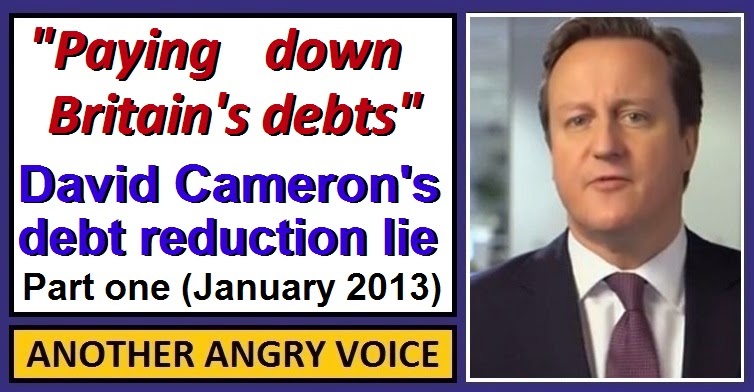
David Cameron's debt reduction lie


Anyone who remembers the details of the 2010 General Election campaign would attest that David Cameron is a barefaced liar, who will say literally anything if he thinks it may work to his political advantage. For those with short memories, and those that don't really pay attention to politics but stumbled across this page accidentally, here are two of Cameron's most oft cited pre-election porkies.

"We'll cut the deficit, not the NHS"
Which was swiftly followed by a £20 billion NHS budget cut once the Tories got into power. The next quote also realtes to the NHS:
"No more top-down reorganisations of the NHS"
This one was particularly egregious considering that even as he was repeating this soundbyte, plans to introduce the largest organisational restructuring in the entire history of the NHS (aimed at privatising vast swathes of the NHS into the hands of private sector companies) were being drawn up by the Shadow Secretary of State Andrew Lansley. Had the public known about these secret Tory plans to sell off vast chunks of the NHS, the Tories would have lost hundreds of thousands of votes and almost certainly failed to even scrape together enough votes to form a coalition government.

As it was, the vast majority of the UK population were well aware of the Tory track record and refused to vote for them. Only 23.5% of eligible voters bothered to vote Tory, meaning that 76.5% didn't. As it happened this lack of public support didn't matter because the Tories managed to obtain power by forming a coalition with the Lib-Dems, who, in return for a taste of Tory power, promised to vote through all kinds of extremist Tory legislation, even stuff that wasn't even in the Tory manifesto like Lansley's enormous top-down reorganisation of the NHS which was passed into law in 2011.

Tory apologists may attempt to deflect attention from these transparent lies by claiming that all modern politicians lie in their pre-election campaigns, and to a certain extent they are right: In 1997 Tony Blair and the Neo-Labour lot lied about bringing in new rules to prevent political corruption ("sleaze" as it was called in those days), but they didn't and ended up taking plenty of dodgy donations themselves from people like Bernie Ecclestone. David Cameron's deputy Prime Minister Nick Clegg also proved himself a pre-election liar by voting through plans to triple university tuition fees for English students aftrer "pledging" to vote against any plans to raise fees just a few months before, a pledge that won his party 100,000s of votes from students, former students and academics.

The problem with this defence is that Cameron and the Tories have continued brazenly lying to the public throughout their administration. Anyone with an interest in military affairs will already know about one of Cameron's big early 2013 lies. He promised that there would be no British "boots on the ground" in the Mali conflict in mid-January, only to decide to send British troops into the conflict zone just a couple of weeks later in late January.


January 2013 also witnessed what I consider to be one of his most egregious lies yet. In a scripted Party Political broadcast, Cameron claimed that "we are paying down Britain's debts". In fact the combination of the catastrophic failure of George Osborne's ideological austerity experiment and rampant industrial scale tax-dodging is creating a situation where the economy is flatlining, Osborne is missing all of his economic predictions and the national debt is still growing at an alarming rate. Given the appalling economic figures in recent months it is debatable whether the Tories are even cutting the deficit, let alone the debt.

The Labour MP Rachel Reeves was quick to pick up on this brazen lie and reported him to the UK Statistics Authority. The response from Andrew Dilnot, the Chairman of UKSA, was damning. He confirmed that there was absolutely no basis for Cameron's claim and then pointed out that the national debt has risen from £811.3bn, or 55.3 per cent of GDP in 2010, to £1,111.4bn, or 70.7 per cent of GDP. It is difficult to obtain any reliable estimates of how bad the debt will be by the General Election in 2015 (The OBR, the ONS and the IMF have all repeatedly produced over-optimistic economic predictions which then need to be downgraded time and again) however a decent ballpark estimate could be £1.4 - £1.5 trillion, or 80% - 90% of GDP.

Dilnot also took the time to explain to Cameron the difference between the debt and the deficit, something that many Tories have struggled with. The way I like to explain it is that a debt and a deficit in economics are analogous to speed and acceleration in physics. The debt is the actual value of the thing and the deficit is the rate of change in the value of the thing.

The big problem for Cameron is that most of the other Tory MPs that have jumbled up the concepts of the debt and the deficit, (or even claimed that they are the same thing!) have tended to do so in the heat of the moment, in live interviews or during unscripted speeches. Cameron has no such excuse. He lied about the national debt in a carefully scripted statement in a party political broadcast, for which there is absolutely no justification because there are only two possible conclusions to draw:

A. Cameron is too stupid to even realise that the script that he was reading contains outright lies about the economy.
B .Or, he knew perfectly well that it was a lie, is  comfortable with telling lies to the public and holds the public in such low regard that he thinks that they are so stupid and ill informed that they won't even realise that he's lying to them.
In my view, either one of these explanations make him entirely unfit to be Prime Minister.


 Another Angry Voice  is a not-for-profit page which generates absolutely no revenue from advertising and accepts no money from corporate or political interests. The only sources of income for  Another Angry Voice  are small donations from people who see some value in my work. If you appreciate my efforts and you could afford to make a donation, it would be massively appreciated.


Flattr this


Thursday, 15 November 2012

Damian Green: A very public liar

I watched the BBC politics show Question Time on the 8th of November 2012 and was staggered by the pathetic standard of debate and absolutely appalled by the blatant lies told by the Tory party Minister for police and criminal justice, Damian Green.

The show, which featured five orthodox neoliberal guests (two members of the neoliberal coalition government, a member of the neoliberal opposition party, a neoliberal banker-economist and a Murdoch cipher from the neoliberal rag called The S*n), started off terribly with universal condemnation from the panel for Philip Schofield of all people. He was criticised by all for daring to ask the Prime Minister the question that was on the nation's lips: "what are you going to do about the paedophilia scandal Dave?"

The next segment was even worse and the focus of this article. It occurred after a question about Quantitative Easing in which none of the panel pointed out that the Bank of England's own research demonstrates that QE and low interest rates are severely impacting savers and people with pension schemes in order to enrich the wealthy minority (a full analysis of that shocking story can be found here).

The economist David Blanchflower sung the praises of Quantitative Easing (hardly surprising since he sat on the Bank of England monetary policy committee that introduced the policy in the first place). Then followed up with a major criticism of Tory debt fearmongering (saying that fearmongering destroys the "animal spirits"/confidence of the market) and a massively understated criticism of George Osborne's utterly catastrophic fiscal austerity policies with an observation that the UK economy has actually shrunk over the course of the last year.

The Tory Damian Green reacted in an incredible way, he openly accused Blanchflower of being wrong and told the obvious lie that:
"Over the last year the economy has been growing"
Blanchflower's incredulous response to this accusation that he was wrong (or downright lying) about the economic evidence, was this:
"Just add the quarters together, it's minus 0.1"
Anyone with basic maths skills could tell you what was the absolutely astonishing thing about this response: It is an example of basic mathematical illiteracy from a guy that sat in one of the most powerful positions in the UK economy (member of the Bank of England Monetary Policy Committee). The glaring error is that you never add percentage changes together, you multiply them.

Here's a simple example +20%, -20%, +20%, -20%. You might instinctively believe that the answer is what you started with (100%) but you'd be wrong. You don't add and subtract, you multiply.
100% +20% =  100 x 1.2 = 120%
120% -20% =  120 x 0.8 = 96%
96% +20% =  96 x 1.2 = 115.2%
115.2% -20% =  115.2 x 0.8 = 92.16%
Quite a difference eh? Obviously when the changes are smaller the effect is smaller too, but it is still a recognisable deviation from the number achieved through addition and subtraction. Here's how the UK growth figures measure up between Q4 2011 and Q3 2012.
2011 Q4 - 100% - 0.4% =  100 x 0.996 = 99.6%
2012 Q1 - 99.6% - 0.3% = 99.6 x 0.997 = 99.3%
2012 Q2 - 99.3% - 0.4% = 99.3 x 0.996 = 98.9%
2012 Q3 - 98.9% + 1.0% = 98.9 x 1.01 = 99.893%
So Blanchflower was right about the UK economy shrinking but he had actually slightly underestimated the rate of shrinkage (which was actually minus 0.107) due to his basic mathematical illiteracy!

Damian Green's response to this counter-statistic was even more incredible, he said that "it's just not true". Not only was Green lying, he actually accused the guy that was (almost) correct of being the one that was lying.

Green's second lie was even more egregious, he claimed that when the Tories came to power, the UK had the largest debt of all the major developed economies. Here's his outright lie, word for word:

"The reason that the 'animal spirit' of the economy was destroyed was that we had the worst debt of any G20 country, because the previous government spent money like water and left us bankrupt"

Anyone that knows anything about the history of Quantitative Easing (the subject of the question) or the economy of Japan would have recognised this as the obvious fearmongering lie that it was. After all the UK public debt is still significantly less than half of Japan's is, even now. In fact, checking the 2009 figures reveals that five of the G20 nations had significantly higher debts that the UK as a proportion of GDP (see graph) In real terms, the UK national debt ($2.183 trillion) was also significantly smaller than the United States ($14.256 trillion), Japan ($5.068 trillion), China (4.909 trillion), Germany (3.352 trillion) and France (2.675 trillion).

Whichever way you look at it, Green's assertion was an outright lie. What is more, an outright lie that gives a lot of credence to Blanchflower's point about 'animal spirits' being too low. Of course market confidence has been lower than it should be, if government ministers regularly engage in spectacularly misleading debt fearmongering such as describing the UK economy as "bankrupt" in front of a live audience and a TV audience of millions.

I don't want to dwell too much on the tribalistic dig at Labour for "spending money like water", other than to say that that also is a pretty spectacular misrepresentation. Until the global economic crisis hit, the national debt under Labour had never exceeded the 41.9% GDP debt they inherited from their Tory predecessors. Even after the spectacular financial sector meltdown in 2007-08, the debt under Labour rose to 52.1% which is significantly lower than the average debt in either the 19th or the 20th Centuries (the average debt throughout the 20th Century was 89.5% of GDP).

This kind of lying and misleading can be seen as a classic example of Tory propaganda. Outrageous lies that become universally accepted through nothing more than constant repetition. This debt fearmongering strategy is part of the tactic I defined as the Great Neoliberal Lie.

After two egregious lies in the space of a minute Green then went on to draw a stunningly one sided picture of a flourishing UK economy with a ridiculous display of cherry-picked evidence. Here's what he said.
"The two big economic measures by which governments are judged are inflation and unemployment. Inflation is half the level it was a year ago and unemployment has been falling... So actually, on the big economic measures things are getting better."
There are so many problems with this statement it is difficult to know where to start. Firstly I'll question the assumption that the two most important measures of government success are inflation and unemployment. Up until the 1970s the size of the trade deficit/surplus was considered the best indicator of economic health, but ever since the British industrial sector decline began under the Thatcher administration, the Trade deficit has fallen out of fashion, simply because the figures have been so unrelentingly awful for the last three decades. In June 2012 the UK trade deficit reached an all time high of £4.4 billion and in August 2012 the second highest ever trade deficit of £4.2 billion was recorded, with a £9.8 billion deficit if only imports and exports of physical goods are included. These appalling trade figures show exactly what a desperate state the UK economy is actually in, as compared to other G20 nations such as the United States, China, Japan and Germany. These woeful figures demonstrate that the UK export market is struggling badly, leaving the economy more reliant upon imports than ever before. Other key economic indicators that Green conveniently discards as trivial include GDP growth (which has been negative for a whole year) and deficit spending (which has been intensified by the stagnant economic conditions caused by austerity).

We only have Green's assertion that we should only be judging the economy by the two measures he gives us, the ones that conveniently show the economy in a flattering light. But then, if we consider the indicators he cherry-picked in more detail we find that these are heavily distorted ways of presenting the data. I'll deal with these one at a time:

Firstly, Inflation. Green is correct that inflation has fallen from the absurd peaks of 2011, but inflation rates considered in isolation are pretty much meaningless. The best way to consider the effects of inflation is to compare the figures with other economic factors such as interest rates or wage rises. If the rates of inflation are compared with the Bank of England base rate we find that inflation has been massively outstripping interest rates. In 2011 inflation/interest ratio peaked above 1,000% on both inflationary measures (see graph).

What this means is that inflation is massively outstripping the interest earned on savings and pension schemes. Even though the headline inflation rate is much lower than the extremely high interest rates of the Thatcher years, the economic impact is much, much worse, because interest rates are not keeping pace with inflation.

Inflation peaked twice under the Thatcher administration, in May 1980 RPI inflation reached 21.9%, but the BoE base rate was 17% making a inflation/interest ratio of 128% and in October 1990 RPI inflation peaked at 10.9%, but the BoE base rate was even higher at 13.875% making an inflation/interest ratio of 79%, both significantly higher than the average throughout the Labour administration, but tiny in comparison to the incredible October 2011 inflation/ RPI interest peak of 1,080%.

Sources:
RPI & CPI inflation data
Bank of England base rates, historical data

Another way in which it can be seen that inflation is actually very high is the fact that inflation has been consistently higher than wage inflation ever since the Tories came to power. Average weekly pay rises in October (change in weekly pay over 12 months) account for only 56% of the value of RPI inflation and 67% of CPI inflation, meaning that wages are shrinking in real terms. When the purchasing power of wages declines in real terms, this creates a fall in aggregate demand. If people find that their wages are not stretching as far as they were last year, they have two choices, they can either cut back spending (reducing economic demand) or borrow more money to maintain their standard of living (not good in economic terms, and not easy given the difficulty of obtaining credit these days).

Even if we ignore comparative assessment of the headline inflation figure and work with the basic numbers there are more problems. Both measures of inflation are conservative, especially the CPI (which excludes housing costs, council tax, transport costs and fuel) but the RPI is also heavily distorted by the fact that it excludes millions of low income pensioners from the calculations and the ONS are even bidding to change the way that RPI is calculated to artificially bring the rate of inflation down.

Just think about inflation it in real terms. How much has your supermarket shopping bill been rising, even though you may have been making cutbacks? How much are the costs of public transport rising? How much has the cost of petrol/diesel gone up this year? How much have your electricity and gas bills risen by? How about your water rates? Green's misleading assertions about the government's low-inflation achievements fly in the face of the everyday experience of millions of people.

Secondly, I'll deal with Green's upbeat assessment of the unemployment situation: The headline unemployment figure may have been falling for several months, but the lack of economic growth leaves us with a paradox. How can employment be rising, yet economic activity be shrinking? You have to be careful with this (perfectly reasonable) question, the Tory employment minister Iain Duncan Smith accused the BBC economics correspondent Stephanie Flanders of "pissing all over British industry" for asking exactly that question and working through some potential answers.

Here are some potential answers:
  • Unemployment is falling but the proportion of workers in part-time work is near an all time high (8.1 million), with over one in four workers doing part time hours.  Hence there is less money in the economy due to falling take-home salaries.
  • Lots of reasonably well paid jobs (civil service, manufacturing, construction) have been lost, whilst a high proportion of new jobs are low-paid and minimum wage work, meaning that even though more people may be in work, a significantly greater proportion are earning poverty wages. 
  • Many millions of workers have been on pay freezes for years, which has driven down their spending power.
  • Another potential answer is that the calculation methods have been rigged for political reasons on so many occasions that the headline figure of 7.8% is virtually meaningless, given that the real level of general unemployment is closer to 20%.
  • Another indicator of unemployment is the number of people claiming unemployment benefits, which rose by 10,100. Quite a remarkable rise, given the increased difficulty of making benefits claims under the the coalition government.
  • Yet another indicator that the unemployment situation isn't as fabulously rosy as Green would have us believe is the fact that long-term unemployment is also on the rise, with the number of people out of work for over a year rising by 12,000 to 894,000.
Whatever the case, people in Britain are acutely aware that the unemployment situation is nowhere near as rosy as Green would have us believe. With the industrial and construction sectors in terrible decline and massive job losses (such as the Transit van closure) coming on a regular basis, you'd have to be a fool to accept the Tory narrative that everything is getting better.

Even though Green cherry-picked the two economic indicators that he could actually work with to weave an absurdly misleading narrative about how everything is getting better, closer examination reveals that both inflation and unemployment are significantly worse than the impression created if the headline figures are considered in isolation. General unemployment is closer to 20% than 7.8% and inflation, when considered in relation to interest rates or wages is far higher than anything experienced during the previous Labour administration, and in fact far worse even than the inflationary spikes during the Thatcher years.

If we consider other key economic indicators, the picture is just as bad: Economic growth (minus 0.113% over the course of an entire year), deficit spending (debt increases as a percentage of GDP comparable to the scale of borrowing needed to fund the Great War and the World War), the trade deficit (2 all time highs in recent months), trade deficit in goods (£9.8billion in August), Exports (minus 1.2% in August) manufacturing output (minus 1.1% in August), construction (shockingly bad figures with an 11% overall decline between Q3 2011 and Q3 2012), Consumer Confidence (an October decline in consumer confidence, a continuation of the appallingly bad long-term low confidence trend under the Tory led government). Wherever you look there is plentiful evidence that the UK is in chaos, with just a tiny pocket of extremely wealthy people insulated from the devastating effects of Tory economic mismanagement and the Bank of England's stagflationary monetary policies.

Conclusion

I realise that this is a bloody long article to make the point that a particular politician is a liar and a manipulator. I mean the growing levels of cynicism about British politics mean that the majority of people seem to accept the idiom that the best way to tell if a politician is lying is by looking to see if his lips are moving. Damian Green however, is a particularly loathsome and  transparent liar, even by modern political standards.When he got caught in his first lie, he simply accused his opponent of lying about the facts. He used his second lie to counter accusations that Tory economic fearmongering had damaged market confidence, a lie that was a particularly egregious display of completely inaccurate Tory debt fearmongering, which completely reinforced the point that his opponent had made about market confidence being damaged by fearmongering. Chuck in a bit of inaccurate tribalistic political point scoring and he managed three stunningly obvious lies in the space of a minute.

He then followed up this blunderbuss of lies with an audaciously rosy assessment of the state of the UK economy, which relied upon cherry picked statistics and lame anecdotes. Anyone with half a brain in the audience could tell that things are not nearly as great as Green would have us believe.

The fact is, that this man feels completely at ease telling obvious lies to huge audiences, and that barely a word that comes out of his mouth is not some kind of lie or distortion. As long as flagrant liars like Damian Green are given the oxygen of publicity, public trust in the political classes will never come close to recovery.

In a government of liars and manipulators, Damian Green is such a bold and bad liar he stands out as particularly dishonest. I have attempted to show (using evidence and analysis) exactly how much of a transparent liar the man is. Hopefully, next time you see the man speak, you'll take whatever he says with a wheelbarrow full of salt.


Monday, 8 October 2012

Tory economic illiteracy

On the 8th of October 2012 the Tory party kicked off their conference with two breathtaking displays of economic illiteracy on national radio.

On Radio Five the Tory MP for Devizes in Wiltshire made the absurd claim that the deficit and the national debt are the same thing. Here's a transcript of the interview:
Victoria Derbyshire: "What is puzzling is, under Labour debt equals bad, under the Conservatives and Liberal Democrats national debt equals?"
Claire Perry: "We have cut Labour’s deficit Victoria by a quarter"
Derbyshire: "I’m talking about debt"
Perry: "Well it is the same thing"
Derbyshire: "It is not the same thing!"
What makes this confusion all the more shocking is that Perry is a former banker who worked for Bank of America and Credit Suisse. A banker getting confused between the concept of debts and deficits is equivalent to a physicist getting confused between the concepts of speed and acceleration!

It suddenly seems no surprise at all that the world has been engulfed by a gigantic financial crisis, if banks have been employing people so economically clueless that they are incapable of differentiating between two such fundamental economic concepts. It is also no surprise that the crisis has dragged on for so long if the political classes are also incapable of making such simple economic distinctions.

Aside from the fact that this seemingly economically illiterate woman has spent a long career in banking and business, another surprising fact is that she also worked as an advisor to the Tory party chief strategist and current Chancellor of the Exchequer, George Osborne. A man who just happens to be the other Tory to have brazenly displayed his economic illiteracy on national radio that same morning.

Osborne's crime against economic coherence is one that he has repeated time and again. It is the simplistic justification narrative that the record low cost of government borrowing is directly caused by market "confidence" in his ideologically driven and economically destructive austerity experiment. here's exactly what he said.
"Our policy has got the deficit down by 25%, it is every single day delivering in the World bond markets record low interest rates for this country, which shows that it has credibility."
 I've already written a long article outlining exactly how fallacious this argument is (which you can read here) however for the purposes of this article I'll summarise some of the main points.
1. Yields are extremely low because of high demand for "safe" investments like government bonds in times of economic crisis. If the market had confidence that Osborne's fiscal policies could stimulate economic growth they would be investing in the wider economy in the expectation of growth, not in extremely low interest government debt. The fear of excessive risk elsewhere in the system is driving investors to mothball their wealth in safe but unprofitable government debt.
2. There is quite obviously more correlation between all time low bond yields and the Bank of England's "unprecedented" monetary policies than Osborne's  fiscal policies which are only unprecedented in the scale and longevity of the catastrophic economic consequences. 
3. Countries that like the UK have held interest rates at near zero and created vast amounts of quantitative easing cash (Japan, USA) have also experienced repeated record lows in state borrowing costs.
4. Other countries implementing similar austerity policies to "Osbornomics" (Spain, Italy, Portugal, Greece) - but not creating quantitative easing windfalls due to lack of monetary autonomy - are suffering recessions like the UK, but also facing unsustainably high borrowing costs.
5. Countries that have been largely avoiding such drastic "cut now, think later" austerity measures are benefiting from similarly low borrowing costs to the UK (USA, Finland, Germany).
All in all a powerful demonstration that Osborne is talking economic gibberish. There are obviously two potential reasons for this, he is either economically illiterate and doesn't even realise that he's talking bobbins, or he knows exactly how disingenuous it is to conflate fiscal policy with monetary consequences, but he has such contempt for the British people that he believes he can just "get away with" creating such a misleading economic justification narrative.

Given the fact that Osborne has no economic qualifications and one of his former advisers doesn't seem to understand the difference between a deficit and a debt, it seems entirely plausible that he is actually so economically illiterate that he actually believes his own pitiful justification narrative. On the other hand, his party have such a long record of dishonesty and contempt for ordinary working "plebs", it is also entirely possible that he knows exactly how disingenuous he is being every time he repeats his absurd "market confidence" story.

Whatever the case, these two examples of Tory economic illiteracy on the same day clearly demonstrate that the Tory party is full of people that either don't understand basic economic theories, or are prepared to talk absolute nonsense in the expectation that the general public are so economically illiterate that they wont get called up for spreading such abject gibberish. It is quite remarkable that the Tories still manage to posture themselves as the most trustworthy party in economic matters, when their economic strategy has been such a disaster (the UK economy is actually smaller now than it was when the Tories came to power despite £200 billion in QE cash during the period) and they feel free to openly demonstrate their economic illiteracy on national radio. 


The fallacy of "market confidence" in austerity


With his ideologically driven "cut now, think later" austerity agenda the Tory Chancellor George Osborne is making a mess of running the UK economy. You don't have to take my word for it, the economic data speaks for itself. Since becoming Chancellor in 2010 Osborne has driven a weakly recovering economy back into recession (despite the injection of £200 billion into the financial system via the Bank of England's Quantitative Easing financial doping scheme). The UK has suffered three consecutive quarters of negative economic growth and the UK economy is actually smaller now than it was when he took over. Even right-wing neoliberal cheerleaders like the IMF have admitted that Osborne's economic strategy is failing. What makes this so remarkable is that the Tories have pumped £40 billion into IMF coffers and the IMF are always very reluctant to criticise their creditors.

Even loyal Tory demographics are beginning to question Osborne's growth strategy, with several influential business groups calling for a change in policy to stimulate growth, exactly the same kind of people that wrote to the Telegraph in 2010 to applaud Osborne's barmy "cut-our-way-to-growth" strategy.

That he is the most unpopular minister in an extremely unpopular government, which includes appalling characters (like Iain Duncan Smith and Jeremy Hunt) is a clear demonstration that a good proportion of the public also recognises that "Osbornomics" is failing,  A poll in September 2012 revealed that his approval rating had reached an incredible minus 42%, (58% of people think he is doing a bad job offset by only 16% of people that think he is doing a good one).

One of the things that infuriates people the most about Osborne's inept performance as Chancellor is his constant reliance upon feeble excuses. At first he stuck with the simplistic Tory mantra, the constant repetition of "the mess that Labour made" even though anyone but a half-wit could recognise that the "credit crunch" was actually a global economic crisis. Over time Osborne has added a number of other excuses such as "the Eurozone crisis", "the Jubilee", "the cold winter", "the wet summer", "the Royal wedding", "fluctuating commodity prices"... Whatever the excuses for the staggeringly poor economic performance there is one that the public will never hear; "I'm just a massively over-promoted rich boy who is completely out of his depth".

The thing that infuriates those of us that understand a bit about economics even more than Osborne's reliance upon pathetic excuses, is his outright abuse of economic evidence to justify his economic policies. The worst example is his near constant repetition of the narrative that the low cost of government borrowing is evidence that "the markets" support his economic policies. 

He has repeated this simplistic and misleading narrative over and again, the latest example being an interview with James Naughtie on the Today show on the 8th of October 2012, where immediately after accusing Naughtie of conflating two things (without a hint of irony) he stated that:
"Our policy has got the deficit down by 25%, it is every single day delivering in the World bond markets record low interest rates for this country, which shows that it has credibility"
It is undeniable that the yields on UK Treasury bonds have reached all time lows during Osborne's tenure, however any claim that Osborne's fiscal policies are the root cause of these low borrowing costs is stunningly fallacious example of ignoring the evidence.

There is so much evidence that the low cost of borrowing is effected by other factors it is difficult to know where to start.

Firstly we'll start by thinking about a correlation.

1. The cost of government borrowing has reached all time historic lows several times during one of the worst prolonged recessions in modern British history.

2. The Bank of England has been holding the base interest rate at the lowest level in British history (0.5%) for over three years.
Does anyone seriously believe that 1 & 2 are completely unrelated and that the unprecidented low cost of borrowing can actually be ascribed to Osborne's fiscal policies rather than the Bank of England's unprecedented monetary policies? When you answer the question try to remember that Osborne's deficit reduction plans are widely criticised fiscal policies that many people believe are responsible for the economic stagnation of the last two and a half years.

Next we should consider who are amongst the principle buyers of UK government debt. Since 2008 the Bank of England have "magicked up" £375 billion via Quantitative Easing to invest in buying up UK government debt for cash in order to "create market liquidity". Does anyone believe that such a vast intervention in the bond market wouldn't have the effect of driving down bond yields?

I'd say that the ultra-low interest rates and the vast Bank of England QE interventions alone are convincing evidence to make a stand-alone case that the low cost of borrowing has little to do with Osborne's barmy fiscal experiment, and everything to do with central bank monetary policy, however I'll continue with the argument just to hammer the point home.

Even discounting the massive effects of central bank monetary policy, it should be considered that Osborne's theory that high confidence leads to low yields is actually backwards. If long term bond yields are extremely low, this actually suggests that potential UK investors have little confidence in the wider UK economy. If they did have confidence in Osborne's fiscal strategy then surely they would invest in stocks and shares in the expectation of economic growth, increased productivity and increased profits, rather than stuffing their wealth into government bonds with extremely low yields. The fact that they choose to invest in safe, low return bonds rather than investing in the wider economy is actually a clear demonstration that they have very little confidence that Osborne's fiscal policies will lead to any kind of long-term economic growth.


It is absolutely clear that international capital has been searching for safe havens from the economic chaos of the last five years. No investor with a grain of sense has failed to lose a great deal of trust in the financial markets after the global meltdown, especially considering the abject failure of regulators to punish those responsible for creating the economic crisis by spewing toxic sub-prime junk into the market slapped with glowing AAA ratings from the ratings agency oligopoly.

If the financial sector robbed investors once, went completely unpunished, and the industry remains almost entirely unreformed; then there is obviously nothing to disincentivise them from doing exactly the same again; hence sensible investors should be scared. Capital is also fleeing several austerity riddled European economies too. The scale of capital flight out of Spain and Greece is unprecedented. All of this "fear capital" has to go somewhere and UK government debt is considered one of the few remaining safe options, given the extremely low probability of a UK debt default and the willingness of the BoE to "magic up" money in order to buy the bonds back for cash.


If Osborne's fiscal policies of mindless austerity (mainly welfare and capital spending cuts) were really creating confidence, one would expect other austerity economies to be benefiting from low bond yields, however this is absolutely not the case. Spain and Greece are struggling to keep their borrowing costs below the 7% marker of complete unsusatinability.

If we look at other economies that have been benefiting from similarly low government borrowing rates we come up with two very notable countries with significantly higher government debt ratios than the UK (or Spain!). The fact that the US and Japan have both been running their own ultra-low interest and quantitative easing policies gives credence to my first argument that the low cost of borrowing is a monetary policy issue rather than a fiscal policy issue. 

The fact that under Obama the US has largely avoided fiscal austerity and achieved a slow but steady economic recovery and maintained ultra-low bond yields blasts yet another hole in Osborne's "market confidence" theory and the fact that Japan has the lowest bond yields of all (often below 1%) despite having maintained vast government debts (currently well over 200% of GDP) for over two decades and run large deficits for most of that time should sink the Osborne ship of "market confidence" for good.

The fact that Osborne is talking utter rubbish every time he spouts this "market confidence" narrative is completely obvious to an untrained economist like me, which makes me wonder why the hell all the trained economists in the mainstream press are giving him such an easy ride when he trots out this economically illiterate narrative. They are essentially allowing him to get away with endlessly repeating what is either a demonstration of brazen economic illiteracy or a display of utter disingenouosness.

Osborne claims that the low cost of borrowing is a demonstration that "the markets" are confident in his fiscal policies when they are actually a clear demonstration that "the markets"  are mothballing their wealth in the safest assets they can find because they are petrified of risking it in the wider economy. The only elements of "confidence" displayed by this behaviour is a confidence that a UK debt default is less likely than elsewhere, and confidence that the Bank of England will continue to "magic up" cash to buy up their bonds, should they want to get rid of them.

By repeatedly claiming that his socially and economically destructive fiscal polices are the root cause of the all time low cost of borrowing, rather than the Bank of England's unprecedented monetary policies of holding interest rates at an all time low for over three years and "magicing up" £375 billion in order to buy up government bonds, Osborne is either demonstrating that he is an economically illiterate idiot, or he is taking you for one.
Another Angry Voice is a not-for-profit page which generates absolutely no revenue from advertising and accepts no money from corporate or political interests. The only source of revenue for Another Angry Voice is the  PayPal  donations box (which can be found in the right hand column, fairly near the top of the page). If you could afford to make a donation to help keep this site going, it would be massively appreciated.


Saturday, 24 September 2011

Mixed Economy vs Neoliberalism

British economist John Maynard Keynes,highly influential
in the creation of the Post-War consensus mixed economy.
I decided to make this comparison after reading yet another baseless and generalised attack on the concept of socialism, which went along the lines of:

"Government's are not very good at spending money. This is one of the reasons socialism doesn't work".


So how about looking at the track records of state socialism and neoliberalism in the contexts of UK public spending and socioeconomic trends before we start accepting sweeping generalisations like this?


The Post-War Consensus mixed economy (a mix of state socialism and regulated capitalism).
  • 1947-1979 (32 years).
  • Key influences & personalities: John Maynard Keynes, R. H. Tawney, William Beveridge, Clement Atlee, Nye Bevan, Harold Macmillan.
  • Origins: Started in the wake of a massive debt crisis (WWI + inter-war economic chaos + WWII).
  • Budgetary responsibility: 28 consecutive years of budget surpluses, only three years of budget deficits.
  • Government Debt: Reduced national debt burden from 237% of GDP in 1947 to 43% in 1979.
  • Economic stability: Other than the economic turmoil of the mid-late 1970s which was used as excuses to destroy the Post-War Consensus, an era of relative economic stability despite the loss of Empire and the Cold War partition of Europe.
  • Poverty: Massive reduction in levels of absolute poverty.
  • Consumer spending power: Provided ordinary working people with levels of discretionary income never seen before (or since).
  • Employment: Kept unemployment low on a long term basis.
  • Housing: Massive reduction in levels of slum housing and gradually improved access to decent housing for hard working people.
  • Public Health: Introduction of the National Health Service to provide health care "free at the point of use".
  • Overview: Long term economic stability, massive public debt reduction, commonly referred to as "the golden age of capitalism".
The neoliberal experiment (based on the bankrupt ideological dogma of amoral neoliberalism).
  • 1979-2011 (32 years)
  • Key influences & personalities: Milton Friedman, Frederick Hayek, Margaret Thatcher, Ronald Reagan, Augusto Pinochet, Gordon Brown.
  • Origins: Started in the wake of a few relatively* minor crises (1973 oil shock, late 70s industrial unrest) with the lowest levels of government borrowing in over a Century.
  • Budgetary responsibility: Only managed to record budget surplus in 17 of 32 years with a best run of 7 consecutive years (1983-1991) which was partially funded by the firesale of heaps of state infrastructure (privatisation).
  • Government Debt: Increased levels of national debt from 43% to 164% (including bailouts 91% GDP & PFI scams 15% GDP, which are misleadingly kept off the national debt figures).
  • Economic stability: A period of increasingly violent economic instability despite the end of the Cold War partition of Europe, exponential improvements in IT capabilities and the influx of cheap Asian commodities.
  • Poverty: Massively widening of the poverty gap and the creation of pockets of absolute poverty in formerly industrialised areas.
  • Consumer spending power: Squeezed levels of discretionary income, especially since Osborne's "self defeating austerity" programme and VAT rises kicked in.
  • Employment: Kept unemployment high on a long term basis, with several nasty unemployment spikes during recessions caused by the instability of deregulated markets.
  • Housing: Increased levels of slum housing (via unregulated something-for-nothing slumloring) and increasing difficulty for working people to find access to decent housing due to unsustainable speculative house price inflation.
  • Public Health: Erosion of free public health provision (dentistry & eyecare), and the gradual privatisation of the National Health Service (PFI hospitals, private sector providers, 2011 Health & Social Care Bill).
  • Overview: Resulted in the Neoliberal Economic Crash and "the crisis of capitalism".
* = By "relatively" I mean in comparison to the economic consequences of the World Wars or the Neoliberal Economic Crisis.

Conclusion

Despite the demonstrable failures of militant neoliberalism
over the last 32 years, the UK is stuck with a government
that adheres to the defunct economic dogma of Milton Friedman.
Although there were still plenty of political and socioeconomic problems during the Mixed Economy years I'd say that overall this basic comparison makes a pretty convincing case for a return to the mixed economy. However the ruling Tory led coalition are insistent that the bankrupt "greed-is-good" neoliberal show must go on and that ordinary working people are going to have to pay through the nose for the huge economic failures of the establishment's defunct neoliberal dogma via deliberately stagflationary economic policies, while the financial sector elite laugh all the way to the (taxpayer subsidised) bank.

Monday, 12 September 2011

Neo-Labour legacies


Occasional cartoon series
(Hit F11 to view in full screen)

 
Neo-Labour legacies           (11 Sept 2011)

Inspired by an accusation that I am a "partisan Labour supporter" on an internet forum. 

More reasons not to vote Labour and an article about  Gordon Brown's economic alchemy schemes.

Saturday, 10 September 2011

Gideon's Folly


Occasional cartoon series
(Hit F11 to view in full screen)


Gideon's Folly           (10 Sept 2011)

Inspired by Chancellor of the Exchequer, George Osborne 
describing his ideologically driven and irrational 
"Deficit Reduction Plan" as "a rock of stability upon which out economy is built". 

More about George Osborne's "rock of stability metaphor"


 If you enjoyed this cartoon, maybe you could buy me a beer? £1 would get me a can of cheap lager whilst £3 would get me a lovely pint of real ale.

George Osborne's "rock of stability"


On 9 September 2011 George Osborne, the man in charge of the UK economy, made a speech at Chatham House in London alongside the newly appointed IMF boss Christine Lagarde in which he made some astonishingly facile statements about the UK economy. The most notable of which was his absurd description of his ideologically driven "austerity agenda" as the foundation of Britain's economic stability. Here it is in his own words:
"We will stick to the deficit reduction plan we have set out. It is the rock of stability on which our economy is built."
It saddens me that anybody could consider using such a glib and inane metaphor in a serious discussion about economics (we must assume he wasn't joking) but that such a misguided economic sentiment could be uttered by the Chancellor of the Exchequer is quite astonishing, although perhaps explained by the fact that he is not an economist, his degree is in History!

I don't have a degree in Economics either but I've worked out for myself that the foundation of economic stability is something a little more fundamental to the system than some ideologically driven government "austerity" scheme.

If he'd read it out this absurd conflation of a fluid political process and an economic foundation, nonchalantly or absent mindedly whilst delivering a long and poorly written speech that he'd only had time to skim read before delivering, we could perhaps forgive him. However this crass and senseless metaphor is actually one of Osborne's carefully selected and oft repeated economic soundbytes, part of the simplistic economic narrative he uses to explain the economy to us "thickwits" in the general population. It seems as if the Tories believe that their economic rhetoric doesn't even have to make any kind of sense, even at the most basic level, it just needs to contain the right balance of reassuring words and economic jargon in order to placate the masses.

How on earth could the Tories have considered using such an incoherent metaphor which relies on the fundamental confusion of processes and a foundations to "explain" their harebrained economic methodology? It's just idiotic.

As a former construction worker I tend to think of processes (like economic policies) as things that take place within structures, which in turn are built upon foundations, not as the foundations themselves. Foundations would tend to be fundamental things without which the rest of the edifice could not even exist. So if we are going to use simplistic metaphors to explain complex economic ideas perhaps we could say that productivity is the foundation of the economy, trade is the structure, and the economic establishment  are the construction workers. This leaves short term ideologically driven government fiscal policies like "Osborne's Austerity" as the builders' tools. In fact it would be fair to say that "Osbourne's deficit reduction plan is a sledgehammer" is a much better metaphor than the fantasy that his ideologically driven plan is some kind of bedrock of economic stability.

I've chosen to use productivity as the foundation of my economic metaphor because without economic production there would be nothing to trade. Human society would soon degenerate back towards the kind of seasonal hunter-gatherer society it originated from if nobody produced any goods or services.

To make a crude distinction, there are two kinds of productivity; private productivity and state productivity. The problem with Mr Osborne's simplistic worldview is that he believes the militant neoliberal economic dogma that state productivity is basically "waste" until it is commodified via privatisation. The Deficit Reduction Plan he describes as a "rock of stability" is actually a mechanism for selling off or simply shutting down state productivity, a sledgehammer that he is using to smash lumps off the economic foundation of productivity, undermining the wider UK economy.

Some people have such a simplistic anti-public sector mentality that they don't even seem to understand that the state services that are under attack are intricately linked with private sector productivity. Without a fit and healthy workforce productivity falls, without adequate policing, crime and soaring insurance costs undermine productivity and without hefty investment in scientific research and higher education, the high-tech industries of the future will look elsewhere to set up production.

Osborne's "slash and burn" austerity policy is riddled with false economies and is reliant on the Great Neoliberal Lie (that immediate deficit reduction is the first and overriding economic priority). It is absolutely no surprise at all that Osborne's economic policies won praise from Christine Lagarde, the head of the IMF.

Many commentators have picked up on lagarde's comments about the need for ministers to retain "flexibility" and used them to claim that she was somehow contradicting Osborne's monetary policies, however as a Chicago school trained economist and the leader of the most powerful neoliberal organisation in the world, it seems much more likely that she is asking Osborne to consider another round of massive financial sector bailouts and more conjouring cash out of thin air through quantitative easing, than asking him to keep an open mind about a return to a stable Keynesian style mixed economy.

Returning to Osborne's idea that his "cuts agenda" is some kind of defence against the collapse of the UK economy, perhaps we should consider that this statement came about because Osborne and the Tories know something that they are refusing to share with us "dimwits" in the general public. Perhaps this "missing information" is that the bankers that provide more than 50% of Tory party political donations have made it absolutely clear to George that they intend to have their overleveraged banks recapitalised by the state, and that ordinary working taxpayers are the ones that are going to have to pay for it, through wage freezes, slashed services and economic deflation.

It seems obvious that Osborne has been warned by the financial sector that they will inflict severe economic sanctions (downgraded credit ratings, refusal to lend to British businesses, vulture capitalism) on the UK government if they let up on the policy of bleeding the real economy dry in order to recapitalise their financial institutions. The fact that most of these "austerity" policies fit snugly with George Osborne's personal faith in militant neoliberal dogma means that there is effectively no chance that these policies will be halted, no matter the scale of the damage they inflict on the UK economy.

Dreadful economic growth, borrowing and unemployment figures for 2011 show that the UK economy is slipping back into recession, which would create a shrinking tax take and immediately eliminate many of Osborne's "austerity savings" through reduced government income. None of this matters though, if Osborne continues refusing to even admit that there is an alternative to militant neoliberal economic vandalism.

It is quite clear that there are alternative methods for reducing government borrowing; we only have to look back a few decades to what preceded neoliberalism. The post war consensus mixed economy created 28 consecutive years of budget surpluses (1948-1975), reduced the national debt from 247% of GDP down to just 43% and improved standards of living across the nation. In the subsequent 31 years of unbroken neoliberal economic policy, governments returned budget deficits in 17 of them and the wealth gap has increased faster than ever before. Since the Neoliberal Economic Crisis really kicked in, government debt (including bailouts) has risen from 36% of GDP (2007) to 150% of GDP (2011).

Another more recent example of a nation state breaking with IMF approved neoliberal heterodoxy in order to power their way out of recession can be seen in Argentina. As the neoliberal economic crisis in Argentina preceded the wider Global Neoliberal Economic Crisis, a comprehensive understanding of Argentine Recovery Economics should be a staple for any government intent on using whatever means possible to drag their nation out of recesion.

With "Osborne's austerity recession" on the doorstep and a new round of economically destructive Quantitative Easing looming, these frighteningly poor government debt figures only look set to worsen, yet virtually nobody in mainsteam politics or economics is prepared to admit that militant neoliberal dogma has been shown up as little more than dysfunctional and amoral economic alchemy, least of all our Chancellor Geogre Osborne.


 If you enjoyed reading this post, maybe you could buy me a beer? £1 would get me a can of cheap lager whilst £3 would get me a lovely pint of real ale.