Showing posts with label Economics. Show all posts

Friday, 31 January 2025

Donald Trump's 100% tariff threats against BRICS could seriously backfire


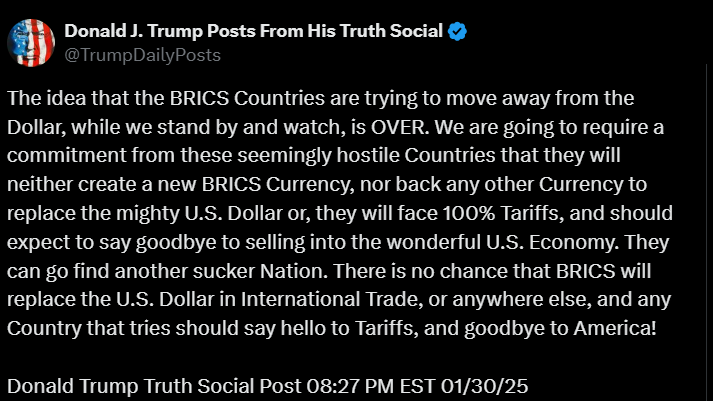
Donald Trump has announced the threat of 100% tariffs on imports from BRICS countries unless they commit to the perpetual superiority of the US Dollar in international trade.
There’s nothing new about Donald Trump threatening extreme protectionist measures against other countries, in fact he’s about to shatter the USMCA trade agreement by imposing 25% tariffs on the United States’ neighbours and allies Mexico and Canada.

However the extreme threat of 100% tariffs on products from Brazil, Russia, India, China, South Africa, Egypt, Ethiopia, UAE, Iran, Indonesia, and a multitude of other BRICS aligned economies just goes to show how threatened his administration feels by any kind of transnational economic cooperation that doesn’t involve the United States.

Despite all of Trump’s assurances (lies) that the tariffs he imposes will be paid by the countries he’s trying to economically sanction, the reality is that they’ll be paid by US businesses and citizens when they purchase imported products.

Raising the price of imported goods via tariffs incentivises consumers to buy domestically produced goods and services by making them artificially cheaper, however it’s impossible to boost US output overnight, so more tariffs mean more price rises.

And 100% tariffs would mean that prices would literally double.

Take China as an example. Over the last few decades US capitalists have made fortunes by closing down domestic production and importing from China instead, where lower wages, weaker regulation, and poorer environmental standards mean much higher profit margins.

In 2023 China exported $501 billion in goods and services to the US, while the US exported $147 billion to China in return, meaning the US trade deficit with China is over $350 billion.

If Trump were to impose 100% tariffs on Chinese imports, that would end up lumbering US consumers with hundreds of $billions in extra taxes.

Then bear in mind that it wouldn’t just be China either. If you add up US imports from the BRICS member states alone (setting aside the 9 partner states and 8 more that have applied for membership), it adds up to over over $660 billion per year in imports.

It’s beyond fantastical to imagine that US companies that rely on Chinese manufacturing and $160 billion+ in imports from other BRICS member states would be either capable of, or willing to close down their overseas operations and build replacement factories in the US overnight, so prices will go up.

You can’t just expect production to shift back to the United States overnight. Neither for high tech electronic components, nor cheap mass produced consumer goods.

You can’t just slam the door shut on global supply chains and expect factories producing hundreds of $billions worth of goods to spring up in your own country overnight.

Who is going to pay for their construction? Who is going to staff them? Who is going to train up all of these new workers, especially in high tech manufacturing and services? Who is going to cover the additional costs of the required machine tools if they’re produced in countries that are subject to Trump’s sanctions? Where are the raw materials that the US cannot produce for itself in sufficient quantities (rare earth metals for example) going to come from?

Trump’s repeated threats to impose tariffs are akin to the behaviour of a local mob boss trying to bully their local community into conformity. Either everyone does as he says, and conduct business through his cartel, or they suffer reprisals and punishment beatings.

And the punishment beatings aren’t just being meted out on rival economies like China either. Trump’s economic sanctions on Mexico and Canada illustrate the fact that the new US administration is prepared to sanction and destabilise its allies, as well as geopolitical rivals.

There are quite obvious parallels between Trump’s tariffs and Brexit. Both raised trade barriers between themselves and their neighbours; both have been sold to the public with a pack of outright lies about the consequences and exaggerations of the benefits; both can be seen as self-applied sanctions with dramatic effects on domestic businesses that rely on imports and exports; and both diminish the country’s reputation and diplomatic standing by unilaterally tearing up previously agreed treaties and agreements.

Then there’s the fact that previous US attempts at protectionism have backfired spectacularly, like the embargo on the sale of advanced AI chips to China, which seemed to force the Chinese into coming up with better and more efficient AI language models, and the $1trillion implosion of US tech stocks after the release of DeepSeek-R1.

It’s vanishingly unlikely that countries that are targeted by Trump’s tariffs would just lie down and take it, without replying with tit-for-tat tariffs of their own, which would seriously damage US exports.

And seeking to bully other countries into subservience to US interests could end up being highly counter-productive to the stated aim of weakening BRICS.

If the US gains the reputation of a bully that purposefully disrupts and damages other countries economies to pursue their own agenda, or simply due to the whims of their unstable and unreliable President, doesn’t that make it more likely that countries will turn towards BRICS for stability and mutually beneficial trade, rather than against it?

Wouldn’t Trump’s trail of disruption and broken trade agreements hasten the development of a global currency "to replace the mighty U.S. Dollar" rather than dissuade it?

Take a look at how the World has changed since the beginning of the neoliberal era in 1980 when China was a trading minnow compared to the United States.
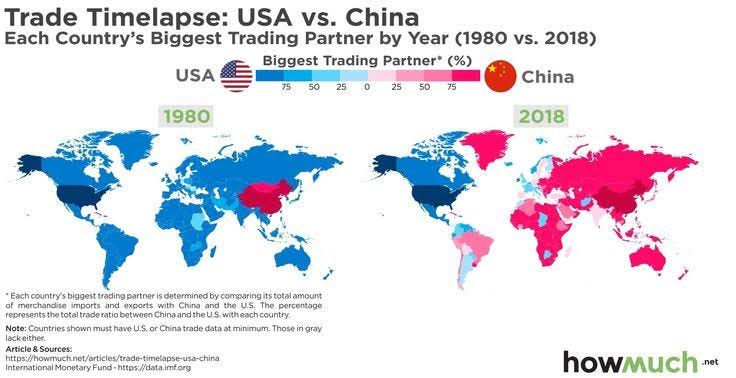
By 2018 China was already doing more trade than the United States with well over half the countries in the world.

If the United States becomes a global bully that doesn’t just destabilise China and its allies on the whims of its increasingly deranged President, but attacks its own allies and trading partners like Canada and Mexico too, doesn’t that further strengthen the Chinese?

If the US seeks to bully a country into coming over to their side of Trump’s new isolationist iron curtain with the threat of tariffs, but China is their bigger trading partner, and doesn’t resort to intimidation and threats of economic destabilisation, who are they likely to choose?

It seems that all China and BRICS need to do for now is to maintain respectful relations with their trading partners and offer a stable alternative to increasingly erratic Trumpian chaos, and they get to expand their sphere of influence by default, right? 


Another Angry Voice is an ad-free Pay As You Feel publication. If you value this kind of content there are various ways to support AAV below.


Buy Me a Coffee at ko-fi.com

Thursday, 30 January 2025

Rachel Reeves' "new approach" is just "more of the same"

In her latest economic speech Rachel Reeves claimed that "at the election people voted for a whole new approach". That’s possibly true, although a more realistic interpretation could be that Labour won by default because the Tories imploded, and millions stayed at home in despair at the lack of alternatives to the failing status quo.

Even if we accept Reeves’ interpretation of the election result at face value, it’s still deeply problematic.

If people "voted for a whole new approach" then where are the new ideas? Where are the policies designed to make life better for ordinary people? And why does Rachel Reeves’ economic rhetoric sound indistinguishable from the succession of Tory Chancellors who preceded her?

Let’s look at some of the Labour government core positions under Keir Starmer’s leadership.

Austerity

One of the first things Rachel Reeves did was to launch another economically debilitating round of austerity cutbacks, pinning blame on the previous government for her actions.

That’s pretty much identical to George Osborne’s strategy in 2010, of blaming Labour’s supposed economic mismanagement for his ruinous programme of austerity cuts.

Conclusion: "More of the same"

Privatisation profiteering

Starmer’s Labour outright refuses to countenance taking vital services and infrastructure away from parasitical privatisation profiteers to run them as not-for-profit public services.

In fact Starmer’s health secretary Wes Streeting is salivating at the mouth at the prospect of carving the NHS open for even more private profiteering, to the benefit of several private health figures who have donated hefty sums to Starmer’s front bench.

Even Labour’s renationalisation of the railways is a sham which keeps the trains and freight services under the control of greedy private profiteers.

Labour are on the side of the privatisation profiteers, just like the Tories before them.

Conclusion: "More of the same"

Wittering on about "growth"

Rachel Reeves keeps going on and on about creating "growth" but without setting out any kind of realistic framework to get the economy growing in real terms, and without defining any redistribution strategy to ensure that any additional growth isn’t simply hoovered up by greedy corporations, exploitative landlords, financial speculators, and the tax-dodger brigade, leaving the rest of us even deeper in the mire of inequality.

Without redistribution policies Reeves’ "growth agenda" amounts to the same old trickle down economic bunk that neoliberal political grifters have been spouting for decades.

’Just let the rich get richer, and eventually some of it will trickle down to plebs like you’ - It didn’t work in the 1980s, it didn’t work in the Tory austerity years, and it’s not going to work now.

Conclusion: "More of the same"

Child impoverishment

One of Keir Starmer’s first acts as Prime Minister was to purge seven Labour MPs from the parliamentary party for the crime of voting to scrap the Tories’ diabolical poverty-spreading Two Child Policy.

Recent research from the Joseph Rowntree Foundation shows that child poverty is due to rise in England and Wales under Starmer’s leadership, due to Labour’s draconian welfare policies.

Meanwhile in Scotland, child poverty rates are set to fall as the SNP government works to mitigate the terrible consequences of Reeves’ poverty-spreading agenda.

If Labour were to follow the SNP example and scrap the Two Child policy, it’d raise 800,000 kids out of poverty, but they don’t want to do that because they’re too busy pandering to the rich.

Labour aren’t just sticking with Tory child-impoverishment policies, they’re wittering on about how growth is magically going to fix everything while a third of all British kids grown up in poverty.

Conclusion: "More of the same"

Welfare scapegoating

One of the most depraved things about the 2010-2024 Tory governments was the way they continually attacked the most vulnerable people in society. Not just whipping up public hate against the poor, the unemployed, and the disabled, but implementing cruel and draconian policies to drive the most vulnerable people in society deeper into destitution (Bedroom Tax, Two Child Policy, Benefit Sanctions, "Fit For Work" assessments …).

Rachel Reeves has been copying from the same Tory playbook by distracting from her own economic failings by whipping public resentment against disabled people, and pledging yet another round of austerity cuts to the disability welfare system.

Conclusion: "More of the same"

The panacea of deregulation

Reeves bangs on and on about deregulation, as if giving powerful corporations even more leeway to do whatever they like is magically going to result in prosperity for the rest of us.

Look at the Grenfell tragedy. Look at our rivers and coastal waters full of raw sewage. Look at the life-ruining Post Office Horizon scandal. Look at the outrageous P&O sackings. Look at the collapse of Carillion. Look at the orgy of corruption going on in Teesside.

Who on earth thinks that any of these things would be have been made better by even less regulation than there was?

And who can forget David Cameron endlessly fulminating against "red tape" and promising a "bonfire of regulations".

How is Reeves’ anti-regulation rhetoric any different from what came before?

Conclusion: "More of the same"

Brexit

Reeves only mentions Brexit once in her speech to say "we are pragmatic about the challenges that we have inherited from the last government’s failed Brexit deal".

But what does this even mean?

Keir Starmer whipped Labour MPs into backing Boris Johnson’s Brexit shambles, and he’s repeatedly insisted that the country is stuck with it now, and there’s nothing to be done to try and mitigate the damage.

How can anyone give a speech on "growth" without acknowledging the diabolical impact that Brexit has had on the British economy?

It doesn’t matter how many pensioners, children, and disabled people Reeves drives into destitution in her cruel and counter-productive austerity book-balancing exercises, when the Brexit sanctions we applied on ourselves are such a massive millstone on the UK economy.

Conclusion: "More of the same"

More of the same

In conclusion Reeves is pretending to offer the change that she says the British public wanted, but in reality whole swathes of her speech, and Labour’s policy agenda are indistinguishable from the rhetoric and policies of preceding Tory governments.

And when people are handed the cold gruel of "more of the same" when they’ve been promised that everything will change for the better, that’s the environment of disillusion that the extreme-right absolutely thrive in.

Another Angry Voice is an ad-free Pay As You Feel publication. If you value this kind of content there are various ways to support AAV below.


Buy Me a Coffee at ko-fi.com

Saturday, 28 May 2022

Do the royals really make us richer?


At times like this, the crawling sycophants always appear in droves to misleadingly insist that the royal family constitute a net benefit to the UK economy.

The absurd creeps making these claims are often so economically illiterate, that they've even been known to claim the entire £19 billion (declared) net worth of the royal family as an annual benefit to Britain!

Putting aside the ludicrous claims that the royal family contribute their entire net wealth to the UK economy every single year, the usual tactic of these subservient grovelers is to place the annual profit generated by the Royal Collection Trust, and the revenue of the Crown Estates in the positive column, without any effort whatever to properly explain what these things actually are, or to add any of the costs of the royal family into the negative column.

Tourism

The most common claim from these fawning royal boot-lickers is that the royal family generates huge amounts of cash in tourism, usually citing the annual profits from the Royal Collection Trust, which are mainly made through tickets to visit royal properties, and gift shop sales.

In 2019/20 they made £49.9 million in profit, but this figure has to be offset by the fact that most of these royal residences would be making far higher profits without a bunch of idle scroungers occupying the properties and dictating opening times.

The former royal palace of Versailles is one of the most profitable tourist attraction in France generating 65 million euros in ticket sales alone in 2019, yet the combined income of all of the royal properties in the UK combined amounted to only £71 million!

Versailles obviously wouldn't be generating anything like as much cash if it was barely open to the public because it was still being occupied by a bunch of inherited wealth squatters, would it?

Imagine how much Buckingham Palace or Windsor Castle would generate if they were fully open to the public most days of the year, rather than used almost exclusively for private purposes.

Imagine how much these properties might generate as ultra-luxurious hotels, where obscenely wealthy guests could pay tens of thousands to dress up in royal garb and pretend to be king or queen of England for the night.

In reality the £50 odd million royalists endlessly claim as a benefit to Britain actually represents a huge loss on what could be being made if the royal family was abolished and the properties were efficiently managed to actually maximise revenues.

The Crown Estates

The claims about tourism are misleading enough, but royal brown-nosers adding Crown Estates revenue into the positive column constitutes downright deception.

The Crown Estates include a 384,000 acre landholding, and the Duchy of Cornwall (another separate estate which has been run since 1377 for the benefit of the heir to the throne) which consists of another 133,000 acres.

Added together, over half a million acres makes the Crown Estates the third biggest land holding in the entire country, after the Ministry of Defence and the Forestry Commission, yet somehow it only brings in £269.3 million in net profit (2021).

If you were some kind of simpleton, you'd add this £250m+ into the positive column for the royal family, but this would simply illustrate that you don't know what the Crown Estates actually are, or how they operate.

In the 18th Century the debt-laden royal family handed over the royal property portfolio to parliament in return for an annual subsidy paid out of public funds, which is loosely based on Crown Estates revenues. In 2020-21 this subsidy amounted to a whopping £86.3m.

Without this whopping Sovereign Grant being taken out of Crown Estates revenues to fund the lifestyles of these inherited wealth layabouts, the public finances would be almost a hundred million quid better off per year!

It's absurd to argue that the wealth generated by the Crown Estates constitutes a net positive, while allowing the royals to siphon off a massive chunk for themselves, and without considering the potential that this vast land-holding could be put to more efficient use without their involvement.

Just like with potential tourist revenues, the continued existence of the royal family actually cause a drain on Crown Estates revenues.

The hidden costs

Aside from the royal sycophants' tactic of brazenly misusing tourist and crown property revenues to make an misleadingly-positive case in favour of the royal family, these grovelling creeps also love to omit the hidden costs from the negative column too.

Boot-lickers love to forget that the fortunes of the royal family are not subject to Inheritance Tax.

If we accept the £19 billion net worth figure as legitimate, they'd owe £7.6 billion when Elizabeth II dies, which adds up to an astonishing £109 million for every single year of her reign so far!

If anyone was interested in doing a fair cost-benefit analysis on the royal family, they'd surely have to add in the £100m+ annual cost of their absurd Inheritance Tax exemption, wouldn't they?

Then there are the secretive royal powers to interfere in parliamentary legislation for their own financial benefit. The UK government still vehemently refuses to reveal which laws have been tampered with by the royal family, meaning it's extremely difficult to estimate what these secretive powers have ended up costing the UK economy.

It's been especially difficult to estimate the economic damage since the Tory government decided to exempt the royal finances from Freedom of Information requests back in 2011, However it's still easy to see how the royals could use this secret veto on democratic legislation to enrich themselves at the expense of the wider UK economy.

Beyond economic considerations

beyond the money, there are other costs to be considered too:

The United Kingdom one of the most unequal countries in the developed world with unacceptably high rates of poverty and destitution, and incredibly low levels of social mobility.

The royal family exist as the figureheads of this unequal and iniquitous system, which is built on valuing inherited wealth and establishment connections ahead of qualities like hard work, integrity, ingenuity, and intelligence.

A bunch of idle malingerers occupying the very top positions in the social order, based on nothing more than hereditary privilege, provides compelling evidence that the UK is nothing like a meritocracy.

Some people are so lacking in self-respect that they actually like to think of themselves as lowly serfs in comparison to their inherited-wealth lords and masters, but the existence of this squalid mob at the top of the pile is an absolute affront to those of us who consider no human as being more inherently valuable than any other, purely by virtue of birth.

Then there's the national embarrassment of a family that insists on bailing out an absolute creep like Andrew, to the tune of £millions, in order to buy his way out of facing up to child sex allegations in court.

What does it tell the rest of the world about the British people that we allow this disgusting creep to continue parading around in public, and representing our nation on the world stage?

What does it tell child sex abuse survivors in Britain, and across the rest of the world, that this vile individual is being allowed to get away with what he's accused of, purely because he was born into a family of born-to-luxury grifters?

Conclusion

Tourist revenues would obviously be higher if the royal properties were fully opened to the public, rather than housing an idle bunch of inherited wealth squatters

The Crown Estates could almost certainly be run more efficiently without the involvement of Elizabeth's squalid mob, and definitely without them siphoning the best part of a hundred million quid out of the public finances each year to fund their lavish lifestyles.

Even if we accept the £19 billion net wealth figure is valid, and not minimised through the hiding of overseas assets, that still adds up to a whopping £7.6 billion in Inheritance Tax these idle parasites are going to avoid through their unjustifiable tax exemption when Elizabeth II dies.

The royal powers to interfere in democratic legislation are so secretive that it's impossible to even estimate how many £billions worth of damage they've done to the wider UK economy by rewriting legislation for their own benefit, but even with such a shroud of secrecy protecting the actual figures, it's clearly an affront to democracy that these powers exist at all.

And then there's the social damage of maintaining such a grotesque social hierarchy, especially when one of the most high-profile figures at the top of it is a sweatless-creep like Andrew.

In light of all of this, the only way to maintain the fiction that the royal family constitutes any kind of benefit to the UK, is through an absurdly biased, and downright misleading interpretation of the actual facts.

 Another Angry Voice  is a "Pay As You Feel" website. Access to my online writing will always remain free. If you see some value in what I do, please consider supporting my work with a small donation/subscription.


OR

Thursday, 28 October 2021

Analysing the Daily Express budget analysis


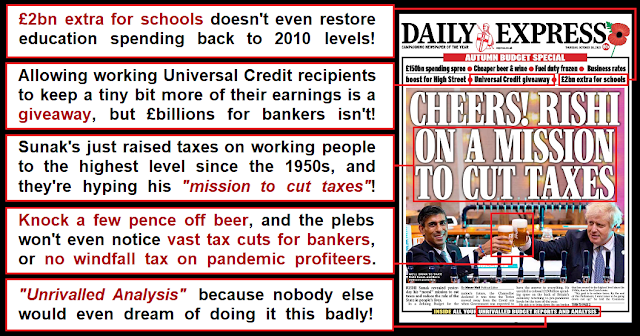
These days the Daily Express is basically nothing more than a pravda propaganda rag for the Tory party, so you'd have to be pretty naïve to expect anything other than heavy pro-Tory bias in their Budget analysis, but in 2021 they went the extra mile with a quite astonishing front page.

Rishi Sunak has just raised the UK tax burden to the highest level since the post-WWII recovery period in the 1950s!

He even admitted it in his budget speech, using the passive voice to say that  "taxes are rising to the highest level of GDP since the 1950s", as if the taxes are somehow rising of their own accord, rather than him being the person who is raising them!

Yet the front page of the Express blares Cheers! Rishi On A Mission To Cut Taxes

He's just raised taxes to the highest rate in over half a century, but hooray for his future ambition to cut taxes!

The disjunct between the reality and the presentation is absolutely laughable.

There are an awful lot more issues in the small print too (too many for me even to fit into the article header infographic!).

2 Billion extra for schools This might sound great if you've been living in a sensory deprivation chamber for the last 11 years, but in reality it's not enough to even return per-pupil funding back above 2010 levels this year, next year, or the year after. 

It'll finally catch up in 2024/25, meaning that an entire generation of school kids will have had their education hindered by massive budget cuts for no discernible reason whatever. Yet the Express somehow consider this decade and a half of wanton destruction of our nation's future economic potential as a cause for celebration!

£150 billion spending spree Hang on. We just suffered a decade of austerity cuts because public spending in the wake of a crisis was supposedly terribly bad, yet the debt's gone up dramatically since 2010, and now we're supposed to celebrate £150 billion in post-crisis spending as if the last 11 years simply didn't happen?

If spending in the wake of a crisis is good, then that obviously means a decade of Tory austerity extremism was pointless, ruinous self-harming, economically illiterate, and extremely bad, doesn't it?

Business Rates Boost For High Street  Everyone knows that tax-dodging online retailers have been dramatically undercutting High Street outlets for the last decade, and that giant out-of-town supermarkets are now soaking up entire family shopping budgets that used to be divided amongst perhaps a dozen different small independent High Street businesses.

Nothing's been done about this until it's far too late, and now High Streets across Britain have been reduced to derelict ghostly shadows of their former glories, occupied mainly by boarded up premises, thrift stores, gambling outlets, and charity shops.

There's some limited help on the table now, especially for the likes of pubs, restaurants, and tea rooms, but it's far too little, far too late.  The lockdown measures have absolutely hammered the majority of the retail economy by forcing them to close their doors, while online retailers and supermarket giants were allowed to continue operating, soaking up £billions in artificially inflated profits. 

There's no effort to rake any of these artificial gains back, and nor will there ever be with a Tory rich-boy like Sunak running the show.

Universal Credit Giveaway The framing here is absolutely insidious. What Sunak's actually done is ever-so-slightly reduced the amount that the state confiscates out of low-earners' wages through reduced social security payments.

Under the Tory-designed Universal Credit system the government used to confiscate 63p in every additional pound a low income worker earns, but Sunak's reduced the confiscation rate to 55p in the pound (which is obviously still more than half!). 

Somehow confiscating a tiny bit less of low-income workers' wages is a giveaway, but the £billions he's handed to bankers by cutting the Surcharge Tax to 3% isn't a giveaway.

In fact it somehow doesn't even warrant a mention!

"By the end of this parliament I want taxes going down, not up" Somehow the Express is celebrating this statement from Rishi Sunak as if it's some almost divine political objective, rather than one of the key strategies of Tory electoral politics:

Front-load all the tax-hikes and attacks on people's incomes into the years after winning power, then ease the boot of people's necks a little bit prior to the next election so they feel like things are getting better and vote Tory, and repeat, and repeat, and repeat.

It's an expression of standard, cynical, short-term electoral political strategy, not some kind of saintly moral mission!

Cheers! Rishi The main headline, and the picture of Johnson and Sunak (who doesn't even drink) holding pints are an example of the oldest trick in the budget book.

Place a slight cut in the price of a pint at the forefront of the budget, in order to distract the plebs from the horrifying details you don't really want them thinking about:
  • Highest tax rate in seven decades
  • Massive tax break for bankers
  • Cutting tax on short-haul flights (just days before hosting a climate conference!)
  • Implicit admission that austerity was a huge mistake
  • National Insurance hike for millions of ordinary workers
  • Insufficient help for High Streets
  • School funding still below 2010 level
  • No windfall tax for pandemic profiteers
Unrivalled coverage This is just about the only thing they managed to get right on their entire front page. It's so laughably bad that not even the Daily Mail or S*n managed to do worse!

 Another Angry Voice  is a "Pay As You Feel" website. Access to my online writing will always remain free. If you see some value in what I do, please consider supporting my work with a small donation/subscription.


OR


Wednesday, 20 October 2021

How social media platforms reward misinformation-spreaders


Dan Hodges is the anti-left polemicist who wrote the Daily Mail's grotesque "Labour Should Kill Vampire Jezza" article, just ten days after Labour MP Jo Cox was brutally murdered in the street in 2016.

Dan's absolutely notorious for his ability to find the wrong take on pretty much any subject, and many have even argued that he's actually delivering some kind of absurd wrong-on-purpose performance piece designed to create as much reaction as possible.

You may well ask why on earth anyone would want to make themselves look like a venal, mindless idiot on purpose, just for attention?

The reason of course is that social media sites are designed in such a way that the loudest, crudest, most attention-seeking idiots actually get rewarded by the algorithm, as a result of the reaction to the bile and misinformation they spew.

These grifters either get their content positively shared by users who have had their minds rotted away by years of exposure to the venal radical right culture war bollocks, or it gets amplified by masses of reasonable people trying to point out how wrong and/or completely unreasonable they're being.

The golden ticket for attention-seeking grifters is the kind of post that does massive numbers from both of these target audiences, like that dreadful GB News hack who was invited onto the BBC to argue in favour of drowning migrants, which caused the extreme-right demographic to gleefully retweet clips of it, and liberal icons with vast social media followings like Gary Lineker to spread it further and wider by retweeting it in order to say how much they disagreed with it.

This kind of polemical attention-seeking grift is the entire modus operandi of GB News, and it's absolutely no surprise that Dan Hodges has got himself involved with their professional grifting operation.
 
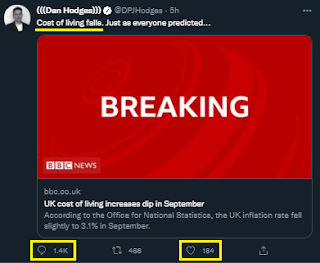
In some cases the traffic is entirely made up of condemnation, as with Dan Hodges' economically illiterate interpretation of a BBC News item about a tiny fall in the rate of inflation, which he tweeted with a caption reading "Cost of living falls, just as everyone predicted".

Over a thousand people responded with comments pointing out that Hodges was completely misrepresenting the meaning of the story, either through economic illiteracy, or out of a desire to deliberately spread misinformation.

It's absolutely obvious that a fall in the rate of inflation from 3.2% to 3.1% is not wonderfully good news for the British people, or for the government, when the inflation target is 2%, and the Bank of England rate of interest is a paltry 0.1%, but who cares about facts and evidence, when Dan can just claim the article he's sharing means the opposite of what it actually says?

A fall in the rate of inflation, is simply not the same thing as inflation falling (deflation), and it's no wonder that public understanding of economic issues is so poor, when high profile commentators like Dan Hodges spread economic misinformation like this with impunity.

After such a large backlash, anyone with a shred of decency would delete the post and put up an apology, but attention-seekers who value their social media numbers above their reputation would never erase such a post, because 1,400+ negative replies, and 400+ negative quote tweets all still point to the Twitter account of Dan Hodges.

For being totally wrong about something, Twitter rewards him with thousands of links pointing to his profile, and the algorithm even begins automatically offering his account as a 'suggested follow' to people who got involved in the conversation about how wrong he was!

Why on earth would Dan Hodges delete his reward for spreading misinformation?

And it's clear that he knows it's misinformation too, because his follow up Tweet admitted that he got it wrong, then smugly implied that the people at fault are actually the ones who got "agitated" by his misinformation (which produced himself another reward of hundreds more negative replies and negative quote tweets).

Dan Hodges publicly admits that he knows that it was wrong, but he's leaving it up anyway, meaning there's no way it can now be interpreted as anything other than deliberate misinformation.

And he's actually gloating at all the people who have called him out, and revelling in all the attention and free publicity!

If social media sites like Twitter actually cared about confronting misinformation, they'd allow users the means to effectively report misinformation (crowdsourced peer review), reduce the visibility of misinformation-spreading accounts, and improve the visibility of accounts that routinely tell the truth and cite their sources.

Instead, social media algorithms reward misinformation-spreaders by treating all the criticism of their misinformation as if it's people merely sharing and replying to something that's "interesting"!

We're well into the second decade of the social media age, and none of the social media platforms have even attempted to try to effectively resolve this rewarding misinformation problem.

In fact Facebook has even developed a bizarre "violations" system designed to reduce the visibility of accounts that cite evidence and sources, whilst allowing outright liars to get off scot free!

This failure to address the rewarding misinformation problem means the rabble-rousers, hate-mongers, attention-seekers, and misinformation-peddlers are obviously going to continue gaming poorly-designed algorithms to bag themselves ever more social media prominence.

In a system in which the more wrong, more venal, and more provocative the content, the higher the reward, it's natural that amoral attention-seeking grifters like Dan Hodges would continue to work the system to their advantage, isn't it?


 Another Angry Voice  is a "Pay As You Feel" website. Access to my online writing will always remain free. If you see some value in what I do, please consider supporting my work with a small donation/subscription.


OR


Monday, 18 October 2021

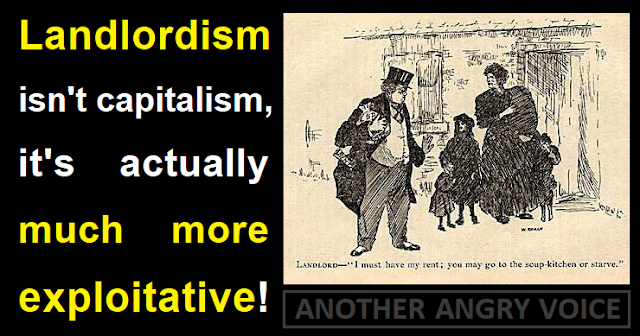
Landlordism is even more exploitative than capitalism!

One of the most commonly-held delusions amongst the property-hoarding class is that being a "landlord" makes them some kind of "capitalist".

It's completely wrong to imagine that landlordism is a sub-branch of capitalism, when it's actually a distinct sphere of economic activity, but it's easy to see how this confusion occurs.

Firstly there's the shockingly widespread misconception that "capitalism" is some kind of synonym for "trade", or "doing business", rather than a specific and defined form of economic organisation involving ownership of the means of production (which it actually is).

Then there's the fact that capitalism and landlordism are both highly exploitative practices that involve profit extraction from other people (employees/tenants), meaning it's easy to mistake one form of living off other people's backs as a version of the other.

The reality of course is that landlordism isn't capitalism, because capitalism is about owning the means of production (materials, facilities, machines) then paying workers below the actual value of their labour in order to extract profit.

I'm no fan of capitalism (to put it mildly) but at least there's some productive output at the end of it!

Landlordism on the other hand creates nothing.

All rentiers do is monopolise existing assets in order to extract unearned profits (whether that's buy-to-let slumlords, or private profiteers monopolising essential services like energy, water, public transport, etc).


Capitalism is a form of parasitism on economically productive activity.

Landlordism is an even purer form of economic parasitism, because it doesn't even produce anything other than unearned profits.

Of course landlords will try to pretend that there is some productive activity involved in landlordism, after all, don't they have to paint and redecorate when old tenants move out?

This is just a con-trick, because if the property was lived in by people who actually owned it, then they'd be much more inclined to invest above the basic bare-minimum, because their motivation is to make their home as comfortable and secure as possible, not to maximise profits by doing things on the cheap, and by cutting corners on long-term maintenance.

It's extremely telling that landlords try to dress up their bare-minimum of investment as some kind of economically productive activity, when it actually represents a reduction in investment on what would probably have occurred had the property never fallen into the hands of economic parasites.

Another common refrain from the idle landlord class is that they're somehow "providing a service" by buying up all the affordable housing, and renting it out to the people they've priced out of the property market!

If rented accommodation is such an essential service, then surely it should be taken under public control, so that it's run for the good of the British economy, and in the best interests of the British people, meaning any profits go back into improving the housing stock, rather than being siphoned off into private pockets?

But the landlordists react in absolute outrage at suggestions the rental market should be nationalised.

How are they expected to survive if they can't idly extract profits merely through ownership of property assets?

How are they expected to survive if they actually have to get a real job, and engage in economically productive activity like the rest of us?

Suddenly the provision of rented accommodation isn't the "important service" they just claimed it was. The only aspect of this "service" they actually attach any real importance to is preservation of the unearned income for themselves!

Of course the landlord class react with hot-headed indignation at those who describe the reality of their grubby, exploitative, unproductive economic parasitism, and desperately try to dismiss this criticism as if it's some kind of radical left-wing conspiracy against noble and honest people like them.

So I'll just leave you with a few quotes about landlordism from people that absolutely nobody in their right mind would ever describe as "leftists":

Winston Churchill
"Roads are made, streets are made, railway services are improved, electric light turns night into day, electric trams glide swiftly to and fro, water is brought from reservoirs a hundred miles off in the mountains - and all the while the landlord sits still. Every one of those improvements is effected by the labour and cost of other people. Many of the most important are effected at the cost of the municipality and of the ratepayers. To not one of those improvements does the land monopolist, as a land monopolist, contribute, and yet by every one of them the value of his land is sensibly enhanced. He renders no service to the community, he contributes nothing to the general welfare; he contributes nothing even to the process from which his own enrichment is derived." [source]

Adam Smith
"As soon as the land of any country has all become private property, the landlords, like all other men, love to reap where they never sowed" [source]

John Stewart Mill
"Only the landowners grow richer, as it were in their sleep without working, risking and economising" [source]

David Ricardo
"The dealings between the landlord and the public are not like dealings in trade, whereby both the seller and buyer may equally be said to gain, but the loss is wholly on one side, and the gain wholly on the other" [source]


 Another Angry Voice  is a "Pay As You Feel" website. Access to my online writing will always remain free. If you see some value in what I do, please consider supporting my work with a small donation/subscription.


OR

Tuesday, 12 October 2021

Squid Game and the steel industry


In the mid-20th Century South Korea was an economic minnow. It was a war-ravaged country with a largely pre-industrial economy.

In 1960, if you divided the total economic activity of South Korea by its population (GDP per capita) it amounted to just $79 per person, but within sixty years, this figure has multiplied to over $47,000 per person, which makes it one of the most prosperous large economies on earth, above large developed nations like Japan, Italy, Spain, Argentina, and Russia.

This remarkable period of economic growth in South Korea is known as the Miracle on the Han River, and it started off in the early 1960s when their government initiated the first of the country's 5 year economic plans.

The objective was to modernise the South Korean economy through full employment, and strategic investment across numerous sectors, including infrastructure (roads, rail, ports), core industries (steel, fertilizer, cement, petrochemicals ...), science, and technology.

South Korea's rapid climb up the world development rankings is proof  of how astonishingly successful their strategic investment agenda has been.

Steel industry

When South Korea set about building their first modern steel production plant they were derided by the so-called experts. Why would a country like South Korea make their own steel, when they could just import it from countries with established steel industries?

Well, South Korea ignored the heckling and derision, invested in their own steel industry, and rose from absolutely nowhere in steel production, to become the 6th largest steel producer in the entire world in 2020. 

From having no modern steel industry at all half a century ago, they've soared past countries with long-established steel industries like Germany, France, and the UK.

In 2020 South Korea produced almost ten times as much steel as the United Kingdom! 

A country with a population of just 51 million people produced almost as much steel as economic giants like Russia (146 million), Japan (125 million), and the United States (331 million).

Not bad for a country that were laughed at when they first proposed developing their own steel industry eh?

Having their own government-owned steel industry gave South Korea a huge economic advantage, allowing them to provide cheap steel to other industrial sectors they wanted to develop, especially ship building, electronics, civil engineering, and road vehicle production.

This ready supply of cheap steel helped turn small South Korean firms like Samsung, Hyundai, Kia, and LG into globally recognised brands.

Thanks in a large part to the development of their own steel industry, South Korea is now the world's largest ship-builder, with 40% of the global ship-building market!

Only China even comes remotely close to the shipbuilding power of the South Koreans.

Strategic investment, and the deliberate nurturing of core industries turned South Korea from an economic backwater into an absolute powerhouse over the course of just a few decades.

While developed countries like the UK were deliberately de-industrialising their economies and outsourcing production overseas, South Korea rocketed past them by modernising their core industries and establishing themselves as the premier high-tech, high-skill, hyper-productive economic workshop of the world.

Creative industries

Having learned from their strategic investment in core industries, the South Koreans have recently begun investing in their cultural industries too, with the objective of establishing their nation as one of the creative powerhouses of the world.

The results have already been spectacular:

You'd have to have been living in a box for the last few weeks to have not heard of the South Korean survival drama Squid Game, that's absolutely smashing streaming records across the world.

But the hit Netflix show Squid Game is far from the first massive South Korean cultural export. 

In 2020 the South Korean boy band BTS absolutely dominated global music sales, securing first and second place in the IFPI album sales chart.

Then there's Bong Joon-ho's black comedy thriller Parasite, which became the first non-English language film ever to win the Oscar for best picture in 2019.

Either it's a massive coincidence that South Korea has come from nowhere to suddenly deliver worldwide smash hits in television, music, and cinema, or maybe could have something to do with their deliberate policy of investing in their cultural industries?

Investment vs Austerity

South Korea have proven twice over that strategic investment is the key to delivering future economic prosperity, but certain western nations seem determined not to learn this lesson, especially the increasingly-parochial United Kingdom.

The UK was home to the industrial revolution, and pioneered all kinds of industries from steel foundries, through railways, to ship building.

It's all gone now, thanks to the deliberate neoliberal policy of de-industrialisation that's been pursued for the last four decades.
  • The country that invented the modern steel industry is no longer even in the top 20 world steel producers, and the remnants of its privatisation-wracked steel sector is now owned by Jingye Group, which is a state-owned Chinese regional bank.
  • The country that invented the railways no longer has a single train manufacturer.
  • The country that once "ruled the waves" deliberately tore down its own ship-building industry as part of a demented radical-right war on trade unionism (destroy the entire industry and the trade union dies with it).
As South Korea has stormed up the world rankings thanks to their strategic investment policy, the United Kingdom is falling away thanks to policies like de-industrialisation, under-investment, and austerity.

And there's a big danger of the same kind of sectoral decline happening in the UK cultural industries.

The UK is still an undisputed world leader in the creative industries, punching miles above its small island status in music, film, television, sport, and arts, but the process of decline is already underway.
  • And just to make his utter contempt for the wellbeing of Britain's £111 billion cultural industries unmistakable, Boris Johnson has recently appointed the notoriously thick, radically right-wing, culture war grifter Nadine Dorries as Britain's culture minister!
South Korea showed the UK the way on industrial strategy, but the Brits ignored it and did the polar opposite, which means South Korea is now an industrial powerhouse, and the UK seems locked into in terminal industrial decline.

South Korea is busy showing the UK the way on cultural strategy too, but once again the British government is doing the opposite, slashing away at cultural funding, when strategic investment is obviously the key to success.

The UK has already reduced itself from industrial pioneer to absolute minnows in industrial sectors that they themselves invented, and if there's not a rapid change in direction, the UK is going to see its position as cultural world leaders eroded away by the same myopic agenda of austerity cuts, and radical-right 'leave it to market forces' ideology, while other countries like South Korea surge ahead by actually investing for the future.


 Another Angry Voice  is a "Pay As You Feel" website. Access to my online writing will always remain free. If you see some value in what I do, please consider supporting my work with a small donation/subscription.


OR