
In the mid-20th Century South Korea was an economic minnow. It was a war-ravaged country with a largely pre-industrial economy.
In 1960, if you divided the total economic activity of South Korea by its population (GDP per capita) it amounted to just $79 per person, but within sixty years, this figure has multiplied to over $47,000 per person, which makes it one of the most prosperous large economies on earth, above large developed nations like Japan, Italy, Spain, Argentina, and Russia.
This remarkable period of economic growth in South Korea is known as the Miracle on the Han River, and it started off in the early 1960s when their government initiated the first of the country's 5 year economic plans.
The objective was to modernise the South Korean economy through full employment, and strategic investment across numerous sectors, including infrastructure (roads, rail, ports), core industries (steel, fertilizer, cement, petrochemicals ...), science, and technology.
South Korea's rapid climb up the world development rankings is proof of how astonishingly successful their strategic investment agenda has been.
Steel industry
When South Korea set about building their first modern steel production plant they were derided by the so-called experts. Why would a country like South Korea make their own steel, when they could just import it from countries with established steel industries?
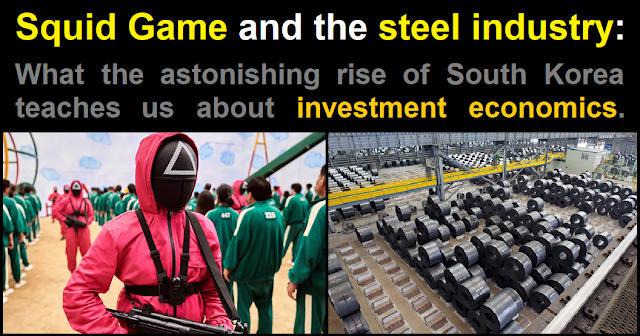
Well, South Korea ignored the heckling and derision, invested in their own steel industry, and rose from absolutely nowhere in steel production, to become the 6th largest steel producer in the entire world in 2020.
From having no modern steel industry at all half a century ago, they've soared past countries with long-established steel industries like Germany, France, and the UK.
In 2020 South Korea produced almost ten times as much steel as the United Kingdom!
A country with a population of just 51 million people produced almost as much steel as economic giants like Russia (146 million), Japan (125 million), and the United States (331 million).
Not bad for a country that were laughed at when they first proposed developing their own steel industry eh?
Having their own government-owned steel industry gave South Korea a huge economic advantage, allowing them to provide cheap steel to other industrial sectors they wanted to develop, especially ship building, electronics, civil engineering, and road vehicle production.
This ready supply of cheap steel helped turn small South Korean firms like Samsung, Hyundai, Kia, and LG into globally recognised brands.
Thanks in a large part to the development of their own steel industry, South Korea is now the world's largest ship-builder, with 40% of the global ship-building market!
Only China even comes remotely close to the shipbuilding power of the South Koreans.
Strategic investment, and the deliberate nurturing of core industries turned South Korea from an economic backwater into an absolute powerhouse over the course of just a few decades.
While developed countries like the UK were deliberately de-industrialising their economies and outsourcing production overseas, South Korea rocketed past them by modernising their core industries and establishing themselves as the premier high-tech, high-skill, hyper-productive economic workshop of the world.
Creative industries
Having learned from their strategic investment in core industries, the South Koreans have recently begun investing in their cultural industries too, with the objective of establishing their nation as one of the creative powerhouses of the world.
The results have already been spectacular:
You'd have to have been living in a box for the last few weeks to have not heard of the South Korean survival drama Squid Game, that's absolutely smashing streaming records across the world.
But the hit Netflix show Squid Game is far from the first massive South Korean cultural export.
In 2020 the South Korean boy band BTS absolutely dominated global music sales, securing first and second place in the IFPI album sales chart.
Then there's Bong Joon-ho's black comedy thriller Parasite, which became the first non-English language film ever to win the Oscar for best picture in 2019.
Either it's a massive coincidence that South Korea has come from nowhere to suddenly deliver worldwide smash hits in television, music, and cinema, or maybe could have something to do with their deliberate policy of investing in their cultural industries?
Investment vs Austerity
South Korea have proven twice over that strategic investment is the key to delivering future economic prosperity, but certain western nations seem determined not to learn this lesson, especially the increasingly-parochial United Kingdom.
The UK was home to the industrial revolution, and pioneered all kinds of industries from steel foundries, through railways, to ship building.
It's all gone now, thanks to the deliberate neoliberal policy of de-industrialisation that's been pursued for the last four decades.
And there's a big danger of the same kind of sectoral decline happening in the UK cultural industries.
The UK is still an undisputed world leader in the creative industries, punching miles above its small island status in music, film, television, sport, and arts, but the process of decline is already underway.
South Korea is busy showing the UK the way on cultural strategy too, but once again the British government is doing the opposite, slashing away at cultural funding, when strategic investment is obviously the key to success.
The UK has already reduced itself from industrial pioneer to absolute minnows in industrial sectors that they themselves invented, and if there's not a rapid change in direction, the UK is going to see its position as cultural world leaders eroded away by the same myopic agenda of austerity cuts, and radical-right 'leave it to market forces' ideology, while other countries like South Korea surge ahead by actually investing for the future.
In 1960, if you divided the total economic activity of South Korea by its population (GDP per capita) it amounted to just $79 per person, but within sixty years, this figure has multiplied to over $47,000 per person, which makes it one of the most prosperous large economies on earth, above large developed nations like Japan, Italy, Spain, Argentina, and Russia.
This remarkable period of economic growth in South Korea is known as the Miracle on the Han River, and it started off in the early 1960s when their government initiated the first of the country's 5 year economic plans.
The objective was to modernise the South Korean economy through full employment, and strategic investment across numerous sectors, including infrastructure (roads, rail, ports), core industries (steel, fertilizer, cement, petrochemicals ...), science, and technology.
South Korea's rapid climb up the world development rankings is proof of how astonishingly successful their strategic investment agenda has been.
Steel industry
When South Korea set about building their first modern steel production plant they were derided by the so-called experts. Why would a country like South Korea make their own steel, when they could just import it from countries with established steel industries?
Well, South Korea ignored the heckling and derision, invested in their own steel industry, and rose from absolutely nowhere in steel production, to become the 6th largest steel producer in the entire world in 2020.
From having no modern steel industry at all half a century ago, they've soared past countries with long-established steel industries like Germany, France, and the UK.
In 2020 South Korea produced almost ten times as much steel as the United Kingdom!
A country with a population of just 51 million people produced almost as much steel as economic giants like Russia (146 million), Japan (125 million), and the United States (331 million).
Not bad for a country that were laughed at when they first proposed developing their own steel industry eh?
Having their own government-owned steel industry gave South Korea a huge economic advantage, allowing them to provide cheap steel to other industrial sectors they wanted to develop, especially ship building, electronics, civil engineering, and road vehicle production.
This ready supply of cheap steel helped turn small South Korean firms like Samsung, Hyundai, Kia, and LG into globally recognised brands.
Thanks in a large part to the development of their own steel industry, South Korea is now the world's largest ship-builder, with 40% of the global ship-building market!
Only China even comes remotely close to the shipbuilding power of the South Koreans.
Strategic investment, and the deliberate nurturing of core industries turned South Korea from an economic backwater into an absolute powerhouse over the course of just a few decades.
While developed countries like the UK were deliberately de-industrialising their economies and outsourcing production overseas, South Korea rocketed past them by modernising their core industries and establishing themselves as the premier high-tech, high-skill, hyper-productive economic workshop of the world.
Creative industries
Having learned from their strategic investment in core industries, the South Koreans have recently begun investing in their cultural industries too, with the objective of establishing their nation as one of the creative powerhouses of the world.
The results have already been spectacular:
You'd have to have been living in a box for the last few weeks to have not heard of the South Korean survival drama Squid Game, that's absolutely smashing streaming records across the world.
But the hit Netflix show Squid Game is far from the first massive South Korean cultural export.
In 2020 the South Korean boy band BTS absolutely dominated global music sales, securing first and second place in the IFPI album sales chart.
Then there's Bong Joon-ho's black comedy thriller Parasite, which became the first non-English language film ever to win the Oscar for best picture in 2019.
Either it's a massive coincidence that South Korea has come from nowhere to suddenly deliver worldwide smash hits in television, music, and cinema, or maybe could have something to do with their deliberate policy of investing in their cultural industries?
Investment vs Austerity
South Korea have proven twice over that strategic investment is the key to delivering future economic prosperity, but certain western nations seem determined not to learn this lesson, especially the increasingly-parochial United Kingdom.
The UK was home to the industrial revolution, and pioneered all kinds of industries from steel foundries, through railways, to ship building.
It's all gone now, thanks to the deliberate neoliberal policy of de-industrialisation that's been pursued for the last four decades.
- The country that invented the modern steel industry is no longer even in the top 20 world steel producers, and the remnants of its privatisation-wracked steel sector is now owned by Jingye Group, which is a state-owned Chinese regional bank.
- The country that invented the railways no longer has a single train manufacturer.
- The country that once "ruled the waves" deliberately tore down its own ship-building industry as part of a demented radical-right war on trade unionism (destroy the entire industry and the trade union dies with it).
And there's a big danger of the same kind of sectoral decline happening in the UK cultural industries.
The UK is still an undisputed world leader in the creative industries, punching miles above its small island status in music, film, television, sport, and arts, but the process of decline is already underway.
- A decade of austerity cuts to the education budget has seen art, sports, and music cast aside in the public education system.
- Small theatres, galleries, arts centres, museums, and music venues across the country have been shut down in their hundreds as a result of absolutely ruinous Tory austerity cuts to local government budgets.
- Government funding of adult education has been halved since 2010.
- Profiteering private owners have flogged off hundreds of school playing fields as a result of the mass school privatisation programme the Tory government has been implementing since 2010.
- The BBC has had its funding repeatedly cut since 2010, and there are even more budget cuts in the pipeline.
- The Tory government has just announced a whopping 49% cut in funding for university arts courses.
- Direct funding for the cultural industries has also been annihilated, with the Department of Culture, Media, and Sports suffering massive austerity-driven budget cuts.
- Brexit is playing absolute havoc with the UK cultural industries by imposing expensive and time-eroding bureaucratic burdens on UK creatives touring across Europe, and on UK venues hosting creatives from elsewhere in Europe.
- And just to make his utter contempt for the wellbeing of Britain's £111 billion cultural industries unmistakable, Boris Johnson has recently appointed the notoriously thick, radically right-wing, culture war grifter Nadine Dorries as Britain's culture minister!
South Korea is busy showing the UK the way on cultural strategy too, but once again the British government is doing the opposite, slashing away at cultural funding, when strategic investment is obviously the key to success.
The UK has already reduced itself from industrial pioneer to absolute minnows in industrial sectors that they themselves invented, and if there's not a rapid change in direction, the UK is going to see its position as cultural world leaders eroded away by the same myopic agenda of austerity cuts, and radical-right 'leave it to market forces' ideology, while other countries like South Korea surge ahead by actually investing for the future.
Another Angry Voice is a "Pay As You Feel" website. Access to my online writing will always remain free. If you see some value in what I do, please consider supporting my work with a small donation/subscription.


