Showing posts with label 38 Degrees. Show all posts

Friday, 17 June 2016

What is ... synthetic outrage?


Outrage is a very useful tool for politicians and journalists alike because it can be used to sell political ideologies as well as newspapers. Some things are genuinely outrageous, and deserving of media condemnation and decisive political action, but often it suits the purposes of vested interests to manufacture a load of synthetic outrage in order to further their own objectives.


In this article I'm going to use various examples to show how the tactic of using fake outrage to sell political ideologies or newspapers is not a specifically left-wing or right-wing thing, but a tactic that transcends the political spectrum. I'm also going to consider how displays of synthetic outrage seem to be becoming ever more common as the standard of political debate in the UK continues it's lamentable and seemingly inexorable decline into the gutter.

Political correctness

Political correctness and manufactured outrage are clearly not the same thing, but there are links. The hard-right love to decry political correctness as some kind of leftist-liberal conspiracy to deny people freedom of speech, but they're simply wrong. 


Of course a lot of right-wingers would like to return to the past when it was considered perfectly acceptable to hurl racist, sexist and homophobic abuse around and do stuff like spit in the prams of mixed race babies and throw bananas at black footballers, but times have moved on. Whether they like it or not there is now a general consensus in the UK that kind of shit is completely unacceptable. Whether they like it or not, in modern Britain it's not OK to hurl insults, physically attack, abuse or discriminate against people based purely on their ethnicity, sex or sexual orientation.

This change in attitudes doesn't mean that hard-right people are banned from using disgusting language to denigrate people, it just means that the majority of people will recognise them as the nasty narrow-minded bigots that they are if they start ranting on about "niggers", "wogs", "spics", "pakis", "bitches" or "queers".


I think most people would agree that given the history of abuse and discrimination that used to be tolerated in this country, political correctness has a place and a purpose. However there are some who have taken it way too far, and resort to displays of synthetic outrage at the slightest provocation.

If someone has clearly demonstrated that they're a tiny-minded bigot, then it's fair to dismiss them as such because arguing with idiots is a waste of time, but if someone has simply mis-spoken, used archaic terminology or demonstrated that they might have underlying prejudices, it's an appalling and self-defeating idea to shout them down as a bigot, racist, homophobe or whatever. 


It's often the case that people don't even realise that what they're saying could be construed as being offensive or discriminatory, so it's best to try to reason with them first rather than snap immediately into hot-headed condemnation. 

A likely reaction of someone who doesn't think of themselves as being a bigot to a polite explanation of how their use of language could be considered offensive could be a change in their use of language. Their reaction to being immediately shouted down as a bigot is highly likely to be self-defensive, which could easily manifest as an reaction against all forms of political correctness due only to being hit with displays of unjustifiable synthetic outrage when they didn't even understand the problem with the language they were using.

Right-wing political correctness


Considering that the backlash against political correctness is a touchstone issue for so many right-wing people, displays of political correctness from right-wingers are drenched in hypocrisy.

One of the most appalling examples was the sudden conversion of millions of die-hard Tories to political correctness after the death of Margaret Thatcher. We all saw right-wingers suddenly switch from decrying political correctness as a toxic ideology of the left to sanctimoniously lecturing anyone who dared utter the slightest criticism of Thatcher or her appalling political legacy as being guilty of disrespecting the dead.

In the wake of Thatcher's death, it really didn't matter how carefully worded the criticism, right-wing people immediately snapped into synthetic outrage mode, decrying anyone who presented an evidence based critique of her political legacy with the same vitriol as they spewed at the "ding dong the witch is dead" people.

Just a month before Thatcher died, the left-wing Venezuelan President Hugo Chávez died of cancer triggering a huge outpouring of delighted gloating from right-wingers. The death of the RMT trade unionist Bob Crow a couple of years later also triggered a similar wave of gloating, insult laden diatribes from delirious right-wingers. It seems that this "must respect the dead" element of right-wing political correctness only applies to dead people with right-wing ideological views. 


The hypocrisy of right-wingers describing socially liberal political correctness (which has the purpose of protecting living people from insults, attacks and discrimination) as an attack on their free speech, whilst using displays of synthetic outrage to make others conform to their special brand of right-wing political correctness (that criticising recently deceased people is completely unacceptable if they happen to have had right-wing views) is a clear demonstration that an awful lot of right-wing people are completely immune to cognitive dissonance.

A fake storm of misogyny

It doesn't take a great deal of nous to recognise that the BBC political editor Laura Kuenssberg is severely biased against the Labour leader Jeremy Corbyn. Eventually, after another particularly egregious display of political bias, someone set up a 38 Degrees petition against Kuenssberg's biased reporting. 

This petition was obviously uncomfortable for the 38 Degrees team for some reason, so they had to invent a reason to delete it. The story they eventually concocted was that the petition had been hijacked by a bunch of misogynists, which gave Tory politicians including David Cameron and the disgraced death threat inventing liar Lucy Allan a perfect platform to air their synthetic outrage about this fictional hoard of misogynistic lefties attacking a journalist just because she's female.

The spectacle of right-wing MPs (one of whom has been guilty of using deeply patronising and sexist language in the past) lining up to attack the left as sexists was almost too much to stomach. Anyone with the vaguest semblance of political literacy understands that the left stood up against the sexism and bigotry of the right-wing political establishment, so to see right-wingers gloating and posturing with coordinated displays of synthetic outrage was utterly nauseating.

The big problem with these Tory displays of synthetic outrage was that the 38 Degrees team completely invented this tide of sexist abuse, meaning that these displays were not only manufactured for political convenience, but also based on nothing but a pack of lies.

I've been a big supporter of 38 Degrees work over the years, but I was appalled that they decided to lie about the behaviour of their own supporters and hand a load of free ammunition to the Tories to launch a sustained synthetic outrage attack the liberal left, but I'm even more appalled by their bone-headed refusal to apologise for what they had done.


Tabloid outrage merchants

Frankie Boyle explained the way that the mainstream press use synthetic outrage in a brilliant blog post about offence and free speech. The whole thing is wort a read, but here's the relevant extract:
"No tabloid journo - whose life is invariably a shattered kaleidoscope of prostitutes, gambling, cocaine, self-loathing, literally going through a strangers bins, erectile disfunction and cocaine - is genuinely offended when some students dress up as the Twin Towers for Halloween. Outrage just makes good copy. It's easier to write, and simpler to understand. A tabloid hack knows that their average reader can barely read and they're not going to try to communicate anything like ennui in the vocabulary of a ten year old."
The right-wing tabloid press love to use synthetic outrage to sell copy because they know that it's easy to write and simple to understand, which is essential given that their whole purpose is to cultivate large audiences of simple-minded people to uncritically absorb their hard-right political propaganda and then repeat it as if it's their own brilliant insight, rather than just some drivel they rote learned from the S*n, Star, Mail, Express, Telegraph, Evening Standard or Metro.

Guardian above-the-line trolling


The Guardian has been on a slow rightwards trajectory for over two decades, but in recent years they've given up almost all pretense at being a left-liberal publication and veered sharply towards actively promoting pro-austerity hard-right economics in their editorial stance. 

Despite this ever faster sprint towards hard-right economic orthodoxy in their news coverage, there's still stuff worth reading in the opinion section (especially contributions from the likes of Frankie Boyle, Stewart Lee, Harry Leslie Smith, Robert Skidelsky, Ha-Joon Chang, Owen Jones ...). Unfortunately, in order to find the good stuff you have to wade through some utterly appalling drivel that I have begun to think of as reverse-psychology clickbait, which consists of synthetic outrage articles written in the most intensely patronising and alienating language. 

In my view the Guardian editorial team have either lost the plot completely by deciding to post so many articles consisting of little more than synthetic outrage drivel, or, more likely, they're playing a cynical game of publishing the most infuriating articles possible in the hope of attracting a load of clicks, comments and advertising revenue as people wade in to criticise the woeful pap they've been presented with.

Either the Guardian have lost the plot completely in allowing the likes of Jessica Valenti to call for Orwellian style cleansing of the language and claim that "all the worst words used to insult men are distinctly female" (erm ... cock, prick, wanker, creep, perv, dick head ...) or they're playing a very cynical game of attracting clicks by deliberately winding people up with contrived synthetic outrage articles and then watching the advertising revenue flow in.


David Cameron's lies


One of the most glaring displays of synthetic outrage I've ever seen came from the Brexiter Tory MP Nadine Dorries, who decided to attack David Cameron as a liar for daring to suggest that Turkey are a very long way from being able to join the EU, (even if their membership application isn't vetoed by the French). She worked herself up into such a fit of manufactured outrage that she even ended up calling for Cameron to resign over the issue.

The bizarre thing about it is that she has repeatedly bitten her lip and said nothing when David Cameron told lies about not planning to increase VAT, about not wanting to cut, privatise or top-down reorganise the NHS, about the national debt (the exact same lie twice), about the UK economy having been "bankrupted", about the leader of the opposition, about having no plans to slash working tax credits ...

It's extraordinary that Dorries could calmly say nothing for all those years as she watched Cameron lie, and lie, and lie, and lie, and lie again - but as soon as he says something that conflicts with her anti-EU sentiments, she ends up shrieking and wailing about it, even though Cameron's claims about Turkey were a case of over-egging the pudding at worst in comparison to his track record of telling outright porkies.


Moral high-horsing
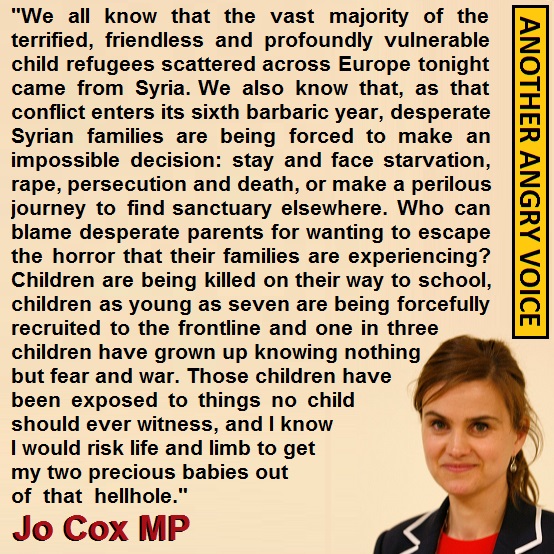

Perhaps the most disgusting displays of synthetic outrage I've ever experienced came after I posted a heartfelt tribute to the humanitarian work of the murdered Labour MP Jo Cox.

Most of the people who commented left condolences and tributes, but a vocal minority set about moral high-horsing as if posting a tribute to the political work of a murdered MP is somehow completely unacceptable.


To pretend that there was no political aspect to the killing, or that it's somehow morally wrong to even consider the political aspects is a bizarre strategy that is strongly suggestive of extreme-right sympathies (because any political analysis is certain to conclude that the killer was a mentally unwell person with a head full of violent, extreme-right, white supremacist politics). 

Had eyewitnesses said that the killer was shouting "Allahu Akbar" rather than "Britain First" and initial investigations found that he had links to radical Islamist groups rather than neo-Nazi groups, does anyone seriously believe that there would be so much of this sanctimonious moral high-horsing and demanding that people don't consider the political dimensions of the killing?

Some of these moral high-horsers tried to claim that it was somehow disrespectful to her family to use a quote from one of her own parliamentary speeches to "promote an agenda" (her own agenda) and even called for the Another Angry Voice Facebook page to be shut down. 


I will not apologise for trying to ensure that Jo Cox's voice was heard louder on the day of her death than it ever was when she was alive and fighting for the welfare of Syrian refugees and their children. Remember what her her husband Brendan said about what Jo would have wanted: He said that she would have wanted people to unite against hatred. In the current political climate, where hatred of refugees is so commonplace, I'm sure that posting a quote of her expressing her concern for the welfare of Syrian refugees is respectful to his wishes.

Some of these moral high-horsers even used phrases like "her body isn't even cold yet" as an attempt to silence me, and other who were expressing their views.

It's completely twisted to imagine that a tribute consisting of a quotation of his wife saying something that she cared deeply about would be more offensive to Brendan Cox than someone harking on about the residual heat of her corpse in order to stoke up synthetic outrage and silence other people from talking about her or the circumstances of her death. It just goes to show how warped people's perspectives to become when they allow themselves to get worked up into fits of synthetic outrage.

Conclusion

Synthetic outrage has always been a thing, but the declining standards of political debate, and the fact that the Internet gives pretty much anyone a platform to air their views, mean that it's becoming ever more prevalent in political discourse.

Sometimes displays of synthetic outrage are simply annoying or hypocritical, but when people begin manufacturing outrage in order to disparage and silence people with whom they disagree, it's much more dangerous. It's perfectly possible to use synthetic outrage to sell newspapers, generate online advertising revenue or promote particular political agendas, but when people start using it as a tool to silence others it stops being just a crude propaganda tool and becomes a weapon of oppression.


 Another Angry Voice  is a "Pay As You Feel" website. You can have access to all of my work for free, or you can choose to make a small donation to help me keep writing. The choice is entirely yours.


OR


Thursday, 12 May 2016

How 38 Degrees have tarnished their own reputation


I have got a great deal of respect for the campaign website 38 Degrees, especially for their tireless work in support of the NHS and in opposition to the TTIP corporate power grab. However nobody is beyond criticism, and their decision to delete a petition with 35,000+ signatures on the most spurious of grounds is incredibly damaging.

The petition in question was one calling for the BBC Political editor Laura Kuenssberg to be sacked over her blatantly biased reporting in favour of the Tories. 38 Degrees decided to delete the petition on the grounds that it was supposedly full of misogynist comments left by "sexist bullies".

The problem for this justification is that Craig Murray found and published the 38 Degrees reserve cache of comments, which revealed that the overwhelming majority of comments on the petition were not sexist in any way. Only one out of the hundreds and hundreds of comments was explicitly sexist.

Instead of admitting their error and explaining the real reason they felt the need to remove the petition (perhaps the kind of establishment pressure that forced the Guardian to smash their hard drives?) someone at 38 Degrees thought it would be a smart idea to delete their reserve cache of comments in a desperate attempt to stop people from seeing the evidence that they had lied. Craig Murray simply switched the link on his blog to the Google cache of the comments, and even if that disappears it's now beyond doubt that many people will have made copies (when will people ever learn that you can't just simply delete things off the Internet? [1] [2] [3]).


One of the worst things from 38 Degrees perspective is that by deleting the petition they handed ammunition to the likes of David Cameron and Lucy Allan (the disgusting Tory liar who got caught out fabricating a death threat in order to harvest public sympathy) to attack Jeremy Corbyn with at Prime Minister's Questions.

By inventing the lie that the petition had to be deleted because of a non-existent tide of sexist abuse, 38 Degrees allowed the Tories to completely bypass the accusation of BBC editorial bias in their favour by painting Labour, Momentum, the left in general and the type of people who sign 38 Degrees petitions as nothing more than a disgusting misogynist rabble.


Perhaps the worst aspect of all is the appalling precedent set by this deletion of an entire 35,000 signature petition over a single sexist comment. The ludicrous decision to delete the petition rather than simply delete any offending comment(s) is clearly a red rag to foul-minded Internet warrior types. Disgusting people like that have now been given a clear indication that an effective way to derail any petition they don't like is to use sockpuppet accounts to post sexist/racist/bigoted/threatening comments in the hope of getting the entire petition deleted.

The decision to delete the entire petition rather than moderating any unacceptable comments is incredibly poor because it gives people reasons to not sign 38 Degrees petitions in future. "Why should I take the time to sign this if it's just going to get deleted if anyone says anything bigoted in the comments thread?" "Why should I sign this if 38 Degrees are going to tarnish my reputation by implying that I'm part of some misogynistic rabble for doing so?".

Handing free ammunition to the Tories to attack their political opponents with is bad enough, but the damage to their own reputation is much worse. By crudely implying that the 35,000 people who signed the petition are largely a bunch of sexist trolls, when the evidence clearly shows that the vast majority were nothing of the sort, 38 Degrees have damaged themselves terribly.

The 38 Degrees reaction after the lie was exposed was even worse. We all make mistakes, but the true marker of integrity is how we deal with those mistakes. Those who admit that they got things wrong and apologise for it have some integrity, those who desperately try to delete the evidence that they lied do not.

It really does pain me to criticise 38 Degrees because as I've said before, they've done sterling work on a number of incredibly important issues, but inventing lies to attack their own supporters, and fuelling a bonfire of synthetic Tory outrage in the process, is a massive cock up, and one they should be apologising for, not trying to hide.


 Another Angry Voice  is a "Pay As You Feel" website. You can have access to all of my work for free, or you can choose to make a small donation to help me keep writing. The choice is entirely yours.


OR

Tuesday, 14 October 2014

12 reasons the Green Party should be included in the leaders' debates


On October 13th 2014 it was announced that the UKIP leader Nigel Farage would be invited to join the pre-election leaders' debates, and that the Green Party leader Natalie Bennett, and the leaders of several other non-traditional parties would be excluded.

In this article I'm going to spell out twelve reasons why the Green Party should be included in the debate.

The European Election results

The fact that UKIP won the most votes in the 2014 European elections has been used as one of the main justifications for allowing UKIP into the leaders' debate. I actually agree that UKIP should be there because of their strong performance in the European elections. However it must be remembered that the Green Party finished with more votes than the Liberal Democrats, and returned three MEPs to the the one remaining Lib -Dem MEP (which is a fact you probably wouldn't even know if you relied only on the mainstream media for your political news).

If the results of the European elections are to be considered as an important factor in the decision about which parties are represented, then the fact that the Green Party managed to outperform the Liberal Democrats, despite the appalling lack of mainstream media coverage they received prior to the election, must also be taken into consideration.

The results of the European elections draw a clear picture of a five party system in England, where the Green Party are the fourth most popular party by some distance ahead of the Liberal Democrats. Using the European election results to justify the inclusion of UKIP, without also using them as a justification for the inclusion of the Green Party too reeks of double standards.

MPs

It seems no coincidence at all that UKIP were invited to the pre-election debates within a week of them winning their first MP, however the Greens also have an MP. Caroline Lucas won her seat in Brighton Pavillion in the 2010 General Election through sheer hard work and dedication to the Green Party cause. The turnout was 70%, so nobody can accuse her of fluking the result on a low turnout.

The way UKIP won their seat was by poaching an MP off a rival party and then winning the protest vote on a low by-election turnout of just 51%. The idea that a guy who was a Tory party politician until two months ago is equivalent to someone who has put an enormous amount of work into building support for their party for decades is totally ludicrous.

When a long-term UKIP supporter wins a seat at a General Election, then they can perhaps contest that their MP is equivalent to Caroline Lucas. But until then, it is clear to anyone that no number of turncoat Tory backbenchers could have the same legitimacy as someone who has actually won a seat for their party at a General Election.

Party Membership

The Greens have experienced a large surge in party membership since the turn of the year. The Green Party of England and Wales has experienced a 45%+ increase in party membership in ten months, and the Scottish Green Party have seen an incredible growth in membership in the same period, from a little over 1,000 members in December 2013 to over 7,000 members in October 2014.

If this undeniable surge in support for the Green Party continues at a similar rate until the next election, it is entirely conceivable that they will overtake the Liberal Democrats in terms of party membership, especially since the Lib Dems have lost 33% of their own members since the decision to jump into bed with the Tories in 2010.

Although this article is about the case for Green Party representation in the debates, the huge surge in membership of the Scottish National Party to over 80,000 (making them the third largest party in the whole UK by a significant margin, despite only standing candidates in Scotland, which has only 8% of the electorate) is a strong argument that the SNP should be represented too.

Local government

In terms of local government, UKIP and the Green Party have both been increasing their representation, however one thing differentiates them, and that is the fact that the Green Party actually run a council.

Admittedly Brighton council is a minority administration, which has made it so much easier for the Tories and Labour to collude in undermining them at every move, but this means that unlike UKIP the Green Party have some real experience of actually governing somewhere.

If local government is to be considered a factor for inclusion in debates, the fact that the Green Party actually runs a council has to count strongly in their favour.

The London Assembly

    
The Green party is the 3rd biggest party on the London Assembly. They only have two seats due to the only partially proportional nature of the London Assembly electoral system, but they picked up significantly more votes in the 2012 election (189,215) than the Liberal Democrats (150,447) who also won two seats. UKIP has no representation at all on the London assembly.

The Scottish Parliament

Once again UKIP has no representation in the Scottish parliament, whilst the Green Party have two MSPs thanks to 87,060 votes in the 2011 Scottish election, making them the fifth party in Scotland. UKIP on the other hand finished with no MSPs at all after attracting only 18,138 votes and being pushed down to 8th position by The Scottish Senior Citizens Party and the independent candidates.

Given the sea change in Scottish politics as a result of the 2014 Independence referendum, it is inconceivable that the Scottish Greens won't surge past the Liberal Democrats in the next Scottish parliament election, and, given the exponential increase in support they've experienced, it's even a possibility that they could leapfrog the Tory party to become the third party in Scottish politics by 2016, behind only the SNP and Labour.

Opinion Polls

Lots of UKIP supporters have tried to defend the inclusion of UKIP in the pre-election debates by highlighting opinion polls which place UKIP as the third most popular party. It is equally possible to dig out opinion polls in which the Green Party are vying with the Liberal Democrats for fourth place at around 6/7% of the vote.

Although I don't think that popularity in opinion polls should be considered a major factor in whether parties are represented in pre-election debates, the fact that so many people are pointing to the opinion poll popularity of UKIP as a factor that supersedes the fact that the Green Party, UKIP and several other parties all just have just one MP, then the fact that the Greens have been vying with the Lib Dems for fourth place must also be taken into consideration.
 

Social Media

In my view judging whether a party should be included in the pre-election debates based on their popularity on social media is as silly as using opinion polls as a justification.

It is worth noting however, that The Green Party have more followers on Twitter than either UKIP or the Liberal Democrats.

It is also worth noting that the Green Party (25,900*) have more than three times as many Facebook interactions as the Liberal Democrats (8,600), and they're rapidly catching them up in terms of total followers too (which is actually a much less important factor on Facebook than the number of active users as measured by interactions).

The Green Party also have more interactions than the official Conservative Facebook page too (23.200), illustrating the Facebook principle that active organic followers are much more useful than inactive paid-for-likes.

                   
The Youth Vote


I believe that it is of fundamental importance that more effort is made to engage the youth vote. The fact that the 18-24 demographic has become ever more apathetic over the generations is a big problem for anyone who believes in the value of participatory democracy, because the youth of today always become the adults of tomorrow, as the older demographics edge towards the retirement from political participation that tends to come with death. 

The Green Party are significantly more popular than UKIP with the 18-24 age group. It depends which measures you use, but they're either vying with the Liberal Democrats for third place according to the polls, or they've already overtaken them in terms of young people who are committed enough to actually become party members.
Whether we class the Green Party as the third party amongst the youth vote or not, what can't be contested is that denying the youth vote representation from a party they're more keen on than UKIP is a surefire way to disengage them from politics, and teach them that their own political concerns are irrelevant.

The exclusion of the Greens from the debate, despite the fact their youth membership has more than doubled in just one year, could even be portrayed as a deliberate attempt to "nip this problem in the bud" 
 by ruling them out of the debate before the Greens become "too popular". 

In order to believe any such theory, you'd have to suspect that someone behind the decision to exclude them from the debate had an intense loathing of the Green Party and the left-wing / libertarian policies they promote.

Rupert Murdoch


One of the bodies behind the decision to invite Nigel Farage, but not the Green Party leader Natalie Bennett to the debate was Sky TV, which is part of Rupert Murdoch's vast media empire.

The other bodies involved in the decision were ITV, Channel Four and the BBC, all of which have been guilty of downplaying, or simply ignoring the Green Party too.

It is no secret that Rupert Murdoch loathes the Green agenda, is sceptical about climate change and has nothing but contempt for the left-wing social democratic agenda promoted by the Green Party. 


It is absolutely clear that Murdoch would object to Green Party involvement out of disagreement with their policies of renationalisation of the rail network and energy companies, their radical proposals for financial sector reform and their determination to overcome the scourge of absolute poverty for once and for all through what would be the biggest benefits reform in history. All of these policies go against the ideological dogma of neoliberalism that he has so successfully promoted using his vast media empire.

Another of the many reasons that Murdoch loathes the Green Party is the fact that their leaders never suck up to him by posing in demeaning publicity shots for his newspaper, or attending private off-record meetings with him, as the leaders of the four chosen parties have all done time and again.

In my view the decision about which political parties are are barred from pre-election debates should lie with an independent body, and there is absolutely no way that a foreign media mogul, who has far to much influence over our media and our political system already, should have any influence over the decision whatever. 


Political plurality

I'm massively in favour of political plurality. The more different viewpoints the better as far as I'm concerned, and the party that would do most to increase political plurality in the leaders' debates would clearly be the Green Party, not UKIP.

Not only do the Green Party offer UKIP's main selling point with their commitment to a referendum on membership of the EU, they also offer a much more radical policy portfolio than any of the other parties. Their proposals on reform of the monetary system, renationalisation of state infrastructure and Universal Basic Income are not offered by any of the other parties.

It's unclear whether UKIP plan to offer free university tuition like the Green Party. And given the haphazard nature of their policy making, it's very unlikely that any such proposals would be costed like the ones in the longstanding and evolving Green Party manifesto. The Green Party are a serious political outfit with longstanding policies that don't just get dumped in the bin when their leader describes their entire manifesto as "drivel" and admits that he never even bothered to read it in the first place!

Nigel Farage would certainly add a bit of personality interest to the debate, but in offering a genuine anti-austerity agenda, and several unorthodox policies, Natalie Bennett would add a lot of interest to the debate for those who see policy as more important than personality.

Without the Green Party, the debate is just going to feature four parties that subscribe to almost indistinguishable variants of pro-austerity neoliberalism ranging from Ed Miliband's sickening brew of toxic right-wing economics and pseudo-socialist sweeteners to disguise the filthy taste, through to Nigel Farage's brand of "keeping the flame of Thatcherism alive" neoliberal militancy.

The most popular policies
 

According to blind tests conducted by the Vote For Policies website, the Green Party have by far the most popular policies, winning in four categories, and appearing in the top two out of all but two of the nine policy areas.

The fact that the Green Party have been excluded from the pre-election debates provides a clear and unequivocal answer to the question of why so few people vote for the Green Party when they have the best policies by such a significant margin, using the most objective measure available.

The answer is that there is a deliberate media blackout is going on, to deny publicity to the party with the most popular policies because, unlike UKIP, they actually present a serious alternative to the Westminster establishment, instead of a party completely bankrolled by ex-Tory donors, and offering nothing but a more extreme version of more of the same.


Conclusion - What we can do?

This is a petition on 38 Degrees for the Green Party and other smaller parties to be included in the pre-election debates.

There is another petition on 38 Degrees calling for an end to the deliberate media blackout on the Green Party.

This is the link for complaining to the BBC over their part in the decision to exclude the Green Party from the debate and/or their general bias against the Green Party.

We can make sure to share social media content from the Green Party, the Scottish Greens and other parties like the SNP and Plaid Cymru, in order to try to counterbalance the bias of the mainstream media, and ensure that as many people as possible are informed about the policies of the non-traditional parties the mainstream media are clearly intent on denying coverage to.

Joining the Green Party is another option. There are well over a million Green Party voters out there, so if just a small proportion of them joined the party in order to help them fight back against the hostility of the mainstream media, the Green Party would soon overtake the Liberal Democrats in terms of party membership. The additional bonus in joining the Green Party is that you could try to influence their policies, which is possible because, despite the Lib-Dem lies to the contrary, the Green Party have by far the most democratic structure, where all members have the right to vote on party policy. Here's the link to join the Green Party of England and Wales, and here's the link to join the Scottish Green Party.


 Another Angry Voice  is a not-for-profit page which generates absolutely no revenue from advertising and accepts no money from corporate or political interests. The only sources of income for  Another Angry Voice  are small donations from people who see some value in my work. If you appreciate my efforts and you could afford to make a donation, it would be massively appreciated.


Flattr this


Footnotes
* = Combined total for the Green Party of England and Wales and the Scottish Greens.
UPDATE: A poll conducted by Channel 4 (one of the parties that made the decision to bar the Green party from the debates) found that the Green Party are the second most popular party with 16-24 year olds, adding further credence to the idea that the decision to exclude the Greens was a deliberate attempt to further marginalise the youth vote by barring their second favourite party from the debate.


MORE ARTICLES FROM
 ANOTHER ANGRY VOICE 
         
If the Greens have the best policies, how come hardly anyone votes for them? 
           
Why 73% of UKIP voters should actually vote Green
                     
Have you joined the Green Party surge?
       

Fish and Ivory - UKIP's appalling EU voting record
                             
The "unpatriotic left" fallacy 
                                         
Who is to blame for the economic crisis?
                          
How the Green Party are miles ahead of the game on monetary policy
                
What is ... Universal Basic Income?


Tuesday, 7 October 2014

The biggest threat to UK sovereignty is the TTIP corporate power grab


UKIP have made a heck of a lot of political capital out of harping on about British sovereignty. So much so that they have the Tory party running scared, looking to ramp up their own anti-immigration anti-Europe rhetoric in order to stop the exodus of voters, political figures and major party donors from their party to UKIP.

Given their professed concerns about British sovereignty it's extremely strange that the UKIP leadership have remained almost completely silent about the secretive Transatlantic Trade and Investment Partnership (TTIP) negotiations underway in the EU, which are designed to carve open European markets (including the UK) for the benefit of gigantic US conglomerates, to bypass the UK courts and to undermine British democracy.


Investor State Dispute Settlements

The most concerning aspect of this so called "trade deal" is the inclusion of Investor State Dispute Settlements (ISDS). These new rules would allow corporations to completely bypass the UK legal system and sue the UK government in secretive tribunals.

I don't think it's a radical view to say that if corporations want to do business in the UK, they should abide by the same legal system as the public. They shouldn't just be able to run off to a secretive transnational tribunal to sue our government every time the government does something that the corporations don't like.

Here are a few brief examples of how corporations could use ISDS proceedings to bypass the British legal system and undermine our democracy.


  • UK Standards: ISDS tribunals could be used to prevent the UK government from bringing in new standards. If the UK government introduced new safety standards on any kind of product, the product manufacturers could launch ISDS proceedings in order to sue the UK government for their lost profits.

  • Public health: The Tobacco company Philip Morris has already used ISDS regulations in other free-trade agreements to sue countries (including Uruguay and Australia) for attempting to introduce plain cigarette packaging. TTIP would allow multinational corporations to undermine all kinds of legislation designed to promote public health.

  • Environmental issues: Corporations have been using the ISDS components of existing free-trade agreements in order to sue governments and attempt to undermine environmental legislation all over the world (Canada, Peru, El Salvador, Australia, Ecuador). If any future UK government were to introduce new environmental legislation to protect our natural environment, or reduce pollution in our cities, the ISDS components of TTIP could make them liable to pay compensation to the companies they prevent from damaging the environment.

  • Tax: Another important area in which ISDS proceedings could be used to undermine national sovereignty is the tax system. If any future UK government were to introduce new taxes (pollution tax, financial transaction taxes, Pigouvian taxes, wealth taxes) they would be opening themselves up to be sued by all manner of corporations.

Mode 4 cross-border trade (immigration)


The EU has a policy of including Mode 4 concessions in all of it's trade negotiations. This allows companies to transfer workers across borders. To simplify somewhat - Mode 4 cross-border trade is similar to outsourcing, but instead of moving the factory to a low-wage economy, workers are moved from the low-wage economy to the factory. Anyone with a job should be worried at the prospect of multinational companies driving down the aggregate value of labour in the UK by shipping in workers from low-wage economies.

This article gives a much more comprehensive description of what Mode 4 cross border trade is all about
.

One would have thought, given their near constant use of anti-immigration rhetoric, the proposal to allow businesses to import foreign labour into the UK would have UKIP up in arms. Given that they now have 24 MEPs in Europe, surely one of them must have realised by now that ratification of TTIP could remove their power to "close the borders" should they ever actually get into power?
 

The Opposition

The silence from the UKIP leadership on the subject of this undeniable attack on UK sovereignty is telling. If they're not prepared to speak out forcefully against TTIP (especially the inclusion of ISDS tribunals and mode 4 cross-border trade) suggests that they don't really care that much about our sovereignty at all. It suggests that they're so wedded to Thatcherite ideology that they can't even see the importance of maintaining the sovereignty of our legal system, and the decisions of our democratically elected governments. They don't seem to mind about attacks on our sovereignty, as long as the beneficiaries are corporations.

The void left by UKIP's hypocritical silence on the issue has been filled by two other players on the political scene.

The campaign group 38 Degrees has coordinated activists and organised public information campaigns to educate people about what the mainstream media seems so desperately reluctant to talk about in critical terms.

The largest political party to take a strong stance against TTIP is the Green Party, who recognise this "trade deal" for what it is: A massive corporate power grab, and a grave threat to our national sovereignty. The three Green MEPs are part of the Green-European Free Alliance, which is the largest EU parliamentary group to strongly oppose TTIP.

   
What can we do about it?

Take direct action: The campaign group 38 Degrees has been coordinating public protests against TTIP. If you feel strongly about protecting British sovereignty it is not difficult to sign up. You don't have to be any kind of "radical" or "leftie" to participate. I'm absolutely sure that if you've never really got into politics before, or if you're a right-wing libertarian (who should surely be appalled at this kind of crony capitalism) you'd be gladly welcomed into your local campaign against TTIP. The more people on the streets speaking out against it and providing public education, the better.

Write to your politicians: We live in a democracy where the politicians would prefer that we keep our noses out of it, and limit ourselves to drawing a cross on a piece of paper every few years. One of the only semblances of participatory democracy in UK politics is the fact that we can write to our political representatives and expect a reply from them. If you're not an experienced letter writer, feel free to copy and paste excerpts from my work (I don't care about copyright). Your local MP has a statutory obligation to reply to you if you include your full name and postal address in your letter. It is also worth contacting your local MEPs too, since TTIP is being negotiated within the European Union. Contact your local representatives here.

Sign the European petition: In September 2014 the European Union blocked the launch of a Citizens' Initiative against TTIP. Apparently they are extremely frightened that if they allow the people of Europe to have a say, they'll say something inconvenient like "we don't want TTIP". The organisers of the Citizens' Initiative decided to go ahead and self-organise the petition against TTIP anyway. The self-organised Citizens' Initiative against TTIP could be the most important petition you sign this year.

Spread awareness: You don't have to join 38 Degrees campaigners on the streets to spread awareness. Many elderly people, people with disabilities, people who work long hours and people with young children often find public protest difficult or intimidating. You can spread awareness by sharing this article or any of my other TTIP related articles and pictures. You can share this concise document from the Green - European Free Alliance, or if you suspect your friends or family might be hungry for more detail, you could share this booklet. If people don't know about TTIP, they can't oppose it.


 Another Angry Voice  is a "Pay As You Feel" website. You can have access to all of my work for free, or you can choose to make a small donation to help me keep writing. The choice is entirely yours.


MORE ARTICLES FROM
 ANOTHER ANGRY VOICE 
         
Why don't UKIP oppose TTIP?
           
The incredible rise of Podemos in Spain
                     
Reasons to vote alternative
         
Why 73% of UKIP voters should actually vote Green
                                         
TTIP and the EU's contempt for democracy
                          
12 things you should know about the 2014 European elections
                
The decline in political participation and the rise of the non-traditional parties